Story code: ST-000577
Part 4: The Easement
The shatter of the architectural glass had felt like a victory for exactly three seconds. Then the system engaged. Before the paramedics had even finished picking shards of tempered acrylic out of Mateo’s shoulder in the pavilion lobby, Julian’s crisis management team had arrived. The narrative was spun and cemented before Mateo’s blood dried on the marble floor. According to the elite attorneys, a bankrupt, disgruntled former property owner had aggressively bypassed security, cornered an executive in a private office, and lost his footing during a defensive struggle. It was a textbook case of self-defense. The district attorney declined to press charges against Julian.
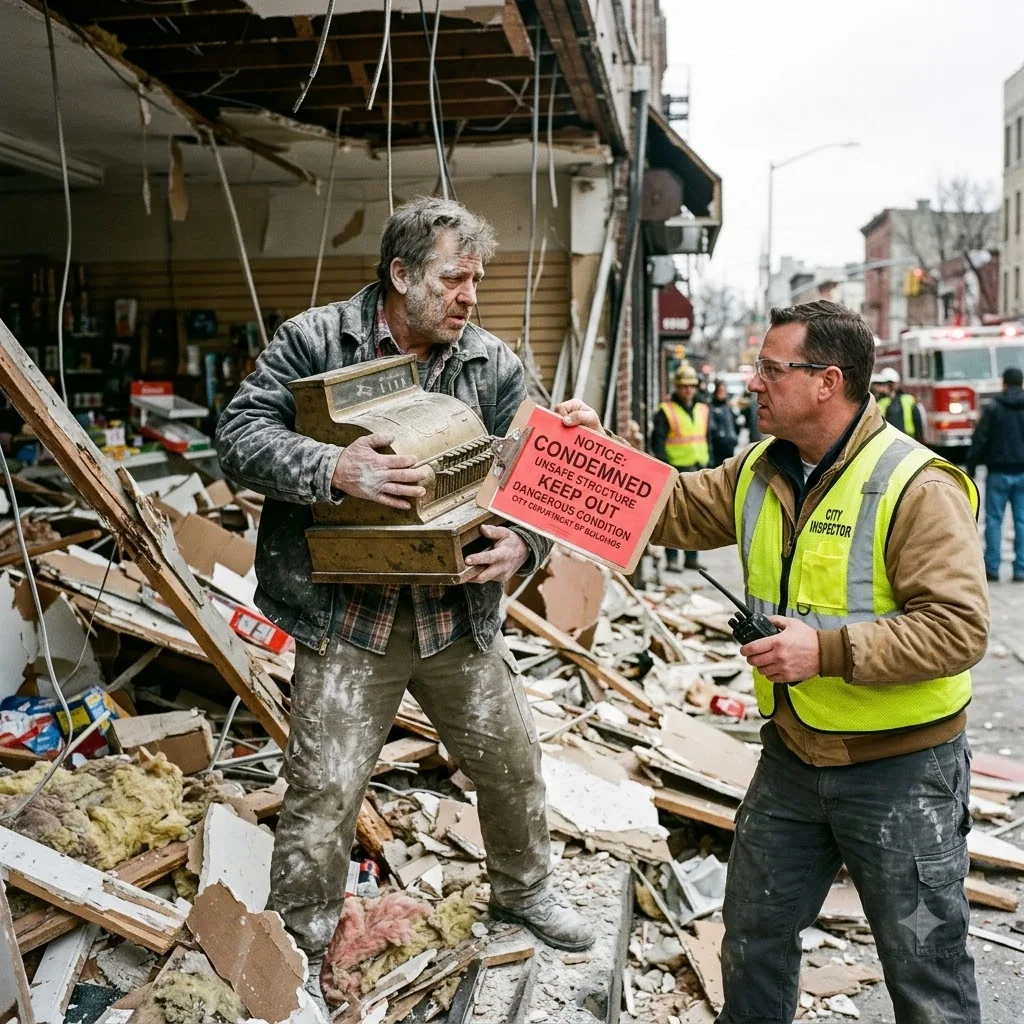
Worse than the assault was the concrete. The morning after the confrontation, while Mateo was detained in a holding cell for psychiatric evaluation-a favor Julian’s lawyers smoothly suggested to the precinct captain-Apex Development moved to “secure the compromised site.” They poured the foundation. Three hundred cement trucks rolled through the neighborhood in a continuous, deafening convoy. By the time Mateo was finally released, his basement, the lockbox, and the DVR were permanently entombed beneath eight feet of high-strength industrial slab. The proof was gone.
A week later, the city mailed Mateo the final insult in a stark white envelope. It was an itemized invoice for the emergency hazard removal. Forty-two thousand dollars for the unrequested demolition of his own family’s legacy. Apex, meanwhile, received a routine municipal citation for the broken showroom door and a five-hundred-dollar fine for a minor zoning noise violation. The system wasn’t broken; it was operating flawlessly, insulating the developer’s vast capital behind a fortress of bureaucracy while liquidating Mateo to clear the view.
Mateo had no building, no business, and a staggering municipal lien that would garnish his wages for the next decade. He was supposed to vanish. He was supposed to take the pitiful insurance payout for his collapsed roof and fade into the outer boroughs, another invisible casualty of urban progress.
Instead, he took the last eight hundred dollars in his checking account and bought a dented, second-hand stainless steel pushcart. He spent his final two hundred dollars at the Department of Consumer Affairs, securing a mobile food vending license.
He didn’t need the excavated lot anymore. He just needed the geography. The city maps were beautifully, rigidly specific about public easements. The sidewalk directly in front of the Apex luxury pavilion-exactly two inches beyond Julian’s newly poured property line-belonged entirely to the taxpayers.
A month later, the luxury high-rise was officially open for pre-sales. Julian stood on the pristine curb outside the glass pavilion, adjusting his charcoal suit, preparing to greet a motorcade of foreign investors. The velvet ropes were perfectly aligned. The red carpet was spotless.
Then came the screech of ungreased metal wheels.
Mateo pushed the heavy, rattling cart over the uneven pavement, parking it dead center against the invisible boundary line. He popped open a faded, brightly striped umbrella that clashed violently with the pavilion’s sleek, monochromatic aesthetic. He fired up the propane burner. Within minutes, the thick, heavy scent of cheap frying oil, roasting onions, and charred meat wafted directly into the climate-controlled entryway of the sales center. He cranked up a battery-powered radio, letting a frantic salsa beat bleed into the pavilion’s ambient jazz.
Julian’s perfect, measured smile vanished. He marched to the edge of the property, his polished oxfords stopping exactly at the invisible property line, unwilling to step onto the public concrete.
“What is this, Mateo?” Julian hissed, keeping his voice low to avoid drawing the attention of the approaching black towncars. “You have nothing left. Go home.”
Mateo flipped a sizzling slab of meat with a pair of metal tongs, letting the grease pop and spit onto the pristine sidewalk. He looked at Julian, seeing the microscopic tremor of sheer fury tight in the executive’s jaw.
“I am home,” Mateo said calmly. “I have a permit for this exact patch of concrete. Good for two years. Fully renewable.”
Julian looked at the battered cart, then at the arriving investors, whose noses were already wrinkling at the pungent smoke drifting over their tailored cashmere coats. Julian couldn’t bulldoze a man standing legally on a public sidewalk. He couldn’t bribe a city inspector to condemn a cart that perfectly passed the health code. The millions in legal armor meant absolutely nothing against a man who no longer had anything left to take.
Mateo leaned against the stainless steel handle, smiling through the greasy smoke. He was going to be there every morning, every afternoon, and every single time Julian tried to sell a piece of his stolen empire. A permanent, inescapable shadow haunting the edge of Julian’s perfect view.