Story code: ST-000587
Part 4: The Weight of the Perimeter
The knee dug into Elias’s spine for another agonizing ten seconds before his words fully registered. The tactical officer pinning him down blinked, the harsh beam of his weapon-mounted light wavering across the polished cherry wood.
“Control,” the officer said, his voice suddenly tight as he keyed his shoulder mic. “Hold on the breach. We have a negative on the device. It’s… it’s a piece of furniture.”
The radio on the officer’s vest crackled with confused cross-traffic. The armored sergeant at the barricade lowered his rifle, staring past the torn fence toward the sparking electrical conduit and the scarred brick wall. He looked at the heavy machinery idling in the frost.
“False alarm,” the sergeant barked, his voice carrying over the oscillating wail of the school siren. “Machinery struck the masonry. I repeat, no active shooter. Kill the engines! Kill the damn machinery!”
The command rippled down the alley. One by one, the massive diesel engines of the front-end loaders sputtered and died. The hydraulic whine faded. Without the mechanical roar, the continuous shriek of the school’s lockdown alarm felt even more piercing, an electronic scream of terror echoing off the frost-covered brick.
The crushing pressure on Elias’s back vanished. Rough hands grabbed his shoulders, hauling him upright out of the freezing mud. He staggered, his bare, numb feet slipping on the slick embankment. He gasped, clutching his ribs where the officer had tackled him.
“Clear the perimeter,” the sergeant ordered, waving a gloved hand at the sanitation workers. “And get someone from facilities to shut that alarm off. Let dispatch know the school is clear.”
Elias stood shivering in his thin shirt, the freezing dawn air biting at his exposed skin. He watched as the tactical units stepped back, their adrenaline evaporating into visible clouds of breath. They weren’t looking at him as a threat anymore. The laser sights and high-lumen beams dropped to the gravel. To them, the crisis was over. Elias was no longer an active bomber; he was just another vagrant complicating a city sweep.
“You can’t be here, buddy,” the officer who had pinned him said, brushing mud off his tactical vest. “You need to move.”
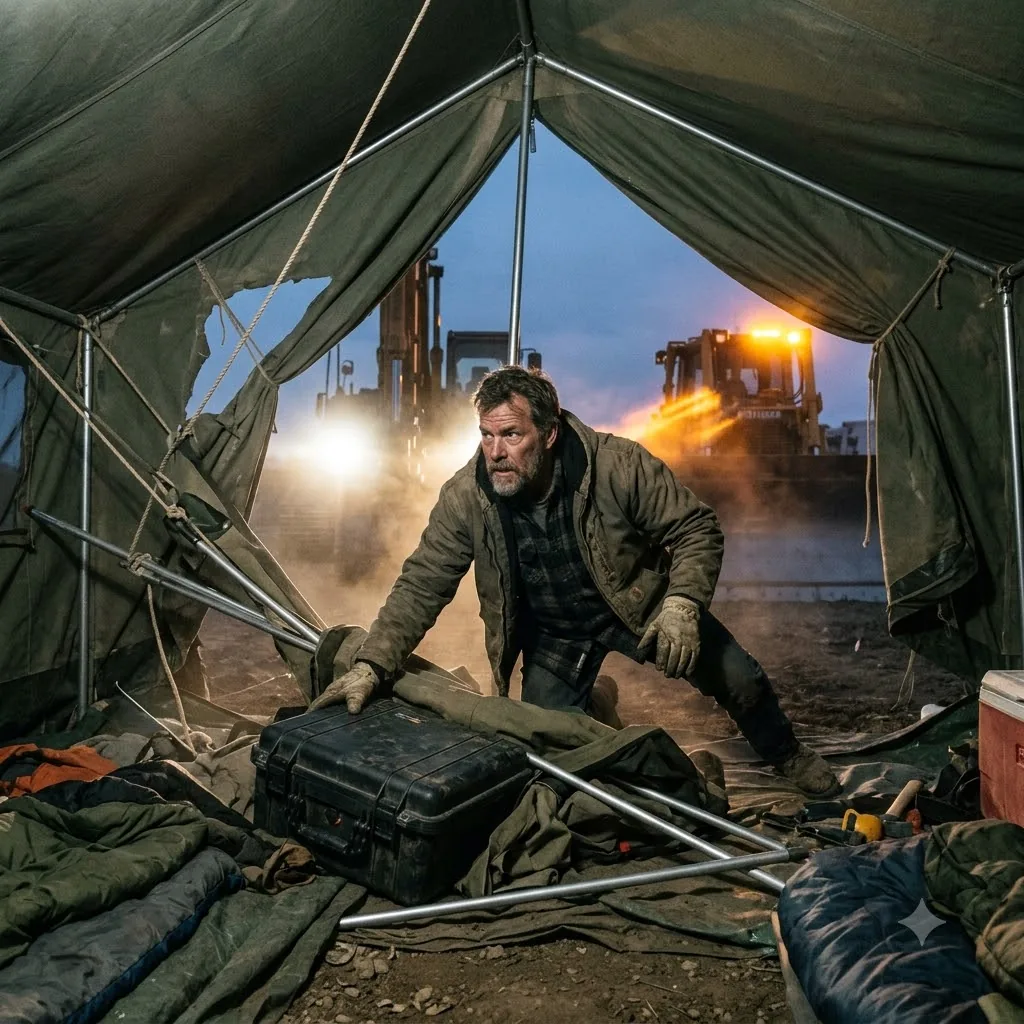
Elias turned his head. The sanitation crew, eager to make up for lost time and finish the sterilization of the summit corridor, had used the distraction to finish their job. Two men in high-visibility vests were dragging the torn remains of Elias’s nylon tent toward the compactor truck at the end of the alley.
“Wait,” Elias croaked, taking a step forward. “My things.”
A worker hurled the tangled mass of canvas and shattered fiberglass poles into the steel hopper. Another picked up Elias’s foam sleeping mat and his duffel bag of winter clothes, tossing them in right behind it. The hydraulic press groaned to life, crushing the only shelter Elias had left into an unrecognizable cube of garbage.
“Sweep’s over,” the worker yelled back, not making eye contact. “You had your five minutes.”
Elias stopped. There was no point in fighting. He had made his choice when he abandoned the tent to pull the desk out.
He turned slowly back to the embankment. The heavy, blanket-wrapped rectangle lay half-unspooled in the dirt. The cherry-wood surface of the drafting desk, painstakingly restored over weeks of freezing nights under the overpass, gleamed perfectly under the sweeping red and blue police lights. The inlaid brass wire spelling *MAYA* caught the glare of a passing flashlight.
“Get that thing out of the fence line,” a patrolman ordered, gesturing vaguely at the heavy slab. “We need public works to patch the chain-link.”
Elias dropped to his knees in the frost. His hands were scraped and bleeding, the fingernails packed with icy dirt. He carefully pulled the ruined moving blankets back over the polished wood, shielding it from the biting cold and the grit. He wrapped the nylon webbing around his forearms and dragged the heavy slab back down the incline, pulling it away from the school courtyard.
He dragged it until he reached the edge of the cleared concrete, right where his tent used to be. The ground was scraped completely bare by the loader’s bucket, leaving only frozen earth and a few scattered pieces of shattered plastic.
Among the debris lay a cracked storage bin. It had been crushed under the treads of the machinery, its contents spilled across the gravel. Elias knelt beside it. His flashlight was smashed. His spare boots were gone. But lying flat in the dirt, untouched by the steel teeth of the bucket, was a rigid, black square of tightly woven synthetic fabric.
Elias reached out with trembling fingers and picked it up.
It was a Level IIIA Kevlar backpack insert. It weighed less than two pounds. He had spent two months collecting cans and scrapping copper wire to afford it. He had ordered it to the downtown shelter, intending to slip it into the hidden laptop sleeve of Maya’s pink backpack when he gave her the desk today.
The oscillating wail of the school alarm suddenly choked, stuttered, and died.
The sudden silence in the alley was absolute, broken only by the distant hum of traffic on the overpass. The school was quiet. The lockdown was over. Inside that brick building, teachers were likely coaxing terrified seven-year-olds out from under their desks, assuring them that the banging outside wasn’t a monster, wasn’t a bad man with a gun. It was just the city, cleaning up.
Elias sat down heavily in the frozen dirt. He didn’t have a tent. He didn’t have a coat. He had a perfectly polished cherry-wood desk sitting in the mud, too heavy to carry anywhere else.
He pulled his knees to his chest to ward off the freezing dawn and clutched the rigid Kevlar panel tightly against his sternum. He stared across the fifty feet of ruined encampment, past the torn chain-link fence, and looked at the silent, impenetrable brick wall of the elementary school. He closed his eyes, his breathing ragged, holding the piece of armor he couldn’t give her, sitting in the world he couldn’t protect her from.