Story code: ST-000993
Part 2: One Version Had To Break
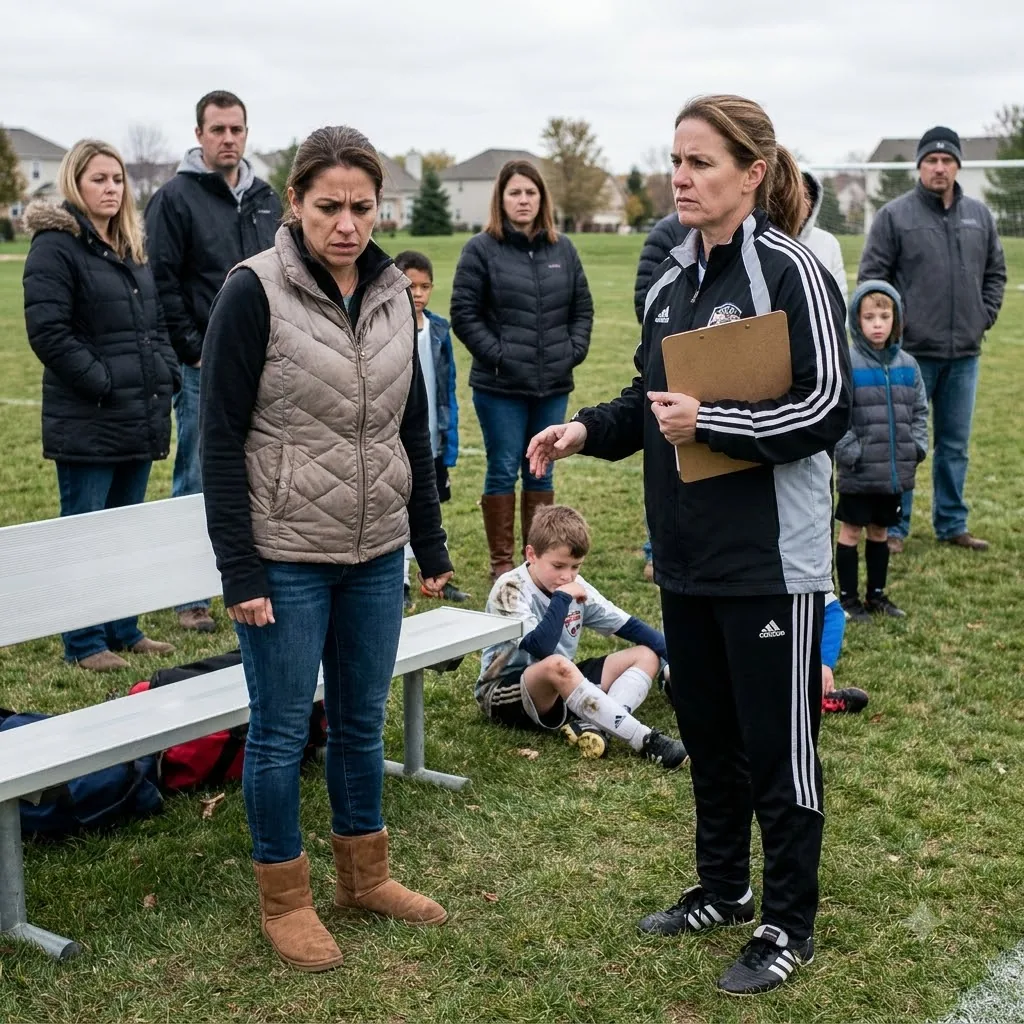
The pause after Marcy’s question was brief, but around a youth field bench, with kids waiting for directions and parents pretending not to stare, it was long enough to change the whole shape of the argument. Dana Pike still held the lineup clipboard against her body. Tessa Moreno stood a step back from her, arms down, not crowding, not shouting. That made Dana’s stillness look less like control and more like refusal. Marcy wiped her fingertips on a napkin and repeated herself in the same careful tone. “Just turn it around before anything gets changed.” Dana looked from Marcy to Tessa and back again. “Nothing is being changed,” she said. “I haven’t erased anything.” But she said it while the marker cap sat in her other hand. Mara saw that before anyone else said it out loud. The black dry-erase marker was uncapped, tucked against Dana’s palm beside the board. A thin streak of fresh smudge shone near the left-side positions under the plastic cover. Parents noticed in stages. One father stopped tightening the strap on a camp chair and stayed bent over it. Two players near the water crate turned fully toward the bench. Eli stayed in the warm-up lane, but he no longer moved his feet. Tessa kept her eyes on the board. “Then showing it should be easy,” she said. Dana answered with practiced patience, the kind adults use when they want a crowd to hear that they are being reasonable. “I am not going to perform lineup decisions for a parent who is upset.” “That’s not what she asked,” Marcy said. Dana’s head turned sharply enough to register, though her voice stayed clipped and even. “Marcy, unless you were in my Thursday conversation with Tessa, I’d appreciate you not making this bigger.” Marcy nodded once. “I wasn’t in that conversation,” she said. “I was here twenty minutes ago when you told Nate’s dad that Eli was first through at left mid and Nate would rotate after. I heard that because you were standing right there by the pinnies.” No one jumped in after that. The bench area went quiet in the particular way a small public group does when everyone has heard something specific enough to matter. Kids kicked at the ground less. Parents stopped rustling bags. Even the usual whistles from another field sounded farther away. Dana shifted her grip and tucked the marker cap onto the end with a click. “You are mixing drill order with game order,” she said. “That’s what keeps happening here.” Tessa answered immediately. “Then why was Eli told to wait in the outside lane with the starters instead of the rotation group?” Dana’s mouth tightened. “Because players need to be flexible.” “Flexible about where to stand?” Tessa asked. “Or flexible about whether words mean what they meant five minutes ago?” Dana looked past Tessa toward the field, as if the conversation itself were keeping practice from running. Then she looked back at the clipboard and began talking faster, stacking explanations before anyone could hold on to one. “First group for warm-up is not the same as first eleven. Left mid in a drill column is not a promised start. Telling a player to be ready is not guaranteeing position. Parents hear fragments and then build whole stories out of them.” The problem was visible as she said it. Every sentence narrowed the meaning further. Each new explanation only worked if the last visible action around the bench meant something different from what everyone had just seen it mean. Mara watched people do that arithmetic in real time. Nate’s dad, still by his chair, glanced toward his son, then back to Eli, then to the board. A grandmother beside the cooler frowned at the drill cones and the starters’ lane, as if measuring the distance between Dana’s words and the setup on the ground. Tessa did not need to get louder. The logic was loud enough now. “So Eli was never starting,” she said, “but he was in the starters’ lane, in the position group, in position gear, and named in the rotation you gave another family.” Dana held the clipboard higher. “You are making connections that are not there.” Marcy pointed, not at Dana, but at the page edge visible under her thumb. “Then let the board settle it,” she said. “Because if his name was never written there, all of us standing here somehow misunderstood the same setup in the same direction.” That was the first moment Dana no longer had a clean answer ready. She looked at the field again. One of the assistant dads farther down the sideline raised a hand, waiting for a signal to start the next drill. Dana did not signal back. Instead, she said, “The board changes constantly. People who don’t run lineups don’t always understand what they’re seeing.” Mara noticed Tessa’s expression stay flat at that. No flinch, no burst of anger, just a small nod, as if Dana had finally reached the part she could not walk back from. “Okay,” Tessa said. “Then there’s one simple consequence.” Dana’s shoulders set. Tessa continued, still calm. “If the board is changing constantly, and if none of us can trust what was written on it ten minutes ago, then you need someone else next to you every time you set the lineup. Starting right now.” That line pulled the argument out of memory and into process. Several parents looked at the short fenced access path that led from the bench toward the equipment shed and coordinator station. Dana noticed it too. “No,” she said quickly. “That is not necessary.” “But you just said we can’t understand what we’re seeing,” Marcy replied. “So either the board showed Eli there, or your lineup system depends on everybody else being wrong at once.” Dana’s fingers slid over the clear cover. For a second it looked like she might finally turn the clipboard around and let the page face the group. Instead she uncapped the marker again.