Story code: ST-000087
Part 2: The Recovery Metric
The violent spasm ripped through Elias’s forearms like a severed cable snapping back. His fingers uncurled involuntarily. For a fraction of a second, the heavy cardboard crate seemed to hang suspended in the stifling air between him and the young engineer. Then gravity claimed it.
The fifty-pound box hit the concrete floor with a deafening, concussive crack. The bottom seam blew out instantly. Heavy brass manifolds erupted across the cracked floor, clattering and spinning wildly. Two of the solid metal fittings bounced off the toe of Julian’s pristine white sneakers, leaving dark, oily smudges on the bright leather.
Elias slumped backward, his spine slamming against the steel upright of the storage rack. His arms hung useless at his sides, completely devoid of strength, twitching as the fried nerves misfired in continuous, agonizing ripples. He sucked down jagged lungfuls of the dusty air, his chest heaving, his vision swimming with dark spots.
Julian did not jump. He did not step back. He merely tilted his head, his eyes tracking the rolling brass fittings before snapping his gaze back to the silver iPad.
“Impact logged,” Julian murmured. The stylus tapped against the glass. “Total duration under load: four minutes, twenty-two seconds. Muscular failure achieved precisely at predicted threshold.”
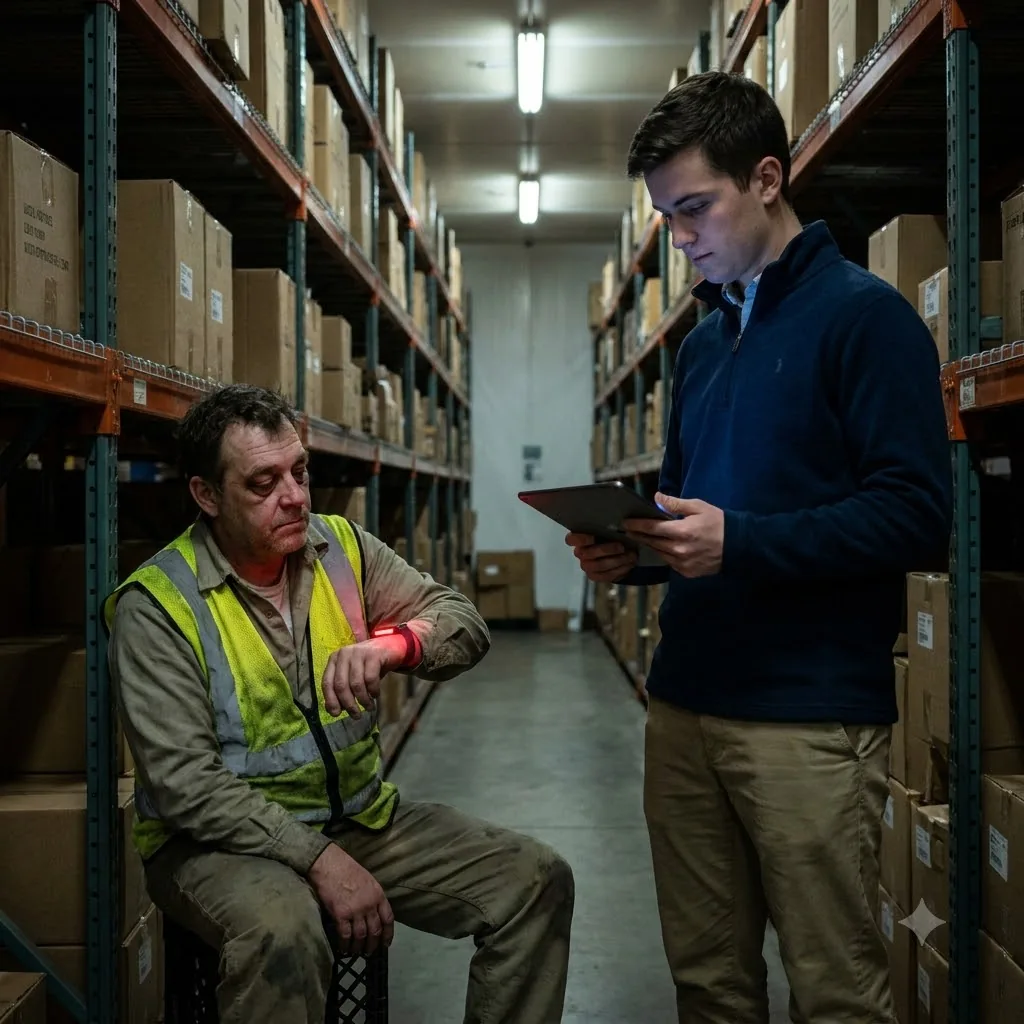
The black polymer band on Elias’s left wrist abruptly ceased its frantic red strobe. A cold, heavy silence fell over Aisle 44, broken only by the ringing in Elias’s ears and his own ragged breathing. Then, the wristband emitted a sharp, dual-tone chime. The screen shifted from the jagged ERR-709 code to a flat, blinding white. Black digital text crawled across the tiny display: *BASELINE ACQUIRED. INITIATING RECOVERY PROTOCOL.*
Elias squeezed his eyes shut, trying to force the dizziness away. His biceps felt like they had been filled with hot lead. “You’re insane,” Elias croaked, pushing himself off the steel rack. His voice shook with a potent mixture of exhaustion and rising panic. “You intentionally pushed me to drop company product. You stood there and watched me tear my muscles for a-for a baseline?”
“I stood here to ensure the integrity of the data,” Julian corrected, his tone as casual as if he were discussing the warehouse’s lighting fixtures. He swiped across the iPad screen, bringing up a new interface that reflected a cold blue light onto his unblemished face. “Theoretical models are insufficient for the new pacing algorithm. We needed a live-fire demonstration of physiological collapse to calibrate the maximum allowable strain per worker.”
Elias stared at the young man, a profound sense of horror creeping through the numbness in his arms. Julian wasn’t a sadist. Sadism required emotion. What Elias saw in the engineer’s eyes was far worse: complete, absolute indifference. To Julian, Elias wasn’t a fifty-year-old man with a mortgage, failing joints, and a wife waiting at home. He was a biological machine that had just been successfully stress-tested until its gears stripped.
The white screen on Elias’s wristband vibrated again, this time emitting a slow, rhythmic pulse. *Bzz. Bzz. Bzz.*
“What is that?” Elias asked, staring at the harsh white glow illuminating his trembling hand.
“That is Phase Two,” Julian said, his eyes never leaving the tablet. “The Recovery Protocol. Now that we know your absolute breaking point, we must measure your physical resilience. How quickly can the asset return to a productive state after reaching total muscular failure?”
“I can’t lift anything,” Elias said, his voice rising in volume. He took a heavy step forward, his work boots crunching against the scattered brass fittings. “My arms are completely burned out. I need a medical station. I need to report this.”
Julian finally looked up. His expression remained entirely placid. “If you abandon the task, the system will automatically classify it as a voluntary walk-off. You know company policy, Elias. A walk-off during an active pick assignment is immediate grounds for termination. It voids your severance and your accumulated pension.”
Elias froze. The threat slammed into him, suffocating the angry protest in his throat. He had given five years to the distribution center. He was two months away from being fully vested in the retirement tier. The system knew that. Julian’s algorithm knew exactly how much leverage it had over him.
“You engineered a spill,” Elias said, his chest tightening. “You caused this.”
“I provided a constraint,” Julian replied smoothly. “You dropped the crate. The inventory is currently scattered and out of its designated containment. The algorithm has logged a Tier 3 spillage event under your employee ID.”
The wristband on Elias’s arm vibrated harder. A countdown timer materialized on the white screen. Three minutes and zero seconds. It began ticking down.
“You have two minutes and fifty-eight seconds to return the fifty pounds of brass manifolds to the crate, lift the crate, and clear the aisle,” Julian read aloud from his screen. “If you fail to meet the recovery metric, the algorithm will register you as physically unfit for the new operational standards. Your employment will be automatically terminated by the central server.”
Elias looked down at his hands. The fingers were locked into slight claws, the forearms swollen and radiating a deep, throbbing heat. He looked at the floor, where dozens of heavy brass pieces lay scattered across the concrete. The cardboard crate was torn, meaning he would have to hold it together while lifting it, applying even more pressure to his destroyed tendons.
“My muscles are failing,” Elias pleaded, the desperation finally bleeding through his pride. “I literally do not have the grip strength left to lift fifty pounds. You saw it yourself. You recorded it.”
“The algorithm believes you have a reserve capacity,” Julian stated, tapping the stylus against his chin. “It calculates that the threat of losing your livelihood will release enough adrenaline to bypass the physical damage. It is a highly efficient model.”
The timer on Elias’s wrist crossed the two-minute mark. *Bzz. Bzz. Bzz.*
Julian stepped back, finally clearing the center of the narrow aisle. He leaned against the steel racking, holding the iPad up like a camera.
“The clock is running, Elias,” Julian said, his eyes bright with clinical anticipation. “Prove the data right.”