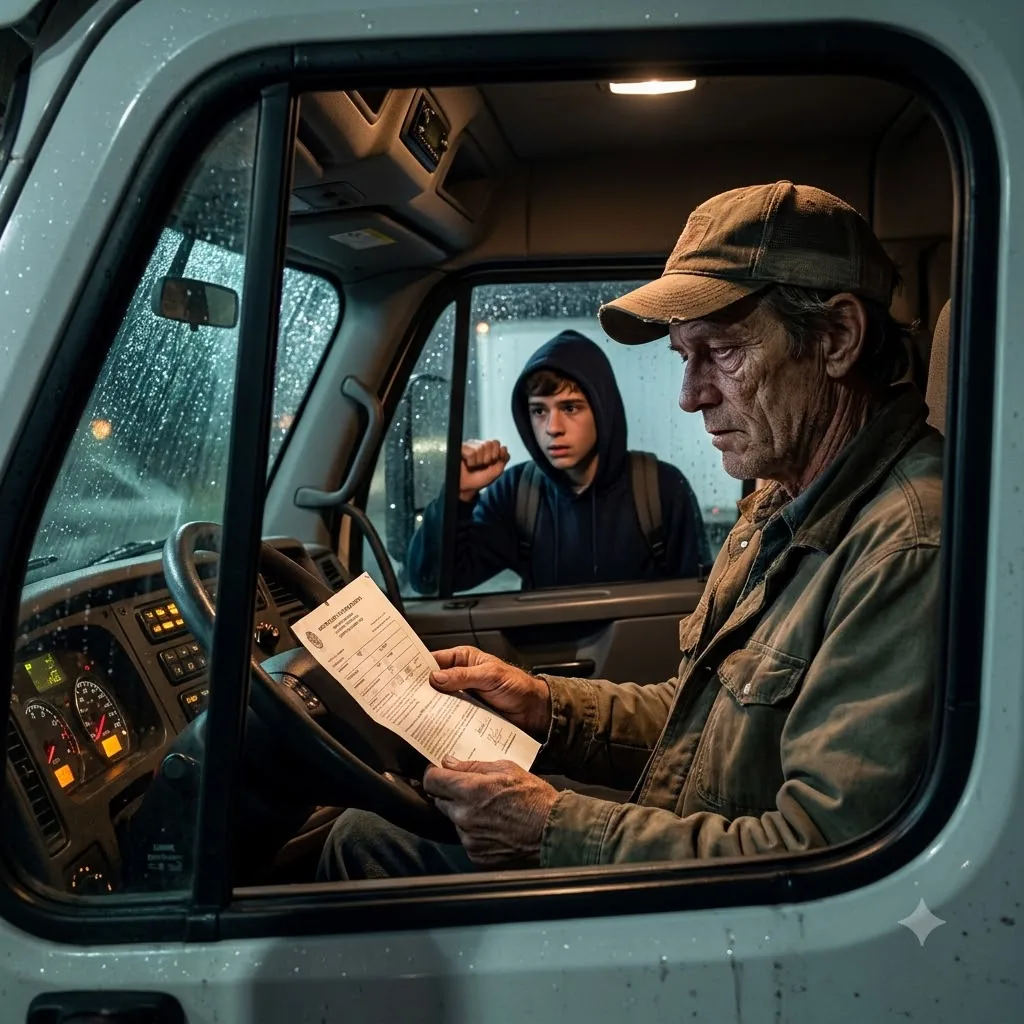
Story code: ST-000163
Part 4: The Price of Peace
The heavy metallic thud of the breaching ram struck the corrugated steel wall again, buckling the siding inward with a deafening screech. The violent noise snapped the tension in the tiny office, drowning out the horrific accusation hanging on Trey’s lips.
Marcus didn’t waste breath on an apology. He reached down, grabbed the thick canvas handles of the duffel bag, and pulled the zipper shut over the spilled stacks of twenty- and fifty-dollar bills. Thirty-four thousand dollars. It was a heavy, dense weight in his fist. He slung the strap across his chest, letting the bag settle against his ribs right over the folded hospital letter in his jacket pocket.
A third strike from the ram tore the corrugated metal completely off its rusted frame.
The office wall vanished. Beams from tactical flashlights sliced through the swirling drywall dust, instantly finding the terrified teenagers huddled on the floor. Silas’s men didn’t shout warnings. They raised their automatic rifles.
Marcus stepped in front of the boys and raised his .45 caliber pistol. For half a decade, he had used his fists and his voice to enforce the neighborhood peace. He had disarmed angry kids and talked down violent men, doing whatever it took to keep the streets quiet for his wife.
That peace died the moment Marcus squeezed the trigger.
The heavy recoil shoved into his palm. In the confined space of the shattered office, the gunshots were a physical pressure against his eardrums. He didn’t fire blind suppressive shots this time. He fired with the ruthless, mechanical precision that had made him Silas’s top enforcer six years ago. The first hollow-point slug caught the lead hitter in the chest, folding him backward into the gravel yard. The second shot took the man next to him in the throat.
Blood sprayed in a dark arc across the floodlit concrete. The remaining men outside scrambled backward, shouting in panic as they sought cover behind the ripped steel wall.
“Out the back!” Marcus roared, his voice tearing from his throat.
The teenagers were frozen, staring in absolute, wide-eyed horror at the bodies twitching in the yard. They had talked about war all night, but they had never actually seen it. They had never seen the man who told them to stay in school casually drop two bodies in a matter of seconds.
Marcus grabbed Trey by the shoulder of his oversized hoodie, violently hauling the boy to his feet. “Move!” he bellowed, shoving him toward the dark corridor leading to the rear service door.
The physical jolt broke their paralysis. The four boys scrambled over the debris, coughing and wheezing through the thick dust as they sprinted toward the back exit. Marcus backed away slowly, keeping his pistol leveled at the breach. Automatic fire chewed through the drywall where he had just been standing, spraying fiberglass insulation across his face. He fired twice more into the darkness to keep the hitters pinned, then turned and bolted through the service door.
He burst out into the cold night air of the back alley. The teenagers were huddled against the chain-link fence, hyperventilating, their cheap handguns dangling uselessly by their sides.
Marcus ejected the spent magazine from his .45 and slammed a fresh one home. The sharp, metallic clack made Trey flinch.
“Take the cut-through over the rail yard,” Marcus commanded, his chest heaving as he pointed down the dark alley. “Ditch the guns in the storm drain. You go straight to your mother’s house and you lock the doors. Do not come out tomorrow. Do you understand me?”
Trey didn’t nod. The sixteen-year-old stood trembling, his eyes dropping from the smoking pistol in Marcus’s hand to the heavy canvas bag slung across his chest. The wild, adrenaline-fueled pride that had lit up the boy’s face at the pharmacy was entirely gone. It was replaced by a cold, sickening betrayal. Trey finally understood the brutal math of the streets. He realized his life, and the lives of his friends, had simply been a chaotic distraction purchased to mask a robbery.
Trey spat on the asphalt near Marcus’s boots. He turned his back on the peacemaker, motioned to his terrified crew, and vanished into the shadows without a single word.
Marcus watched them disappear, feeling a hollow ache open up in his chest. He turned and jogged down the alley to where he had hidden his Silverado. He unlocked the cab, threw the heavy duffel bag onto the passenger seat, and climbed behind the wheel.
In the distance, the faint wail of police sirens began to rise over the city. But the sirens didn’t matter. What mattered were the shouts echoing from the salvage yard behind him. Silas’s men had found their dead. By morning, the entire Eastside would mobilize. They would cross the avenue in full force, and the neighborhood Marcus had painstakingly shielded for five years would drown in blood.
Marcus sat rigid behind the steering wheel in the dark. He reached into his jacket and pulled out the denied coverage letter, its crisp edges now softened by his sweat and stained with a faint smear of drywall dust. He looked at the thirty-four thousand dollars sitting in the canvas bag.
He had the money. His wife would get her treatment. She would survive. But as the distant sirens grew louder, pulling the neighborhood into a war that would consume a generation of boys like Trey, Marcus realized he had destroyed everything else to save her.