Story code: ST-001829
Part 4: The Price of Perfection
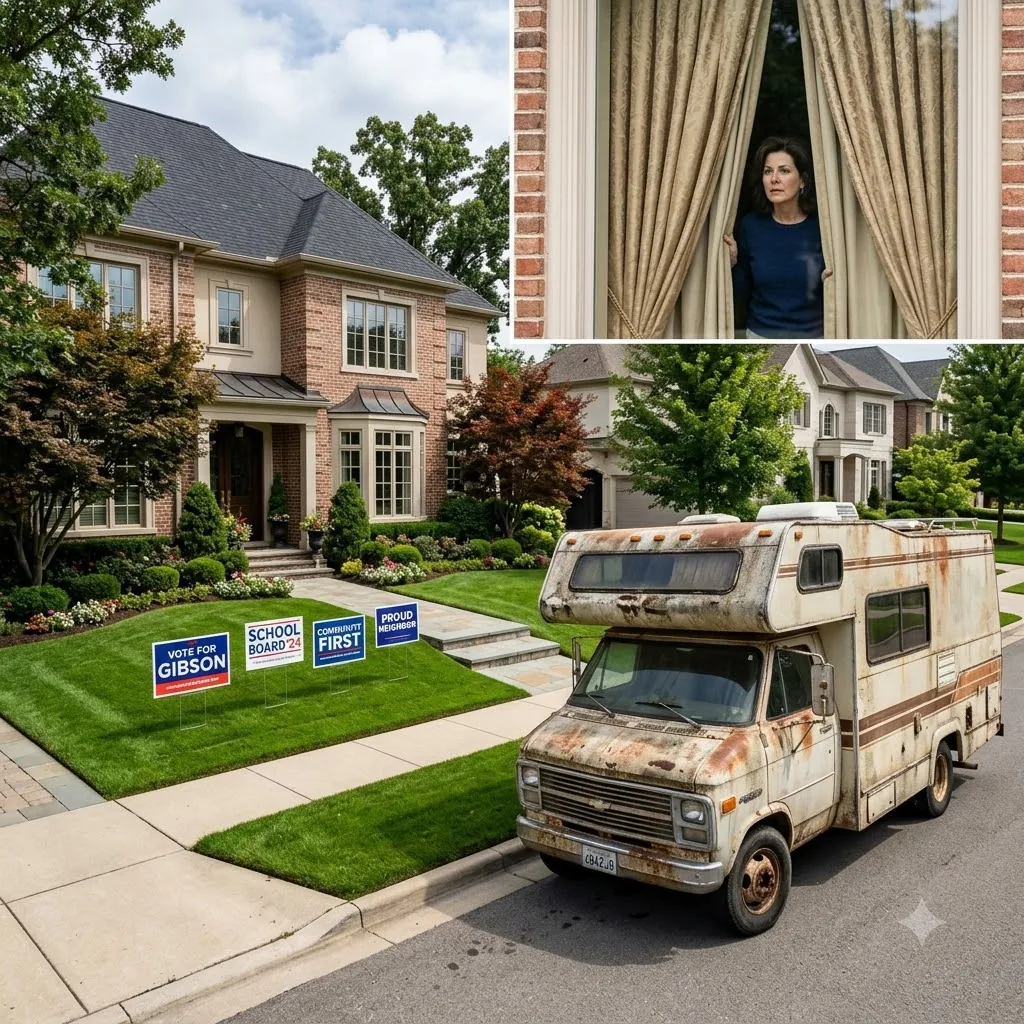
The heavy municipal wrecker arrived just as the autumn sun dipped below the pristine rooflines of Oakridge Estates. Eleanor stood perfectly still behind her living room curtains, watching the flashing amber lights wash over her flawless walls. The rusted Winnebago protested with a horrific, screeching grind of metal as the massive tow truck dragged it onto the flatbed. It took less than twenty minutes to remove the blight. By nightfall, a city sanitation crew had arrived with industrial pressure washers and biohazard bleach to scour the asphalt.
When morning broke, the street was aesthetically perfect again. There were no leaks, no peeling decals, no visible desperation. The cul-de-sac was a flawless expanse of gray concrete and emerald lawns, exactly as the homeowner’s association intended.
Eleanor had won.
Yet, two weeks later, the victory felt like a jagged stone lodged in her throat.
She sat at her kitchen island, staring blankly across the gleaming expanse of white Calcutta marble. The house was utterly silent, save for the rhythmic, mocking tick of the grandfather clock in the hallway. Her pristine sanctuary had become a mausoleum. She had not attended the last two neighborhood watch meetings. She had stopped answering calls from the HOA president, who wanted to publicly commend her for her unparalleled vigilance in keeping the community safe.
On the counter in front of her sat a crisp, heavy-stock envelope from the State Attorney General’s office. It had arrived in the morning post. She did not need to open it to know what was inside. It was the civic reward. Ten thousand dollars, issued to her name, as mandated by the Reproductive Integrity Act. It was the ultimate validation of her actions, legally sanitizing the vicious lie she had told to save herself from being handcuffed in front of her prize-winning hydrangeas.
Eleanor reached out with a trembling, manicured hand and pushed the envelope away. It slid across the marble with a soft hiss, bumping against the base of her espresso machine.
Needing noise to drown out the oppressive quiet, she reached for the remote and turned on the small television mounted beneath the upper cabinets. The noon broadcast of the local news flickered to life. Eleanor kept her eyes fixed on her cold cup of Earl Grey tea, until a familiar, rusted metal hull flashed on the screen.
She snapped her head up.
The anchor, a woman with perfectly sprayed hair and a somber expression, was reading from a teleprompter. Behind her hovered a graphic showing a gavel and the state seal.
“…an update on the first major prosecution under Senate Bill 8,” the anchor announced, her voice entirely devoid of the horror it was conveying. “Sixteen-year-old Chloe Pendleton has officially been charged as an adult with felony conspiracy to conceal an unlawful termination. Her father, Arthur Pendleton, remains in county lockup without bail, facing identical charges along with child endangerment.”
The broadcast cut to B-roll footage of the teenager. She was walking out of a courthouse in an orange jumpsuit, her wrists shackled to a waist chain. She looked incredibly small. Her face was hollowed out, pale and deeply bruised with exhaustion, her eyes glued to the pavement just like her father’s had been on that first morning.
“Prosecutors allege,” the anchor continued seamlessly, “that an anonymous neighborhood tip led to the discovery of the father attempting to cover up the medically induced procedure. Due to complications, the delay in medical intervention during the resulting police standoff caused the teenager to suffer severe hemorrhaging, ultimately requiring an emergency hysterectomy.”
Eleanor stopped breathing. The air in the immaculate kitchen suddenly felt entirely too thin.
The television showed a brief clip of the father being led to a transport van. He wasn’t the violent menace she had conjured in her mind. He was just a broken man who had been trying to stop his daughter from bleeding to death in the only home they had left.
And Eleanor had looked at that desperation, at that profound suffering, and manufactured a gunshot to speed up the police. When caught in her lie, she had weaponized the cruelest law she could find, completely inventing a story about abortion pills simply to maintain her own unblemished social standing and avoid a misdemeanor charge.
She was a pillar of the community. A paragon of rules, order, and morality. She had spent her entire adult life judging others for their moral failings, their messy lives, their inability to maintain the rigid standards of Oakridge Estates.
She looked away from the television, her gaze falling on her own reflection in the dark, polished surface of her stainless-steel oven. She looked at her perfect hair, her expensive cashmere cardigan, her spotless kitchen.
The hypocrisy was a physical weight, crushing the breath from her lungs. She had orchestrated the destruction of a grieving family, permanently maimed a child, and incarcerated a father, all because she didn’t like the look of their vehicle parked on the public street. There was no hostage-taker on Oakridge Drive that afternoon. The only monster present had been standing safely behind the living room curtains.
Eleanor lowered her face into her hands, pressing the heels of her palms against her eyes until sparks burst in the darkness. She tried to weep, but the tears would not come. There was only the low drone of the news anchor detailing the absolute destruction she had wrought, echoing endlessly through her perfect, empty house.