Story code: ST-000554
Part 3: The Purge Protocol
Mateo’s boots hit the concrete rim of the planter. The local news cameraman immediately adjusted his heavy rig, the blinding LED top-light swiveling to illuminate Mateo’s face. A murmur rippled through the front rows of the protest.
Marcus Thorne flinched. The executive’s polished smile faltered for a fraction of a second as he realized a frantic, disheveled gig worker in a faded jacket was now sharing his pristine television frame.
“Excuse me,” the on-the-ground reporter said, thrusting a microphone toward the planter. “Sir, are you with the school administration?”
Mateo opened his mouth to yell the truth-to announce to the entire local broadcast that the community hero standing beside him was a corporate executive actively stealing four hundred dollars from a local driver. But before a single word left his throat, Thorne’s hand clamped onto his bicep like a steel vise.
“Just a confused courier caught in the crossfire, Susan!” Thorne announced to the reporter, his voice instantly projecting the warm, paternal authority of a seasoned grassroots leader. He smiled for the lens, but his fingers dug painfully through the thin fabric of Mateo’s jacket. “Let’s get him safely out of the demonstration zone. We are peaceful, folks! We don’t trap innocent workers!”
Thorne didn’t give Mateo a chance to brace his feet. Using his larger frame and the leverage of the elevated planter, Thorne practically pulled Mateo backward, dragging him away from the glaring camera lights. Mateo stumbled down the concrete steps, nearly twisting his ankle on a patch of frozen mulch.
Thorne stayed right on top of him. The executive kept his public smile plastered on, waving to the cheering parents as he forced Mateo around the corner of the brick gymnasium. They slipped behind a line of rusted green dumpsters and a parked maintenance truck. The heavy brick wall instantly muffled the roaring chants of the crowd.
As soon as they were out of the camera’s sightline, Thorne released Mateo’s arm and violently shoved him backward into the corrugated metal of a dumpster.
The righteous patriot persona evaporated in an instant. Thorne’s face twisted into a mask of pure, unadulterated corporate contempt. The warm, rallying gleam in his eyes went completely dead.
“Are you out of your mind?” Thorne hissed, pointing a trembling finger at Mateo’s chest. “You try to hijack a live press hit over a contract dispute? I will have corporate legal bury you so deep you won’t be able to get a job delivering newspapers!”
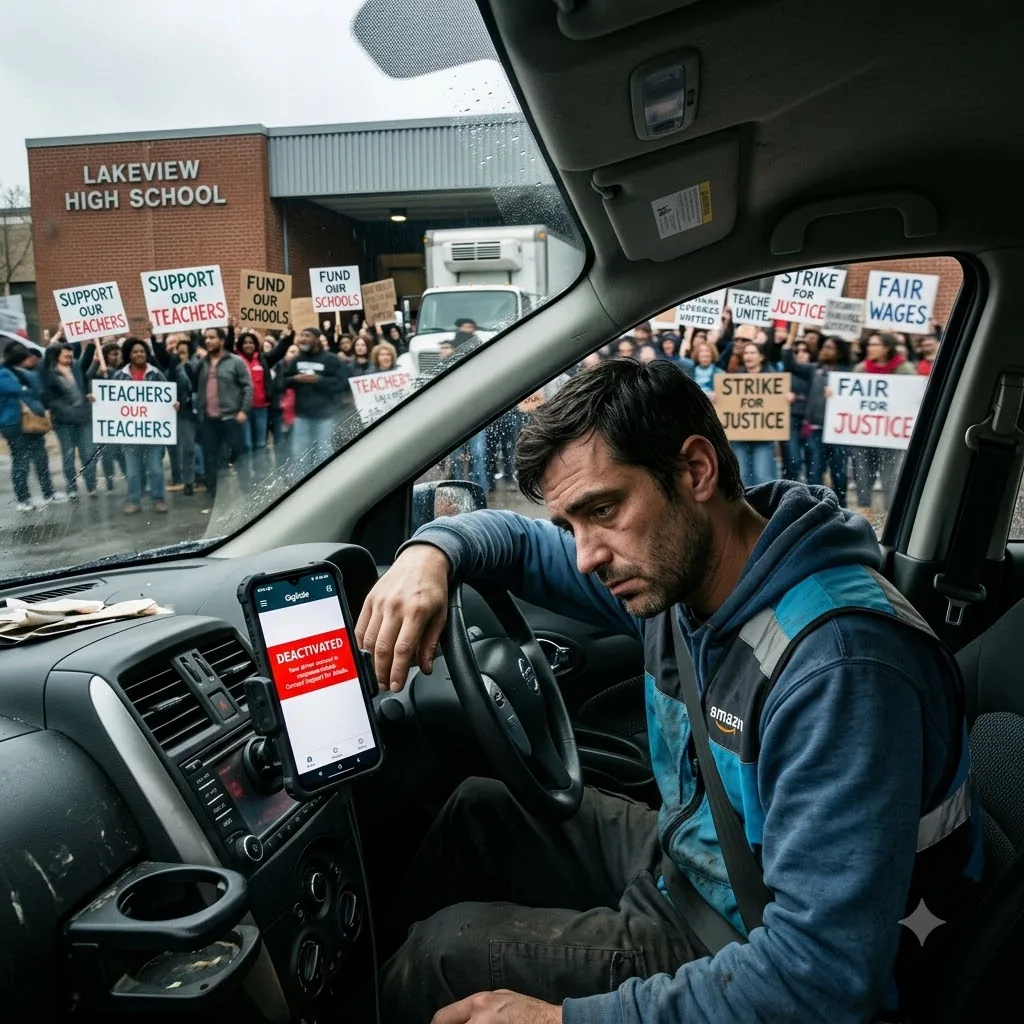
Mateo’s heart hammered against his ribs, but his panic was quickly giving way to a searing, desperate anger. He pulled his cracked phone from his pocket and shoved the screen toward Thorne’s face, displaying the red deactivation notice and the $428.50 negative balance.
“You’re already burying me!” Mateo snapped. “Your app fired me because you physically trapped my car! And now your automated system is charging me for stolen goods that I can’t deliver or return because your mob is leaning on my hood! Your timer is completely defective.”
“It’s not defective,” Thorne scoffed, aggressively straightening his navy quarter-zip. He checked his reflection in the maintenance truck’s side mirror, smoothing his hair.
“It literally fired me for being stuck in a traffic jam you organized!” Mateo shouted, stepping forward. “Your geofence logic is a broken piece of garbage. It doesn’t recognize when a protest is blocking the road!”
Thorne paused. He turned away from the mirror and looked at Mateo, not with anger, but with the cold, assessing gaze of an engineer examining a hopelessly obsolete machine. A cruel, dismissive smirk tugged at the corner of his mouth.
“You really think it’s a bug?” Thorne asked, his voice dropping into a quiet, arrogant register. “You think TaskSprint pays me seven figures a year to write code that can’t tell when fifty GPS nodes are suddenly locked in a quarter-mile radius?”
Mateo froze, his thumb hovering over his cracked screen. “What?”
Thorne stepped closer, no longer bothering to hide his absolute disdain. He looked around the empty loading alley to ensure no one was recording, then leaned in. “The routing algorithm knows exactly what this is. It flags the high-density cellular clustering. It knows you’re trapped in a protest zone. And it deactivated you anyway, because that is exactly what it is programmed to do.”
The freezing afternoon wind whipped between the dumpsters, but Mateo barely felt it. He stared at the executive, trying to process the sheer cynicism of the words. “You programmed it to fire people who get stuck?”
“It is a designated procedure to protect the network,” Thorne corrected, speaking slowly as if addressing a slow child. “When a driver gets pinned in a gridlock event-a protest, a parade, a bridge closure-their delivery times tank. If we let you sit there for an hour, your stagnant metrics drag down the entire region’s efficiency averages. My quarterly bonuses are tied to regional velocity.”
Thorne tapped the cracked glass of Mateo’s phone. “So, the geofence protocol initiates a purge. It draws a digital perimeter around the anomaly and terminates any contractor trapped inside for more than forty minutes. It automatically removes the slow nodes from the active network to save the localized metrics.”
Mateo felt a sickening knot twist in his stomach. “And charging me for the food?”
“Cost recovery,” Thorne said with a casual shrug. “You failed to complete the contract. The system recoups the merchant payout by debiting your ledger. The regional velocity goes back up, our liability drops to zero, and the platform gets an influx of cash from penalized drivers. It’s an automated, highly efficient purge.”
Mateo looked from the phone in his hand to the man standing in front of him. The pieces violently locked together in his mind. Thorne wasn’t just a hypocrite leading a protest. He was actively weaponizing his own community’s outrage to trigger his software’s purge protocol. By blocking the loading dock, Thorne had intentionally trapped a cluster of delivery drivers in the school’s perimeter just before the end-of-quarter performance review.
“You set this up,” Mateo whispered, the realization making his voice shake. “You parked that minivan across the exit. You organized the barricade. You’re intentionally trapping drivers in this zone to inflate your own efficiency metrics.”
Thorne opened his mouth to deliver another slick, corporate dismissal, but the words died in his throat. His eyes widened slightly as he processed the stark accusation hanging in the cold air. The arrogant smirk vanished. For the first time since Mateo had stepped out of his car, the powerful VP of Engineering realized he had just confessed his systemic fraud out loud to a man who had absolutely nothing left to lose.