Story code: ST-000484
Part 2: The Digital Fog
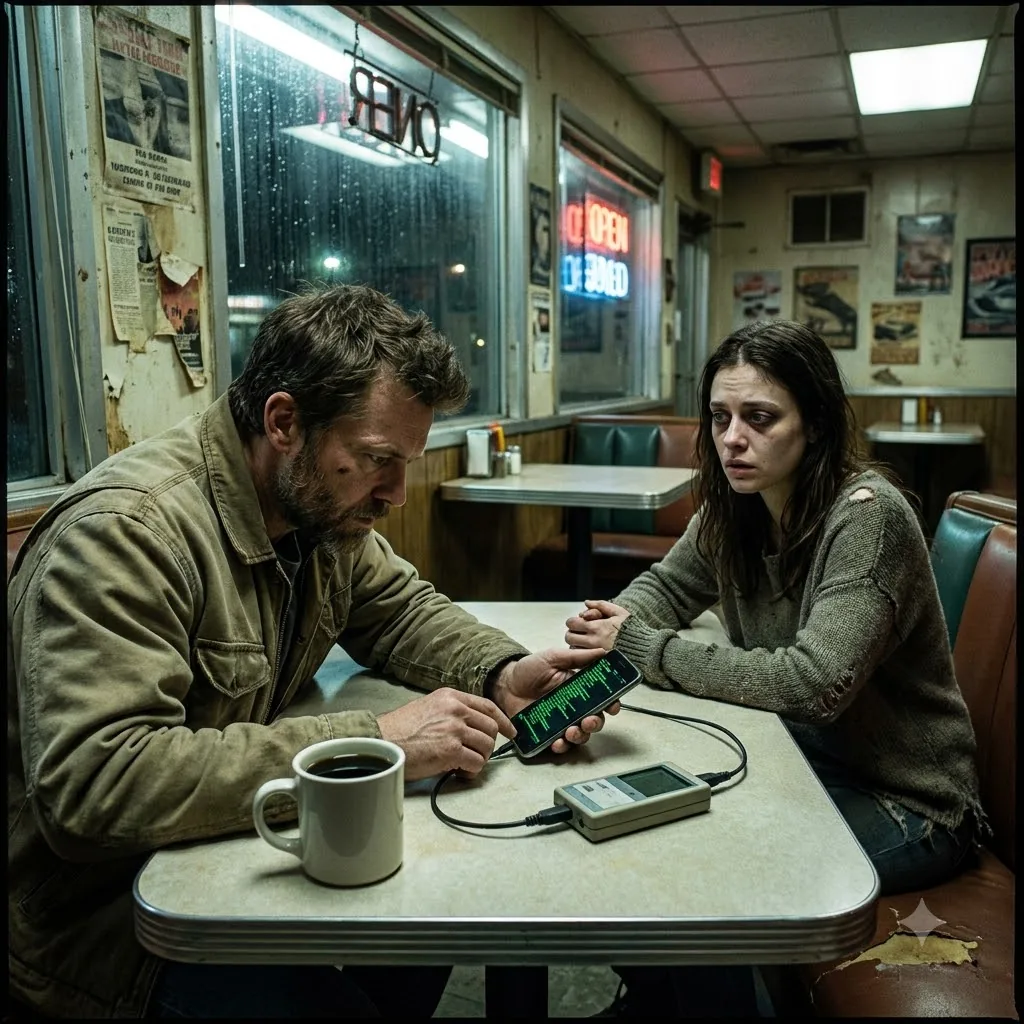
The cracked smartphone hissed as the scalding black coffee invaded its exposed circuitry. A faint pop echoed from the bottom of the ceramic mug, followed by a thin wisp of acrid, gray smoke that smelled of melting lithium and burnt plastic.
Leo kept his eyes locked on his laptop monitor. The violent red strobing of his network terminal froze, immediately replaced by a cascading wall of timeout errors. The physical destruction of the hardware had successfully severed the micro-tunnel, but Leo’s jaw clenched as he read the final line of the hex dump. The last packet had slipped through the virtual sinkhole just before the motherboard short-circuited.
The municipal server had received a fragmented data burst. It wasn’t a pinpoint lock, but it was enough to give the prosecutor’s investigators a one-mile radius-a radius that placed the diner right at the center of their crosshairs.
“What did you just do?” Sarah gasped, shrinking back into the vinyl booth as the dead phone sank to the bottom of the mug.
“I bought us a head start,” Leo said, rapidly disconnecting his laptop and slamming the reinforced lid shut. “We have maybe four minutes before local cruisers converge on this intersection. We need to leave. Now.”
He threw a crumpled twenty-dollar bill onto the Formica to cover the coffee and grabbed his canvas messenger bag. Sarah scrambled out of the booth, her movements jerky and panicked. She followed him out the diner’s heavy glass door and into the damp, fog-choked night.
Leo bypassed his usual methodical security checks and sprinted straight for his vehicle parked in the alley behind the kitchen. It was a 1998 analog sedan, specifically chosen because it lacked Bluetooth, GPS, and an internal cellular modem. It was a mechanical ghost in an increasingly connected world.
As soon as they slammed the heavy doors shut, Leo jammed the key into the ignition, but he didn’t turn it. Instead, he opened his laptop in the passenger seat, resting it on the center console, and retrieved a heavy-duty Software Defined Radio (SDR) antenna from his bag. He magnetically clamped the antenna to the metal roof through the open window, plugged the thick coaxial cable into his USB hub, and fired up his offline dashboard.
“Are we driving?” Sarah asked, her voice trembling as she stared out the window at the empty street. “The state line is only twenty miles away.”
“If we just drive, we’ll never make it across the county line, let alone the state border,” Leo replied, his fingers flying across the mechanical keyboard.
He brought up a digitized infrastructure map of the county. The screen was dark for a fraction of a second before a grid of crimson nodes flared to life along every major interstate, highway, and secondary dirt road leading out of the jurisdiction.
“The prosecutor isn’t waiting,” Leo explained, pointing at the glowing red chokepoints. “They’ve triggered a county-wide dragnet. Automated License Plate Readers at every intersection, traffic cameras, and mobile Stingray units mounted on patrol cars. The Stingrays act like fake cell towers, forcing any phone nearby to connect to them. The moment we drive past one of those nodes, they’ll have us.”
“But my phone is dead,” Sarah said, gripping her seatbelt.
“They don’t need your phone anymore. They have a physical description of you, and they have my license plate from the diner’s parking lot cameras,” Leo said grimly. “If we try to run the gauntlet, the automated system will flag my car and drop a net on us before we cover five miles.”
To get a recovering addict safely out of the prosecutor’s jurisdiction, hiding was no longer an option. Leo had to blind the eye in the sky.
He opened a specialized terminal window and booted up a heavily modified spoofing script he had kept dormant for years. If the municipal server wanted to use the county’s digital infrastructure as a dragnet, Leo was going to drown it in white noise. He configured the SDR antenna to broadcast on the unencrypted emergency response frequencies used by the county’s traffic management system.
“Hold on,” Leo warned.
He hit the execute command. The heavy SDR antenna on the roof emitted a low, localized hum.
On the screen, Leo watched as his laptop began blasting thousands of fake MAC addresses, spoofed cell phone IMSI numbers, and randomized license plate signatures directly into the county’s network. He was effectively simulating a massive traffic jam of ghost vehicles driving in every conceivable direction.
Within seconds, the county’s digital map on his monitor turned into a chaotic blizzard of overlapping alerts. The red nodes blinked frantically as the local server struggled to process the sudden influx of ten thousand phantom cars speeding toward ten thousand different destinations. The dragnet was completely blinded by the digital fog.
Leo finally turned the ignition, throwing the heavy sedan into gear and peeling out of the dark alley. They hit the secondary highway heading west toward the state line. For fifteen miles, they drove through the night, the laptop screen showing nothing but a jammed, paralyzed municipal network.
Sarah finally let out a long, shaky exhale, her posture softening as the road signs indicated the border was only three miles away.
But Leo’s eyes remained locked on the secondary monitor. The county’s automated alerts had stopped entirely. The screen wasn’t just flooded with ghost data anymore; the municipal server had abruptly severed its connection to the traffic grid.
“They shut the automated network down,” Leo muttered, a cold knot forming in his stomach.
The prosecutor’s investigators had realized the dragnet was compromised. Instead of sifting through the fake data, they had gone fully manual.
Suddenly, the SDR module on the dashboard let out a piercing, high-pitched squeal. A localized, military-grade radar sweep was violently pinging Leo’s laptop directly, bypassing the county infrastructure entirely.
Leo glanced in the rearview mirror. Out of the pitch-black fog, a pair of blinding halogen headlights appeared, closing the distance at a terrifying speed. The unmarked SUV wasn’t using the county network to find them; they were using a localized, physical tracker, and they were already on his bumper.