Story code: ST-001110
Part 2: The Demographic Matrix
Nineteen. Ninety. Eight.
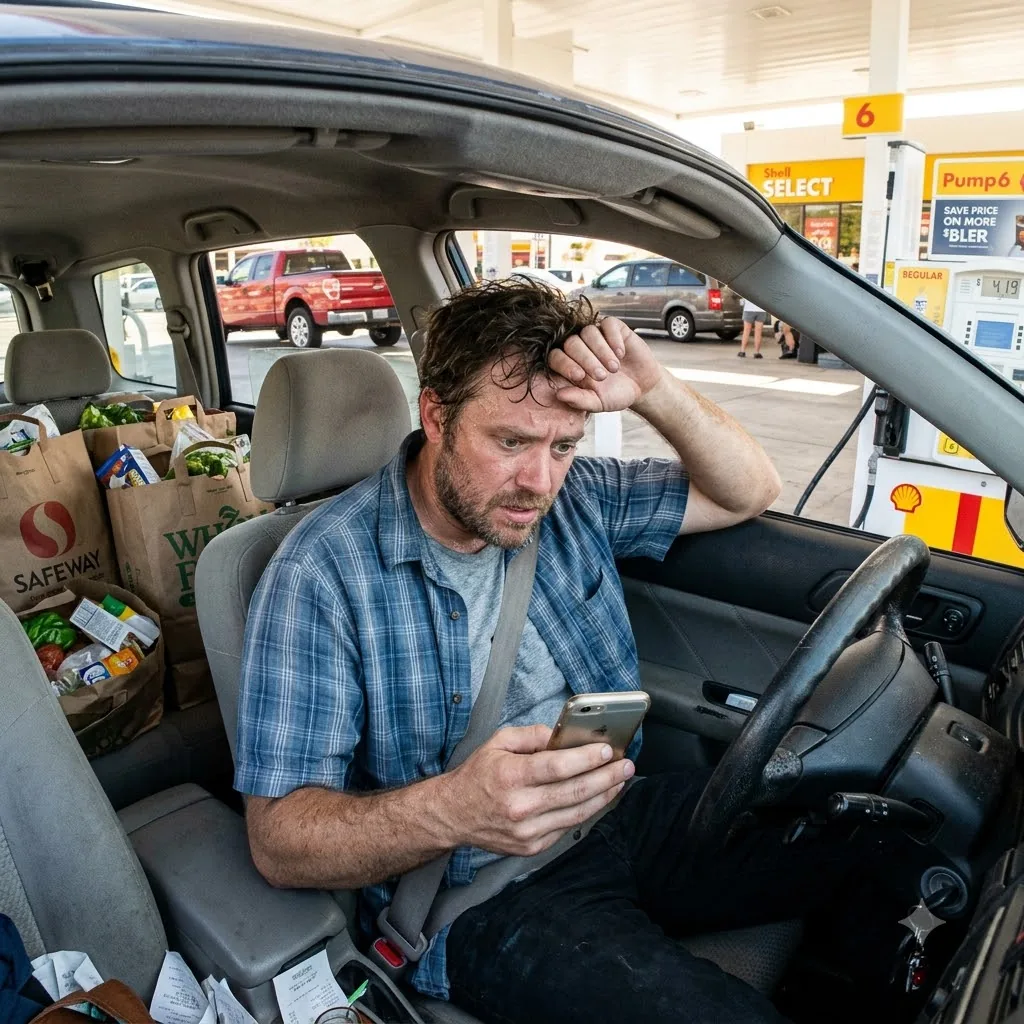
David stared through the windshield at the shimmering heat waves rising off the gas station asphalt. His brain sluggishly attempted to process the math. He was thirty-three years old. In 1998, he was in the second grade. He distinctly remembered losing his front two teeth that year. He did not remember filing a federal tax return.
He navigated the bank’s phone tree, frantically pressing zero until the automated system finally surrendered and transferred him to the Department of the Treasury’s offset division. The hold music was a tinny, distorted classical loop that crackled with static.
Inside the car, the heat had become oppressive. The air conditioning was off to save what little fuel remained in the tank. The smell from the back seat was no longer just sweet cream; it was beginning to take on the sharp, sour tang of spoiling dairy. On his dashboard, the grocery delivery app chimed a harsh, discordant three-note alarm. A scarlet banner dropped across his screen: *DELIVERY ABANDONED. ACCOUNT SUSPENDED PENDING INVESTIGATION.*
David choked back a desperate laugh. The app had just fired him. His sole source of income, the only thing keeping him from total ruin, was gone.
The hold music abruptly clicked off. “Treasury Offset Program, Agent Miller, ID 4409. This call is recorded.”
The voice was flat, bored, and entirely human. David scrambled to press the phone tighter to his ear. “Yes. Hello. My bank account was just drained. A federal levy for a tax debt in 1998. But I was seven years old in 1998. My name is David Ramirez. This has to be a mistake or identity theft.”
Keyboard keys clacked loudly over the line. “Social Security Number?”
David rattled it off, his voice cracking on the last digit.
“Pulling the file,” Miller said. The clacking continued for agonizing seconds. “I see the levy. Unpaid taxes on a 1099 independent contractor filing. Commercial landscaping business in Texas. With twenty-six years of penalties and compounded interest, the outstanding balance is forty-one thousand, two hundred dollars. The sweep of your bank account captured eight hundred dollars. The levy will remain in place for the remainder.”
“I didn’t own a landscaping business in the second grade!” David shouted, his voice echoing in the stifling cabin. “Someone stole my social security number. Maybe my father, maybe a stranger, I don’t know. But it wasn’t me. You have to reverse the levy. I’m stranded at a gas station. My bank account is negative eight hundred dollars because of overdraft fees triggered by your sweep. I can’t buy gas. I just lost my job. I have nothing.”
“If you are claiming identity theft, you must file Form 14039 in person at a regional IRS branch with an original birth certificate and state ID,” Miller recited, clearly reading from a script.
“I can’t get to a branch! I have no gas. I have zero dollars. I need an emergency hardship release. Just unfreeze the account for twenty-four hours. Please. I am entirely impoverished right now.”
“One moment. I will run a hardship assessment matrix.”
David squeezed his eyes shut, letting a drop of sweat roll down his nose. He prayed to whatever algorithm was deciding his fate. He had twelve cents to his name. If any human or machine looked at his financial reality, it would clearly see a man drowning.
“Hardship release denied,” Miller said.
David froze. “What? How? Did you look at my account? I’m completely broke!”
“The demographic matrix flags your profile as ineligible for poverty exemptions, Mr. Ramirez,” Miller said, his tone perfectly bureaucratic. “The system models financial behavior based on your socio-economic demographic. Unmarried Hispanic male, urban zip code, gig economy worker. Statistically, the algorithm determines a near-certainty of unreported, off-the-books cash income and a reliance on multi-generational family networks for financial pooling.”
David’s jaw dropped. The words felt like physical blows. “Are you kidding me? A multi-generational network? I grew up in foster care! I haven’t spoken to a blood relative in fifteen years!”
“I don’t program the matrix, sir,” Miller replied, entirely unmoved. “The Treasury model assumes you have access to unbanked cash from an extended cultural family structure, and that you keep your primary wealth off the books to avoid taxation. The government does not subsidize hardship claims when the algorithm indicates a hidden cash safety net. Your claim of poverty is rejected by the system.”
“It’s a racial stereotype!” David yelled, slamming his hand against the steering wheel. “You’re denying my reality based on a racist algorithm! I am telling you, I am alone. I have no cash. I have no safety net!”
“The levy remains in place,” Miller continued, ignoring the outburst. “Additionally, because the bank sweep did not satisfy the forty-one-thousand-dollar balance, the automated system has escalated collection. A secondary asset seizure has been queued. A lien will be executed on your registered vehicle, the 2008 Toyota sedan, at 8:00 AM tomorrow.”
The air left David’s lungs. Without the car, he truly had nothing. He couldn’t work, he couldn’t sleep in it if he lost his apartment, he couldn’t even leave the city.
“How do I stop the seizure?” David whispered, all the fight draining out of him.
“File the identity theft affidavit in person before the close of business today. The regional office is in the downtown federal building. They close at four-thirty PM.”
The line went dead.
David slowly lowered the phone. He looked at the digital clock on his dashboard. It was 3:18 PM.
He looked down at his fuel gauge. The needle rested heavily on the red *E*, and the low-fuel indicator light was glowing a steady, mocking amber. The downtown federal building was twelve miles away, directly through heavy afternoon traffic. He had negative eight hundred dollars, an empty gas tank, a suspended gig account, and exactly one hour and twelve minutes before the government stole his car for a crime a seven-year-old didn’t commit.