Story code: ST-000964
Part 2: Collateral
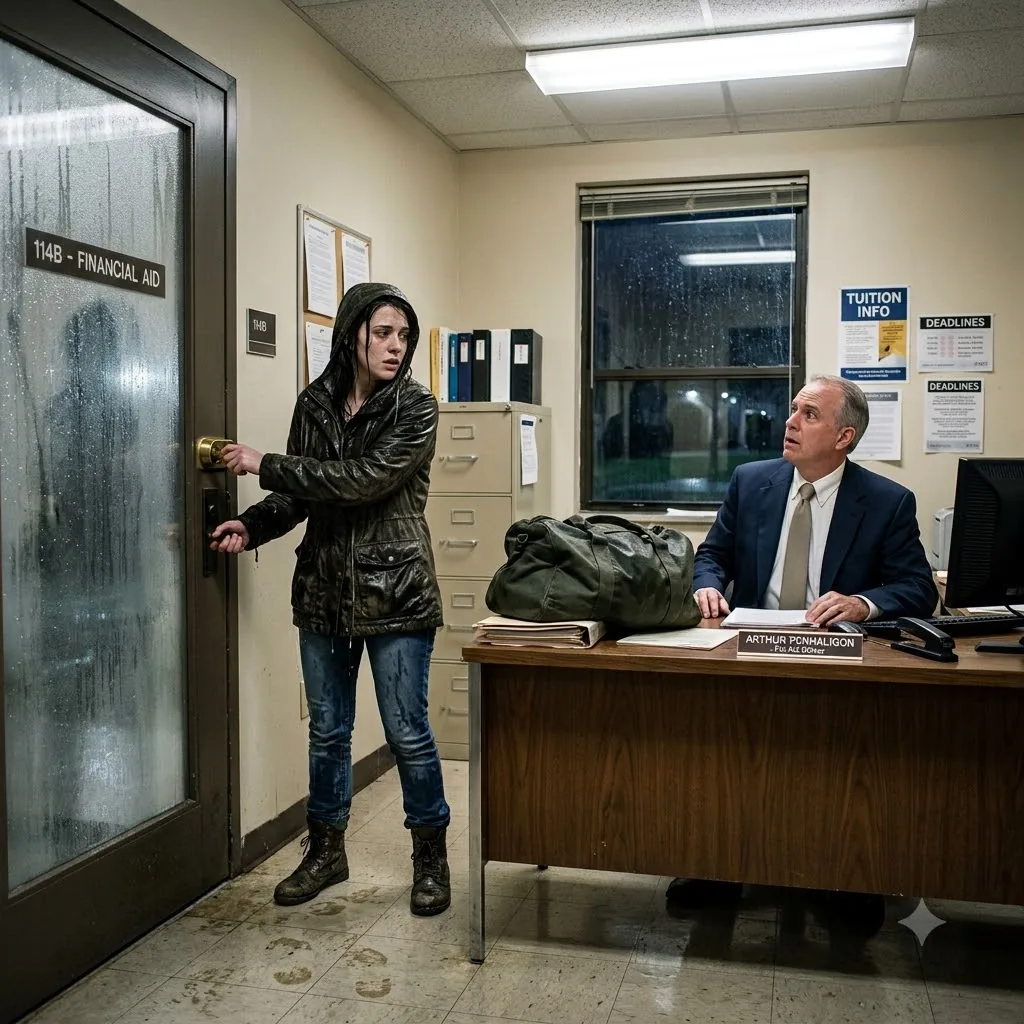
The metal slider of the zipper tore open with a sharp, grating shriek. A distinct chemical stench flooded the sterile, climate-controlled air of the financial aid office. It was a suffocating wave of industrial bleach, boiled marrow, and calcified dust that instantly overpowered the faint smell of Marcus’s citrus room spray.
Leah released the zipper, grabbed the reinforced bottom corners of the heavy canvas duffel, and hoisted it upward with a ragged groan of sheer exertion. A cascading avalanche of pale, rigid shapes poured out of the bag in a deafening clatter. They rattled violently against Marcus’s dual monitors, completely buried his mechanical keyboard, and swept his plastic pen cup and framed compliance certificates off the edge of the desk.
Marcus recoiled, pressing his spine so hard against his ergonomic mesh chair that the plastic backing groaned. His mind, heavily conditioned to process federal mandates and spreadsheet logic, completely stalled as he tried to comprehend the grotesque heap of debris now occupying his workspace.
It was a mountain of bones. Thousands of them. There were split turkey femurs, thick fragments of beef ribs, and countless hollow, delicate chicken vertebrae. They had all been meticulously boiled, scraped, and bleached until they were stark white and entirely devoid of organic matter. They formed a jagged, interlocking pile nearly two feet high, spilling over the edge of the laminate desk and clattering onto the gray commercial carpet. This was the source of the dry, shifting noise. It was the accumulated skeletal waste of the campus dining hall, harvested and sterilized by a student who had lost absolutely everything.
Leah let the empty, wet canvas bag drop to the floor. She leaned over the pile of bleached remains, her rain-soaked hair dripping onto the sterile white fragments. “The Department of Education states that an institution may seize physical assets equal to the outstanding debt if monetary funds are insufficient,” she recited, her voice eerily calm and entirely devoid of the weeping hysterics Marcus usually dealt with. “You zeroed out my checking account this morning. Eight hundred and forty-two dollars and sixteen cents. My entire month of wages from the dining hall.”
Marcus stared at her, his heart hammering violently against his ribs. He tried to rely on his training, desperately searching his memory for the de-escalation scripts he had been taught during his administrative onboarding. “Leah,” he started, keeping his voice deliberately soft and modulated, carefully ignoring the mountain of remains between them. “I understand you are under a tremendous amount of stress. But bringing biological material into an administrative building-”
“It isn’t waste,” Leah interrupted flatly. “It’s collateral. You wanted a pound of flesh for my mother’s defaulted loans. I couldn’t bring flesh. But I brought the framework. It took me three weeks working the closing shift to boil these clean in the industrial kettles.” She reached across the desk, her freezing fingers brushing against the bleached joint of a cattle femur. “I have paid my physical debt. Now, give me my wages back.”
Marcus looked at the secure authorization terminal, its screen barely visible beneath a tangled layer of ribs and vertebrae. He knew exactly what she was asking for. She wanted an ACH reversal. In the financial aid system architecture, reversing a finalized garnishment required a Level 4 Provisional Override. Doing so without a certified judicial mandate wasn’t just a fireable offense-it was a direct violation of the Higher Education Act. The system would generate an immediate, unalterable audit flag. The Office of the Inspector General would be notified within twenty-four hours. He would lose his pension, face immediate termination, and likely endure federal prosecution for wire fraud.
He glanced toward the frosted glass of his locked office door. The hallway lights outside had automatically dimmed to their energy-saving half-power. It was past five o’clock on a Friday. The advising center was officially closed for the weekend. The shadows of the few remaining staff members had already drifted past his door minutes ago, heading for the parking garage. On his desk, the headset he had abandoned emitted a series of sharp, automated beeps-the weeping caller had finally disconnected. He was entirely alone with her.
“Leah, listen to me,” Marcus said, slowly raising his hands in a placating gesture, his palms facing outward. “The system doesn’t work like that. The funds are already in a federal holding escrow. The terminal physically will not allow me to authorize a reversal without a senior manager’s encrypted hardware token. I literally do not have the clearance to do what you are asking.”
Leah didn’t blink. She didn’t scream or accuse him of lying. She simply reached into the deep, sagging pocket of her oversized yellow raincoat.
Marcus braced himself, his mind flashing wildly to firearms or chemical sprays. Instead, Leah withdrew a massive, heavy-duty commercial meat cleaver. The wide steel blade was at least ten inches long, severely scarred, chipped, and pitted from years of heavy abuse in the dining hall kitchens. The wooden handle was tightly wrapped in layers of cheap, peeling electrical tape.
She didn’t point the weapon at him. She simply raised it high above her head and brought it down with a terrifying, two-handed strike.
The heavy steel blade cleaved cleanly through the pile of bones and buried itself three inches deep into the center of Marcus’s desk, shattering the plastic casing of his mechanical keyboard and embedding into the laminated particleboard beneath it. A chaotic spray of white bone splinters and black plastic keys erupted across the room, bouncing off Marcus’s chest and stinging his face.
Leah kept her hand firmly gripped on the taped handle of the cleaver. She leaned over the ruined keyboard, her face inches from his. The smell of rain and cold sweat rolled off her pale skin.
“Don’t lie to me about hardware tokens, Marcus,” she whispered, her eyes locked onto his. “I serve coffee at the administrative faculty meetings. I heard you bragging to the admissions director. I know you have a provisional credit bypass. I know you used it for the Dean’s nephew last semester when his disbursement bounced. You type your credentials, you press F8, and the money drops back into the account.”
Marcus stared blankly at the ruined keyboard, his breath caught in his throat. He noted, with a sudden, horrifying clarity, that the numeric pad and the function row were still perfectly intact. The blinking cursor on his left monitor waited patiently on the override screen. She was right. He had the code. But using it meant ending his own life as he knew it.
Leah gripped the handle of the cleaver and smoothly wrenched it free from the ruined desk, raising the heavy steel blade an inch above the tangle of severed wires and fractured bones.
“Log in,” she commanded.