Story code: ST-000624
Part 4: Zero Sum
The echo of Carter’s scream hung in the freezing air of the conference room, vibrating against the glass walls. Sterling did not flinch. He slowly uncrossed his legs, reached into the inner pocket of his thousand-dollar blazer, and withdrew a silver fountain pen. He capped it with a soft, final click.
“Sarah,” Sterling said, his voice dropping to a conversational murmur that somehow carried more weight than Carter’s roaring. “Please call Legal. Tell them to immediately pull the term sheet.”
“Already texting them,” the woman replied, slipping her phone into her leather handbag and standing up.
Carter whirled away from Elias, the furious red mottling on his face draining into a sickly, chalky white. “Sterling, wait. Let’s not overreact. I can explain the Apex structure. It’s highly standard in transitional-”
“It is fraud,” Sterling interrupted, locking his briefcase. He didn’t look angry; he looked bored, which was infinitely worse. “You attempted to pass off stolen intellectual property during a live acquisition audit while concealing an offshore shell company designed to defraud your own staff. My firm does not invest in radioactive liabilities, Carter. And by the time my partners are done making their phone calls this afternoon, you won’t be able to raise a dime from anyone on the eastern seaboard.”
“Sterling, please!” Carter begged, actually stepping into the investor’s path, his hands raised in a placating gesture. The tyrannical boss of Sentinel Tech had vanished, replaced by a desperate, sweating salesman watching his millions evaporate. “He’s disgruntled! He’s crazy! We can do the deal without him, I have the backend passwords-”
“Get out of my way,” Sterling said. It was a command, flat and absolute.
Carter stepped aside, his shoulders slumped. The four investors filed out of the glass room, their expensive shoes clicking a synchronized, retreating rhythm on the hardwood floor. The heavy glass door swung shut behind them, sealing the room in a ringing silence.
Elias sat at the head of the mahogany table, methodically winding the power cord of his laptop. He tucked the frayed end into his messenger bag and zipped it shut.
Carter slowly turned back around. His chest heaved. He looked at the unplugged projector cable, the blank screen, and finally at Elias.
“You killed it,” Carter whispered, his voice trembling with a terrifying, hollow rage. “You killed the company. The valuation is gone. We are bankrupt tomorrow without that cash infusion.”
“You killed it, Carter,” Elias said quietly. He grabbed the edge of the table and forced himself to stand. His right knee screamed in protest, a blinding flare of pain that made black spots dance in his peripheral vision. He leaned heavily on his good leg. “I just turned on the lights.”
“You walk out that door, you get nothing,” Carter sneered, gripping the back of a leather chair. “Zero. Three years of your life, gone. You’re broke.”
“I know,” Elias said.
He hoisted the strap of his messenger bag over his shoulder. He didn’t look back as he limped toward the glass door. He expected Carter to yell again, to throw something, but there was only the pathetic sound of Carter’s ragged breathing.
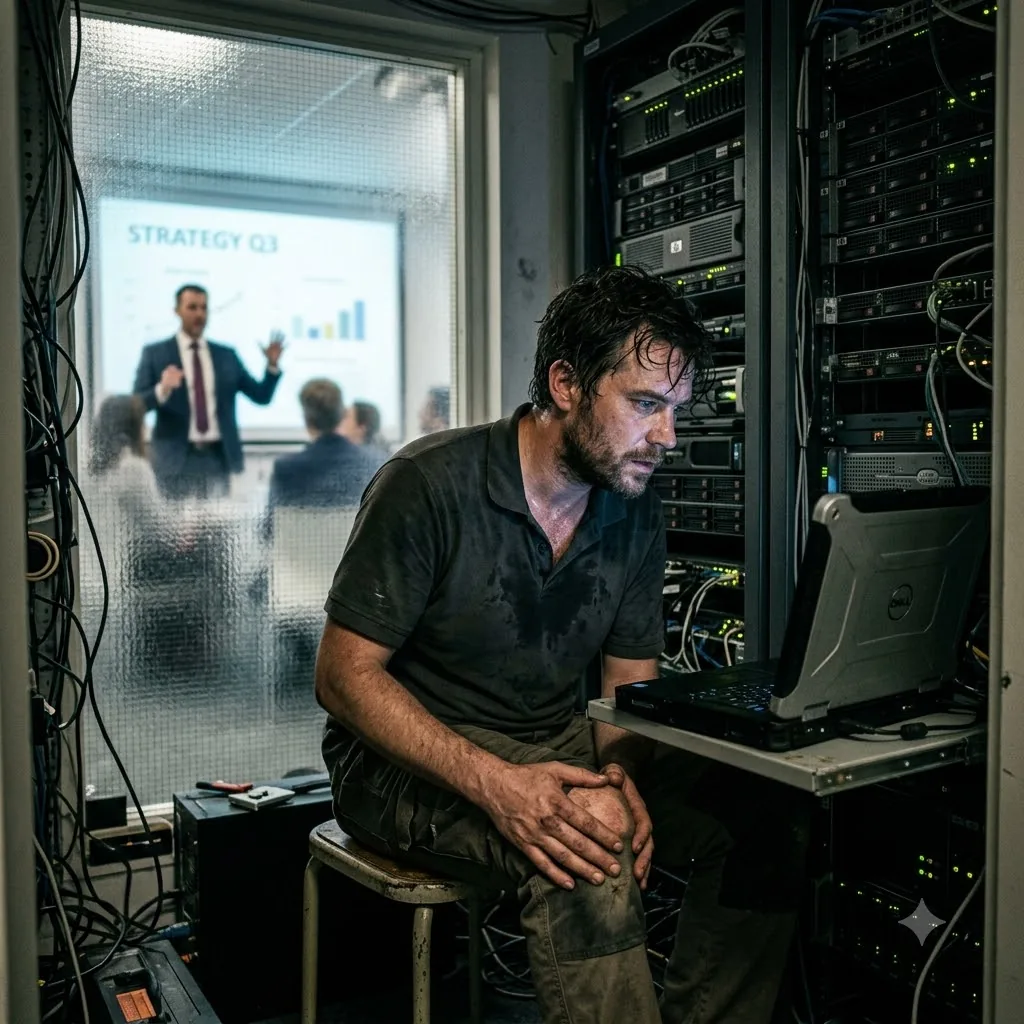
Elias pushed through the glass door, crossed the empty hallway, and bypassed the server closet entirely. The dull hum of the backup battery tower was just background noise now, a problem for whoever Carter managed to trick into cleaning out the office.
The elevator ride down to the lobby took exactly forty seconds. For three years, Elias had spent those forty seconds calculating lines of code, stressing over server loads, and agonizing over how to keep Carter’s promises from breaking the platform. Today, he just watched the floor numbers tick downward.
He pushed through the heavy revolving doors and stepped out onto the Boston sidewalk.
The afternoon sun hit his face, warm and real. The oppressive, artificial chill of the conference room and the suffocating heat of the server closet washed away. He stood out of the flow of pedestrian traffic, leaning against the concrete facade of the building, letting the ambient city noise wash over him.
Carter was right. Elias had zero money to show for three years of eighty-hour weeks. He had no equity, no startup millions, and no job. His bank account was practically empty, and his right leg was trembling so badly he had to brace himself against the brickwork just to stay upright.
But as he took a deep breath of the city air, a profound, overwhelming lightness spread through his chest. The invisible, crushing weight he had carried since the day he agreed to build Sentinel Tech was gone. The constant, gnawing anxiety of trying to prove his worth to a man who only saw him as a prop had completely evaporated.
Elias reached into his pocket and pulled out his phone. He bypassed his email, ignoring the dozen automated alerts from the aborted transfer script. He opened his contacts and scrolled to a number he had aggressively ignored for thirty-six months because Carter always insisted they couldn’t spare him for a week of recovery.
He pressed the green call icon and held the phone to his ear.
“Veterans Affairs Orthopedic Clinic,” a tired but polite voice answered on the second ring. “How can I help you?”
“Hi,” Elias said, shifting his weight, feeling the phantom ache in his joint one last time. “My name is Elias Thorne. I need to schedule a knee surgery.”