Story code: ST-000238
Part 4: The Price of Dry Ground
The ringing feedback from the microphone faded, swallowed by the heavy silence of the plaza. Mateo didn’t wait for Arthur Vance to recover his composure. He tightened his blistering hands around the handle of the sledgehammer, raised it high over his shoulder, and brought it down squarely on the brass locking mechanism of the main sea valve. The heavy padlock shattered, spraying metal shrapnel across the dry concrete.
Mateo dropped the hammer. He grabbed the rusted iron wheel of the manual override. Tomas Ramirez stepped up beside him, his hands slick with iridescent sludge, and together they threw their remaining weight against the metal. The valve groaned, letting out a deep, agonizing scrape of neglected steel, and then it turned.
Beneath their feet, the concrete plaza vibrated. A colossal, subterranean roar echoed up through the metal grates as millions of gallons of trapped toxic water found their violent escape. The massive discharge pipes violently expelled the black, chemical-laced tide straight into the ocean, charting a direct, unstoppable path right through the pristine, newly developed coastline of the Palisades.
Arthur Vance collapsed to his knees, the microphone stand clattering against the podium. He clawed at his tailored navy suit, babbling incoherently at the reporters who were frantically adjusting their camera angles to capture the billionaire’s live breakdown against the backdrop of the roaring discharge pipes.
Mateo didn’t stay to watch the ruin of a wealthy man. He turned his back on the cameras, his chest heaving, his lungs burning with every breath of the dry ocean air. He walked back to the concrete stairs and began the slow, painful descent into Las Palmas.
The water was already dropping. The artificially induced flood was rushing toward the sea, but it was not a clean retreat. As Mateo waded back into his street, the waist-deep sludge lowered to his knees, then to his ankles, revealing the true devastation. The toxic tide left behind a thick, suffocating layer of black, oily mud that coated every surface. Cars sat at crooked angles on the asphalt, their interiors completely hollowed out by the chemical solvent. Dead lawns were plastered with a sickly, yellow-green film. The stench of raw industrial rot hung heavy in the stifling heat, baking into the ruined wood of a hundred homes.
By the time Mateo reached his own property, the water had entirely vanished down the unsealed storm grates. The neighborhood was saved from drowning, but it was thoroughly dead.
He trudged up his front walkway, his boots sinking two inches into the chemical mud with every step. The front door of his house hung off its bottom hinge, warped and swollen from the flood. Inside, the drywall was peeling away in wet, gray sheets, collapsing over the sludge-caked remains of his furniture.
Mateo didn’t go inside. He couldn’t stomach the dead silence of the ruined rooms. Instead, he dropped heavily onto the top step of his sagging wooden porch.
His body was beginning to crash. The adrenaline that had carried him through the toxic water was evaporating, leaving behind a profound, agonizing ache. His forearms and neck were covered in raised, angry blisters that oozed clear fluid. Every patch of skin that had touched the water felt like it had been scrubbed with coarse sandpaper and soaked in battery acid.
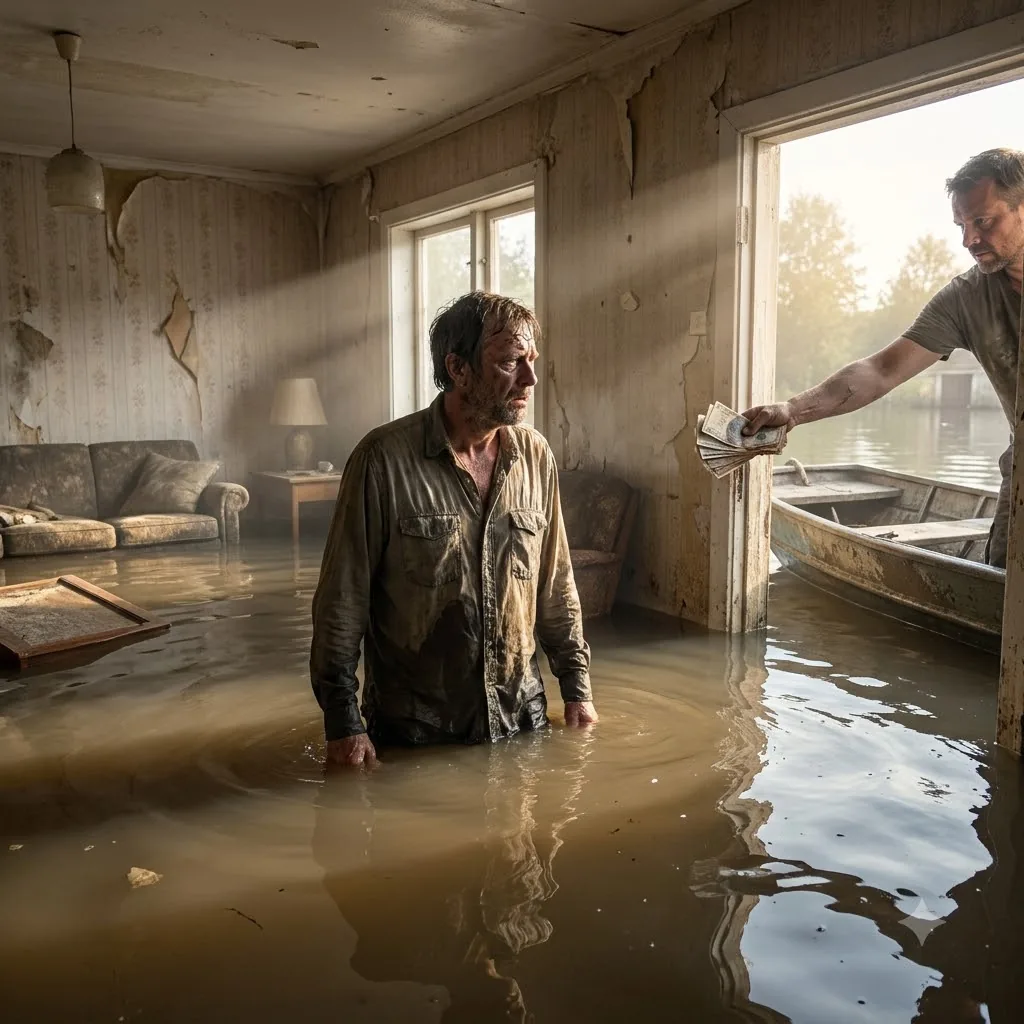
At the edge of his ruined azalea bush, half-buried in the black mud, lay the brick of hundred-dollar bills Hector had thrown through his window. The rubber band had snapped. The waterlogged currency was scattered in the toxic dirt, completely useless. Mateo stared at it, feeling absolutely nothing.
The sun dipped lower, casting long, bruised shadows across the devastated street. There were no sirens. No emergency management trucks. No local police cruisers rolling in to assess the damage or offer medical aid. The city was leaving them to rot in the residue of Vance’s mistake.
Then, the low hum of a heavy engine broke the silence.
A vehicle turned onto Mateo’s street. It was not an ambulance. It was a matte black, armored van with heavily tinted windows and heavy-duty run-flat tires. It rolled at a deliberate crawl, the thick rubber tires squelching through the chemical mud. As it passed beneath a flickering, miraculously surviving streetlight, Mateo caught the faint, stenciled letters on the side panels: DHS. Department of Homeland Security.
The van didn’t use a siren. It didn’t flash any lights. It simply coasted down the center of the ruined block, a dark, silent predator surveying the damage. It slowed as it approached the Ramirez house, paused for a few agonizing seconds, and then continued its crawl.
It came to a complete stop directly across from Mateo’s porch.
The engine idled, a deep, vibrating purr that resonated in Mateo’s chest. The tinted windows remained rolled up. No doors opened. No one stepped out to ask if he needed a medic. They just sat there behind the black glass, watching him.
Vance had lost his tennis courts, his luxury estate, and his public reputation, but billionaires rarely bled alone. They had friends in high places, quiet leverage that reached far beyond municipal pump stations. Mateo had humiliated a powerful man on live television. He had forced the hand of the city, and now the city’s immune system was responding.
Mateo sat still on his ruined porch, the chemical burns screaming across his skin. He watched the dark, reflective glass of the government van, the heavy realization settling like a stone in his stomach. The pumps were shut down, the water was gone, but the real flood was just beginning. He rubbed his blistered arms, facing the chilling, irreversible cost of his heroism.