Story code: ST-000658
Part 2: The Compliance Chair
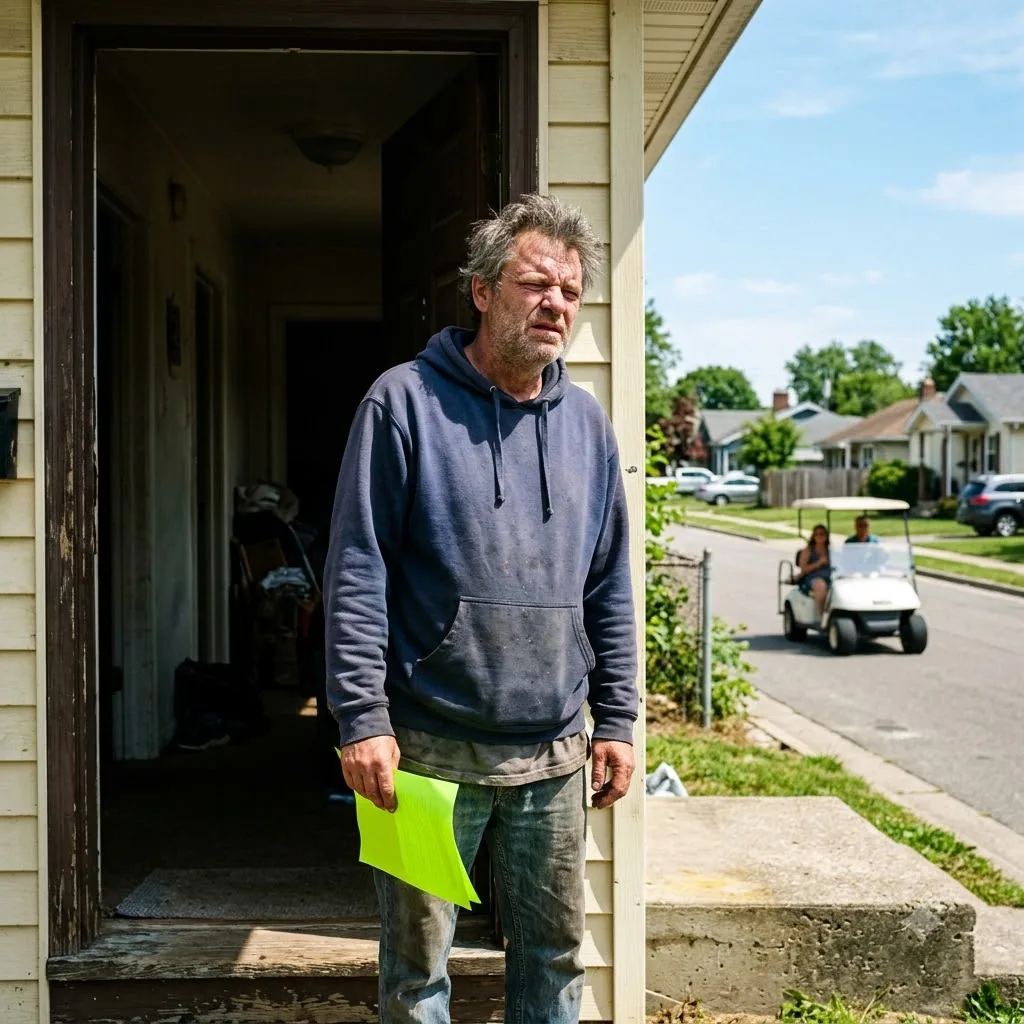
The blistering heat of the asphalt finally registered through the soles of Marcus’s bare feet. He pivoted, gritting his teeth as a fresh wave of nausea washed over him, and hobbled back up his driveway. Every step sent a hard, reverberating shock up his spine and directly into the base of his skull.
He threw himself through the front door and slammed it shut, leaning his entire weight against the heavy wood as the deadbolt snicked into place. The sudden darkness of the entryway was a profound relief, but the damage was already done. The brief exposure to the midday glare had turned the ice pick behind his left eye into a serrated blade.
Marcus slid down the door until he hit the floorboards, pulling his knees to his chest. He sat there in the gloom for ten minutes, focusing entirely on the rhythm of his breathing, waiting for the threat of vomiting to pass.
When he finally trusted his legs, he pushed himself up and limped into the kitchen. He flipped on the lowest setting of the under-cabinet lighting. The dim, warm glow was just enough to see by without triggering another spike of agony.
He smoothed out the crumpled yellow HOA citation on the granite island. Then, he reached for the crisp white VA denial letter he had discarded earlier.
He placed them side by side.
Marcus leaned over the counter, rubbing his temples as he forced his eyes to focus on the fine print. At the bottom of the VA letter, beneath the boilerplate text dismissing his neurologist’s findings, was a digital signature block.
*Warren Croft, Deputy Regional Director, Veterans Benefits Administration.*
Marcus dragged his gaze to the yellow HOA citation. The handwriting filling the blank lines was sharp, pressed so hard into the cardstock that it left deep indents. He looked at the bottom right corner, where the citing officer was required to sign. It wasn’t a full signature, just a hurried scrawl above a pre-printed title.
*W. Croft, HOA Compliance Committee Chair.*
The breath caught in Marcus’s throat.
It wasn’t a coincidence. The heavy plastic parking pass swinging from the silver sedan’s rearview mirror hadn’t just been a generic federal permit. It belonged to the exact bureaucrat who had just rejected his medical claim.
Marcus pulled his phone from his pocket, the screen brightness already turned down to its lowest setting. He opened his banking app. The bold numbers sitting at the top of the screen offered no comfort.
Available Balance: $412.50.
The initial HOA fine was two hundred and fifty dollars. The citation explicitly stated that an additional fifty dollars would be levied for every twenty-four hours the “unapproved modifications” remained in place. If he left the blackout curtains up, his entire bank account would be drained by Thursday.
If he took the curtains down, the sheer volume of sunlight flooding the living room would render the house uninhabitable for him. A severe TBI migraine didn’t just cause pain; it caused a total neurological shutdown. Without the dark, he would lose his vision, his balance, and eventually consciousness. He would end up in the emergency room. And because Warren Croft had just denied his VA claim, Marcus would be completely responsible for the out-of-pocket hospital bills.
He tapped the phone app and dialed the number printed on the back of his HOA community handbook. After four minutes of excruciating hold music, a representative from Premiere Property Management picked up.
“Premiere Property, this is Sarah. How can I help you?”
“My name is Marcus Vance,” he said, keeping his voice to a low, hoarse whisper to minimize the vibration in his head. “I live at 414 Oak Creek Drive. I received a citation today for unapproved window coverings. I submitted a medical variance for those curtains two weeks ago with a doctor’s note.”
He heard the clacking of a keyboard on the other end of the line.
“Okay, Mr. Vance, I’m pulling up your file now,” Sarah said, her voice entirely detached. “Let’s see… ah. Yes. The variance request was reviewed this morning by the compliance chair. It was rejected.”
“On what grounds?” Marcus asked, his grip tightening on the edge of the island. “It’s an ADA accommodation. I have a traumatic brain injury.”
More keyboard clicking. “The notes from Mr. Croft state that the variance is denied due to a lack of verifiable federal disability rating. The note says, ‘Resident cannot claim severe medical necessity for architectural deviation without matching documentation from the Department of Veterans Affairs.'”
Marcus stared blankly at the wall.
Croft was weaponizing his day job against his neighbors. Since Croft, acting as the VA Director, had denied Marcus’s medical claim, Croft, acting as the HOA Chair, could claim Marcus had no legal proof of his injury. He had built a perfect, inescapable bureaucratic loop.
“If you don’t pay the fine by five p.m. tomorrow,” Sarah continued, reading from her screen, “the account will be flagged for accelerated enforcement. That includes immediate suspension of community privileges and the initiation of property lien proceedings. Will you be submitting a payment today?”
“No,” Marcus said softly, and hung up.
He walked slowly to the front window. He peeled back the absolute edge of the heavy rubberized curtain, creating a slit no wider than a pencil.
He looked down the street. The silver sedan had not left the neighborhood. It was parked in the broad, meticulously stamped concrete driveway of the large corner house at the end of the cul-de-sac.
Warren Croft wasn’t just an anonymous administrator in a downtown office building. He was the neighbor at number 400.
Marcus watched as a man in a crisp navy polo shirt stepped out of the sedan, clipboard in hand, and walked casually up to his pristine, fortress-like home. He paused at his front door, turned around, and stared directly down the street at Marcus’s house.