Story code: ST-001664
Part 3: The Tip
The heavy, brass-studded oak doors of Education Committee Room 412 swung open, shattering the quiet murmurs of the assembled lawmakers. Marcus was shoved gently but firmly over the threshold. His shoulders slumped forward, his untucked cotton t-shirt was wrinkled with sweat and floor grit, and his wrists were ringed with angry, purple bruises from the zip-ties and steel cuffs.
A senior Capitol Police captain strode in beside him, gripping the faded olive-green backpack by its canvas top handle. The captain marched down the center aisle and deposited the heavy bag onto the polished mahogany witness table with a resounding, unnatural thud. The sheer weight of it made the thick wood groan.
“Clearance verified, Madam Chair,” the captain announced to the elevated dais, his voice tight with lingering adrenaline. “DoD liaison confirmed his courier status and the asset tags on the tungsten modules. The perimeter is stood down.”
Marcus sank into the heavy leather chair at the witness table. His chest still ached terribly from where the trooper’s knee had driven into his ribs, and his breath hitched every time he inhaled.
Across the center aisle, sitting at the competing witness table, was the impeccably dressed older man from the rotunda.
He was no longer just an anonymous bystander in a custom-tailored charcoal suit. A polished brass nameplate rested perfectly aligned with the edge of his table, right next to his pristine leather briefcase: *Dr. Arthur Vance*.
Vance did not look surprised to see Marcus walk in under police escort. Instead, he offered the young man the exact same slow, predatory smile he had worn downstairs. It was a look of complete, untouchable superiority.
Chairwoman Abbott, sitting at the center of the semicircular dais, peered down through her reading glasses. Her expression was a mask of cold impatience.
“Mr. Hayes,” she said, her voice dripping with bureaucratic disdain. “Your delayed arrival and the ensuing panic have cost this committee a great deal of time and public goodwill. While your clearance for these prototype engineering models apparently holds up, this spectacle calls your basic competence into severe question.”
Before Marcus could force air through his bruised ribs to answer, Vance leaned forward, pressing his manicured fingertips together in a steeple.
“If I may, Madam Chairwoman,” Vance said, his tone dripping with mock sympathy. “This unfortunate event is precisely why my firm raised concerns about awarding a defense-funded educational grant to someone so young. Mr. Hayes’s… volatility is a matter of public record. Causing a bomb squad deployment in the state Capitol? It highlights a profound, deeply concerning instability. Perhaps his traumatic experiences make him fundamentally unsuited for this tier of government responsibility.”
Marcus stared at Vance. The bitter, metallic taste from the rotunda flooded the back of his throat again. He looked down at his own hands, which were still resting on the mahogany table, vibrating with violent, uncontrollable tremors.
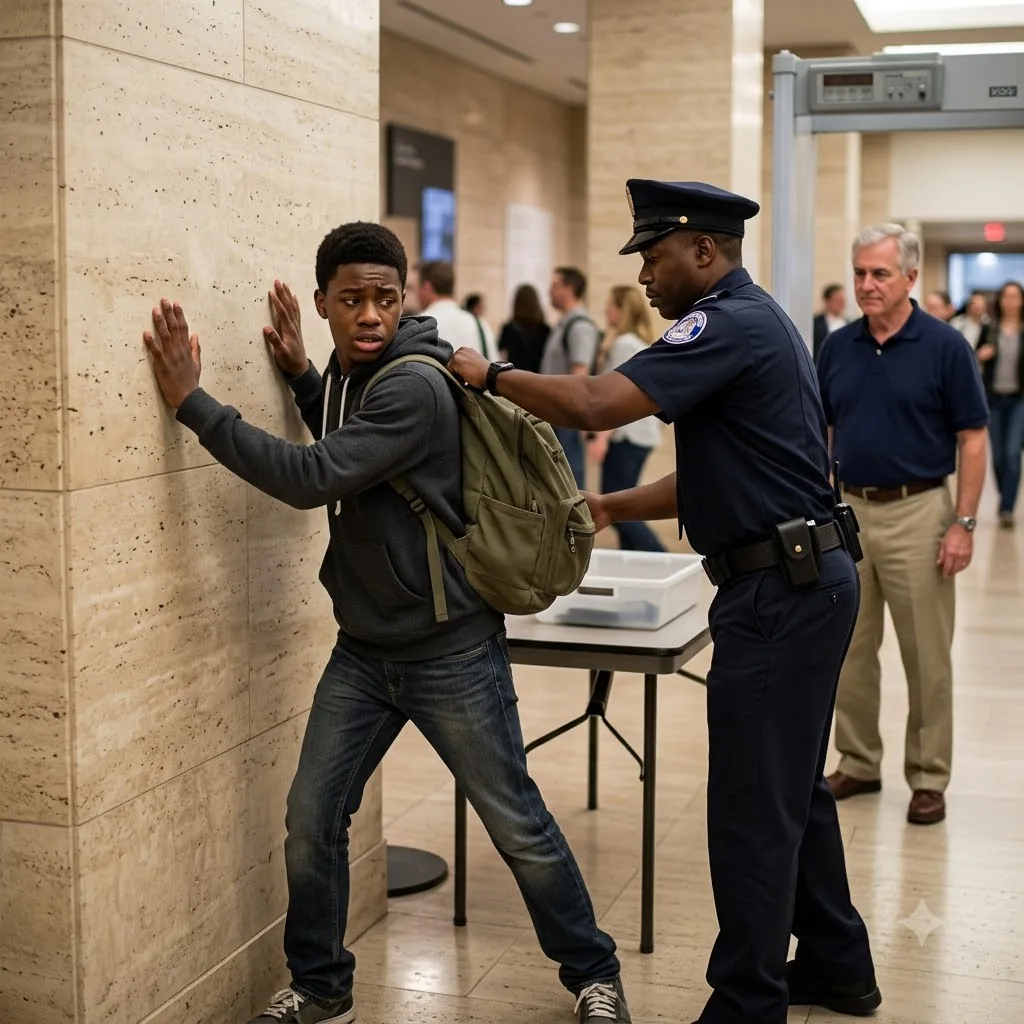
His mind raced back to the freezing marble wall downstairs. He remembered the trooper bypassing a dozen other people. The officer had marched in a straight, unwavering line, zeroing in on Marcus the exact second he walked through the security doors.
*Just a routine, random screening.*
It wasn’t random. Vance had been standing at the velvet rope, waiting. He had been entirely confident in what was about to happen because he had orchestrated it.
Marcus looked up at the police captain, who was standing at attention near the exit. “Captain,” Marcus said. His voice cracked, sounding painfully frail in the cavernous room. He swallowed hard and tried again, forcing the words out louder. “Why did your officer stop me?”
“You’re not asking the questions here, son,” the captain snapped, his jaw tightening.
“You called a Code Red before you even unzipped the bag,” Marcus persisted, his heart hammering against his bruised ribs. “You bypassed a lobbyist and a massive tour group. You knew exactly who you were looking for. You had a specific description.”
Chairwoman Abbott frowned, her gaze shifting to the officer. “Captain, the committee would also like to know what exactly prompted the lockdown.”
The captain sighed heavily, pulling a small, spiral-bound notepad from his breast pocket. “Capitol Security received an anonymous tip through the emergency dispatch line at 8:42 AM. The caller reported a young male suspect entering the south wing, carrying a heavily weighted olive-green backpack, exhibiting erratic behavior, and suffering from severe, visible nervous tremors.”
A heavy silence fell over the committee room.
Vance’s smile widened by a microscopic fraction. It was a flawless, devastating trap. The police had found exactly what the anonymous tipster promised: a shaking, sweating, erratic suspect with a bag full of heavily taped metal boxes.
Marcus looked at his vibrating fingers tapping against the wood. Then he looked at Vance’s sleek silver phone, now resting face-up next to his brass nameplate.
“At 8:42 AM,” Marcus said slowly, the words echoing off the oak-paneled walls, “I was three blocks away, sitting on the city transit train.”
“The timeline of your commute is irrelevant, Mr. Hayes,” Vance interrupted smoothly, waving a dismissive hand. “The police observed your state when you arrived. You are visibly trembling right now. Your condition is evident to everyone in this room.”
“I am trembling now,” Marcus said, stripping the frantic, defensive edge from his voice, replacing it with a cold, absolute clarity. He stood up, ignoring the shooting pain in his shoulders, and planted his shaking palms flat against the table. “Because my PTSD tremors are contact-triggered.”
Chairwoman Abbott lowered her glasses. “Explain what you mean.”
“It is fully documented in my sealed medical discharge file,” Marcus said, keeping his eyes dead-locked on Vance. “I do not have a baseline tremor. I don’t shake when I walk. I don’t shake when I carry my equipment. The tremors only manifest when I am physically restrained or pinned against my will. It is a leftover neurological reflex from a blast incident.”
He turned his face up to the Chairwoman. “I wasn’t shaking when I walked through those brass doors downstairs. If you pull the rotunda security footage right now, you will see me walking perfectly calmly. My hands were completely steady. The shaking didn’t start until your trooper slammed me into the marble wall and pinned my arms.”
The ambient rustling of papers on the dais stopped. The room went perfectly still.
“The anonymous caller,” Marcus continued, his voice ringing with undeniable certainty, “reported my severe nervous tremors thirty minutes before they actually happened. They reported a physical symptom that didn’t exist yet.”
The captain’s posture shifted immediately. He dropped his notepad, his hand resting instinctively on his leather utility belt as he stared at Marcus, then turned his gaze slowly toward Vance.
“Only three entities have access to my unredacted medical file to know my specific, physical triggers,” Marcus said. “This oversight committee. The Department of Defense. And the lead competing contractor, who was granted full legal discovery of my background check yesterday.”
Marcus pointed a bruised, shaking finger directly at the man in the charcoal suit.
“He didn’t just call in a fake bomb threat to delay my testimony,” Marcus said, the truth locking into place with devastating precision. “He weaponized my PTSD. He knew that ordering an aggressive, physical pat-down by armed police would trigger a severe neurological episode. He orchestrated the assault just so I would look unstable, erratic, and broken by the time I sat at this table.”
Vance didn’t speak. He didn’t move to adjust his cuffs or reach for his briefcase. But for the first time since Marcus had seen him standing victorious in the rotunda, the older man’s predatory smile vanished entirely, replaced by a rigid, bloodless line.