Story code: ST-000116
Part 4: The Hollow Victory
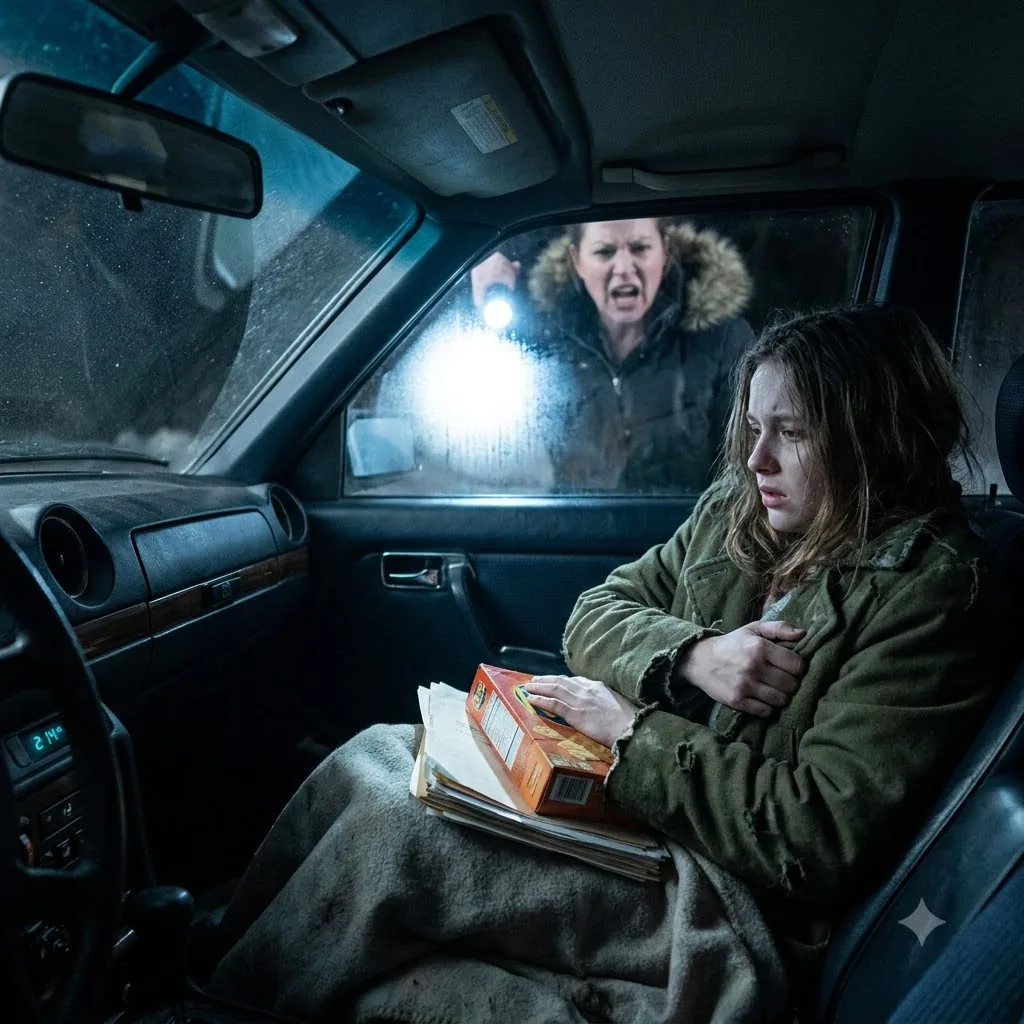
The mahogany table in the Chancellor’s conference room gleamed under the warm, recessed lighting. Sarah sat in a plush leather chair, the heavy heat from the room’s vents completely thawing the lingering chill in her bones. She kept her hands folded tightly in her lap, her fingernails still chipped from scraping against the icy glass of her Corolla just forty-eight hours ago.
Across the polished wood, Chancellor Hayes and two stone-faced members of the university’s Board of Trustees shifted uncomfortably in their tailored suits. Between them sat a thick manila folder.
The internet had worked with terrifying speed. By Wednesday morning, Tyler and Maya’s videos had completely eclipsed Provost Kensington’s initial livestream. The students had posted their multi-angle footage of the parking garage confrontation, pairing it directly with the Provost’s recent, campus-wide email mandating “compassion and civility in our shared academic spaces.” The juxtaposition was explosive. Millions of views piled up before lunch. The comments section had become a digital firing squad, dissecting the two-thousand-dollar torn cashmere coat against the rusted, stalling Corolla and the slush-soaked student essays.
Kensington’s fabricated narrative of a violent, feral vagrant collapsed under the weight of the students’ high-definition evidence. The world saw the university’s second-in-command violently kicking a car, threatening to destroy the academic records of tuition-paying sophomores, and screaming venom at an underpaid adjunct grader.
“We want to assure you, Professor Davis,” Chancellor Hayes said, his voice dripping with practiced, careful diplomacy, “that the university does not condone the abhorrent behavior displayed in the VIP structure. The culture of this institution is built on mutual respect.”
Sarah stared at him. She thought about her bright blue EBT card, still tucked into the pocket of her frayed winter coat hanging on the rack behind her. She thought about the generic saltine crackers that had been her only dinner.
“Provost Kensington has decided to take an immediate, early retirement,” one of the board members stated, carefully avoiding the words ‘fired’ or ‘disgraced.’ “She will no longer be associated with the campus. Her… departure will be announced to the student body this afternoon.”
Sarah nodded slowly, her face entirely passive. She knew exactly what “early retirement” meant. It meant a quiet exit, a protected pension, and a desperate attempt by the university to distance itself from a massive public relations nightmare. Kensington had lost her absolute power and her prestigious title, chased out of the ivory tower by the very digital mob she had tried to weaponize.
Chancellor Hayes slid the manila folder across the gleaming mahogany. It stopped inches from Sarah’s hands.
“In light of the extreme distress you suffered, and in recognition of your obvious dedication to your students,” Hayes continued, offering a tight, anxious smile, “the board has authorized an immediate restructuring of your employment. We are offering you a tenure-track position in the Literature Department. Effective immediately.”
Sarah looked down at the folder. She opened the heavy cover. The salary figure printed on the first page made her breath catch in her throat. It was more money than she had made in the last four years combined. It meant a working radiator. It meant an apartment with consistent hot water. It meant she could finally afford to fix the Corolla, or even replace it entirely. Also clipped to the contract was a brand-new, rigid plastic parking pass. The lanyard was stamped with the gold lettering of the executive VIP lot.
“We value our faculty,” the Chancellor added, his eyes darting nervously to Sarah’s face, searching for a sign that the digital bleeding would stop. “We want to make sure you feel entirely supported here.”
They wanted her silence. They were terrified she would go to the national morning shows, terrified she would sit in front of a television camera and explain exactly how an adjunct professor ended up freezing in a car because she couldn’t afford to heat her own apartment. The tenure-track position wasn’t a reward for the five years she had spent grinding through towering stacks of essays, or the brilliant lectures she delivered to sophomores like Tyler and Maya. It was hush money wrapped in academic prestige.
Sarah picked up the heavy, expensive pen resting beside the contract. The metal felt entirely different from the cheap red plastic grading pens she bought in bulk. She signed her name on the dotted line, the ink flowing smoothly across the thick, high-quality paper.
The board members visibly exhaled, their shoulders dropping in unison. Handshakes were offered. Hollow congratulations echoed in the over-heated room.
An hour later, Sarah walked out of the administration building and into the biting winter air. She held the shiny VIP parking pass in her pocket, her thumb tracing the embossed gold letters. She had finally achieved everything she had spent half a decade starving for. She had the title, the salary, and the security. But as she looked across the sprawling, manicured campus, the victory felt entirely empty. The system hadn’t recognized her worth, her intellect, or her dedication to her students. It had only recognized its own reflection in a shattered digital mirror, panicking at the ugly truth, and throwing money at her just to hide the cracks.