Story code: ST-000729
Part 4: The Alphabet Rug
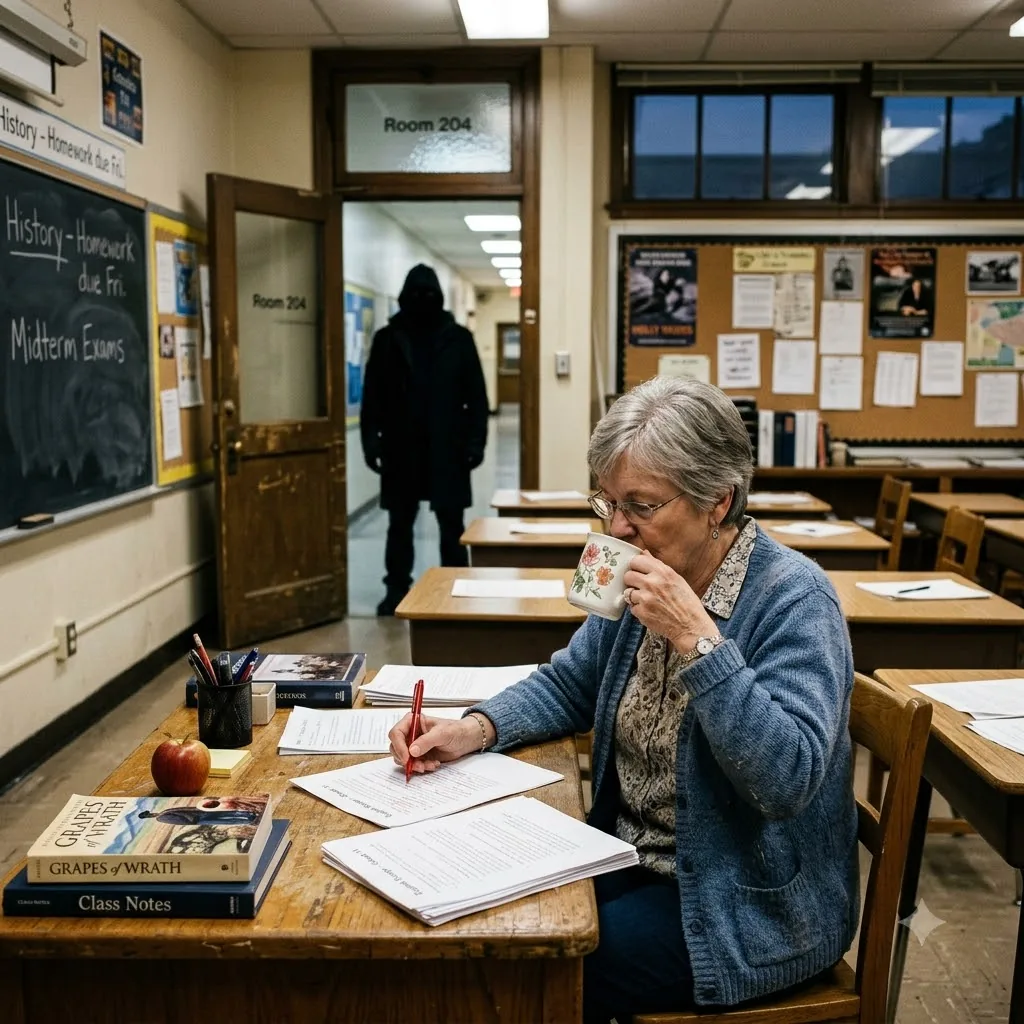
Brown liquid dripped slowly down the painted cinderblock wall, pooling on the waxed linoleum. Shards of the chipped ceramic mug lay scattered among the ruined spelling tests. Miriam stood perfectly still, watching a single drop of lukewarm chamomile tea bleed a red ‘X’ on Tommy Henderson’s paper into a pink, shapeless blur.
Principal Hedges finally found his voice, though it emerged as a high, reedy squeak of institutional panic. “Vance! For God’s sake, that is school property!”
Vance did not answer. He stood over the toppled desk, his broad chest heaving, staring down at his trembling, black-gloved hands. The expensive tactical gear suddenly looked like a child’s oversized costume.
Miriam bent down, her knees popping softly in the quiet room, and began to pick up the larger shards of ceramic.
“Leave it, Miriam,” Hedges stammered. He pulled a bulky walkie-talkie from his belt and keyed the microphone. “All clear. Code green. Exercise concluded. All staff, return to standard schedule.” He dropped the radio back to his hip and pointed his plastic clipboard at her. “I cannot believe what I just witnessed. You provoked him.”
“I diagnosed him, Gary,” Miriam said, dropping a curved piece of ceramic into her metal trash can with a sharp clatter. “There is a distinct difference.”
“You refused to lock down. You refused to barricade. You provoked an authorized contractor and jeopardized this entire district’s safety compliance rating.” Hedges’s face flushed, a frantic vein pulsing at his temple. “I am placing you on administrative leave, effective immediately, pending a full disciplinary hearing with the school board.”
Miriam straightened up. The bruise on her collarbone throbbed, a dull, rhythmic ache radiating down to her elbow where the man had grabbed her. “Suspended.”
“Pending termination,” Hedges clarified, his voice dropping into its familiar, bureaucratic drone, hiding his cowardice behind the armor of administrative procedure. “You will surrender your keys. You are not to speak to the students. Gather your personal effects and vacate the premises.”
Miriam did not argue. She walked behind her desk, carefully sidestepping the spilled tea. She opened her bottom drawer and pulled out her faded canvas tote bag. She packed her red ballpoint pens. She packed her small bottle of unscented hand lotion. She reached for the silver thermos she kept for afternoon bus duty and slipped it into the side pocket. Finally, she picked up the damp, tea-stained stack of spelling tests.
“I said personal effects, Miriam,” Hedges warned.
“These are my students’ grades,” Miriam replied, holding the ruined papers against her chest. “They worked very hard on them. I will finish entering them into the system from home.” She placed them gently into a plastic folder and dropped it into her bag.
She picked up her beige cardigan, which had fallen over the back of her kicked chair, shook it out, and draped it over her uninjured arm. She unhooked her lanyard with the classroom keys and placed it silently in the exact center of the bare desk blotter.
The heavy oak door, still lacking its wire-mesh safety glass, stood wide open. Miriam stepped out into the corridor.
The wailing alarm had finally been silenced, replaced by a sound that chilled Miriam far more than the siren ever could. Up and down the hallway, children were crying.
Classroom doors were cautiously opening. Third-graders, pale and shaking, were being ushered out of dark supply closets and from beneath clustered desks by teachers who looked just as traumatized. Little lungs hitched with lingering, terrified sobs. A boy dropped his metal lunchbox, the heavy clatter echoing sharply against the lockers. Three children nearby flinched violently, curling into themselves with pure, instinctual terror.
Miriam tightened her grip on her tote bag. This was what Gary and the board had purchased. They had bought trauma masquerading as security. They had taught eight-year-olds that the world was a place of arbitrary, inescapable violence, and that the adults charged with protecting them would be the ones to deliver it.
At the end of the hall, near the main stairwell, sat Vance.
He had stripped off his heavy black tactical vest, leaving it discarded on the floor like a dead insect shell. He sat slumped on a wooden bench beneath a bulletin board displaying construction paper turkeys. His elbows rested heavily on his knees. He was staring at his smartphone, the screen glowing weakly against his pale, sweaty face.
Miriam walked past him, her orthotic shoes squeaking softly on the linoleum. She glanced down. Vance was staring at a photo gallery. It wasn’t a tactical layout or an invoice. It was the picture of the little girl in the butterfly jacket, smiling on a swing set. The photo was heavily pixelated, clearly saved from a distant social media account.
Vance looked up as Miriam passed. His eyes were entirely hollow, stripped of the manic, aggressive energy that had fueled him. There was no anger left in him, only the devastating, crushing weight of the truth she had forced him to carry. He looked away, his shoulders curling inward, making the broad man look incredibly fragile.
Miriam pushed open the heavy glass double doors of the main entrance and stepped out into the crisp autumn air. The police cruisers were already turning off their flashing lights in the circular driveway, the officers laughing casually with the physical education teacher.
Miriam walked down the concrete steps. She had no classroom to return to on Monday. She was walking away from thirty-five years of service in disgrace, carrying her life in a canvas tote bag.
She reached the sidewalk and adjusted the strap over her bruised shoulder. The pain was sharp, but it grounded her. She took a deep breath of the cool air, letting it fill her lungs, entirely free of the smell of gun oil and panic. She was completely alone, walking toward the empty faculty parking lot, but as she listened to the fading sound of her own steady footsteps, Miriam knew she was the only person in that building who had refused to surrender her humanity.