Story code: ST-001217
Part 1: The Blockade at Oakridge Grocery
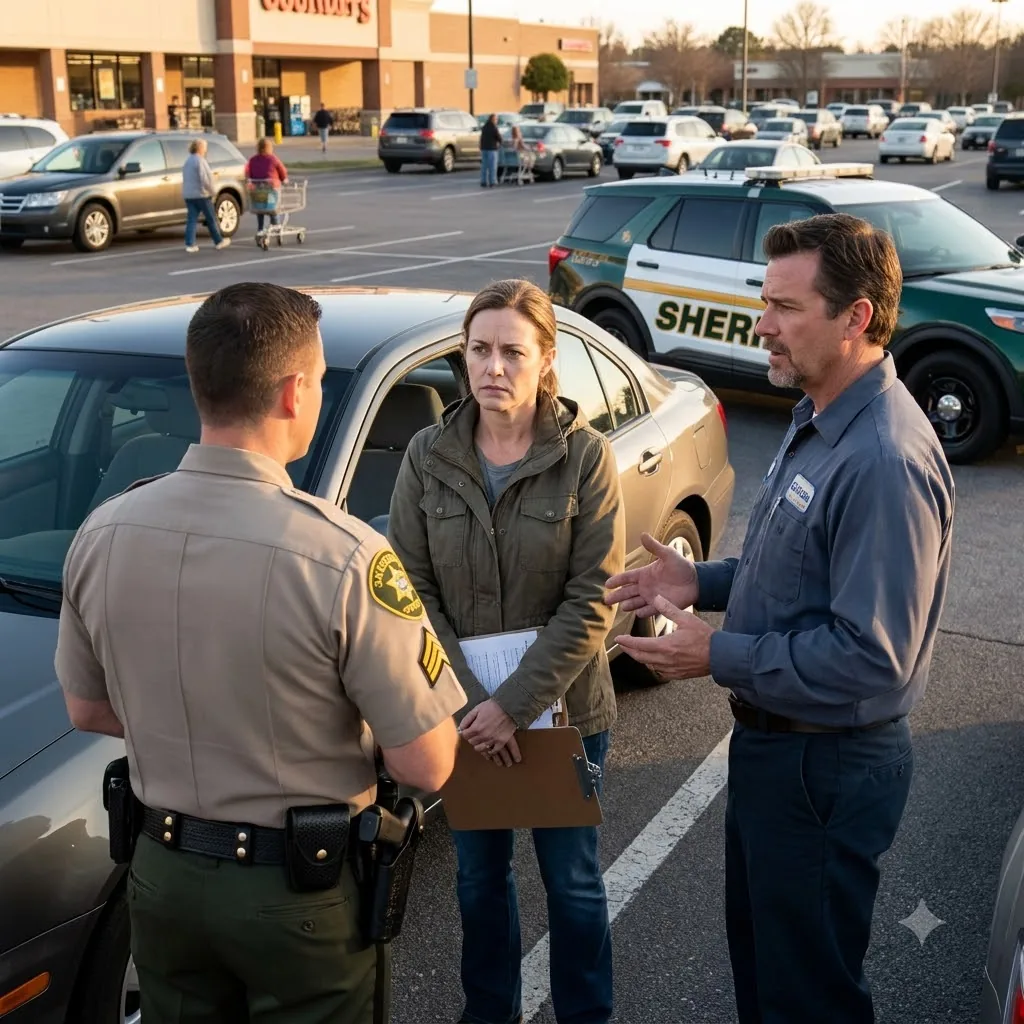
According to the security footage and municipal audio logs reconstructed for this investigation, the incident in the Oakridge Grocery parking lot began at precisely 4:12 PM. Local resident Sarah Jenkins had just finished her weekly shopping, placing her reusable canvas bags into the trunk of her gray sedan, when her path of egress was suddenly cut off. Carl Vance, an off-duty county sheriff’s deputy wearing a faded polo shirt, jeans, and a utility belt, maneuvered his private pickup truck directly behind her vehicle, blocking her from reversing out of the standard parking stall. The reconstruction shows the ordinary activity of the suburban retail district continuing around them-shoppers pushing metal carts across the asphalt, the distant hum of traffic from the highway-while Vance stepped out of his truck and approached Sarah’s driver-side window. The afternoon sun cast long shadows across the faded yellow lines of the parking spaces. When Sarah rolled her window down, Vance announced, with an air of official authority, that she was legally prohibited from backing out due to a ‘restricted egress policy’ enforced during peak afternoon hours.
My review of the subsequent internal affairs file reveals the immediate process gaps in Vance’s action. He had not logged his off-duty location with dispatch, nor did he possess the authority to enforce private store rules. When Sarah, maintaining a controlled and unhurried cadence, asked Vance to produce the written policy or point to a posted warning sign, he simply tapped his utility belt and claimed the rule was standard protocol for the shopping center. Sarah’s fingers remained resting quietly on her steering wheel, her posture showing none of the agitation Vance seemed to expect from a citizen under pressure. As a software trainer, she was accustomed to walking people through rigid systems, and she treated Vance’s claims with the same systematic skepticism.
‘If there is a restricted egress policy for this row, why are other drivers reversing and leaving?’ Sarah asked. She pointed to a blue minivan three spaces down that was backing out without issue, followed immediately by a silver SUV.
Vance’s posture stiffened. On the security camera footage, his hand can be seen resting near his holster, a defensive physical gesture that contradicted his claims of routine administrative enforcement. He stood in the path of her car, silent for a moment as the silver SUV drove past his truck and exited the lot. When Sarah pressed him again for an explanation as to why the rule applied only to her vehicle, Vance could not explain the cross-application. He simply repeated his directive that she was to remain parked, his bureaucratic bluff offering no logical answer to the obvious contradiction.
The security video from the store’s primary outdoor camera captured the visual timeline of this impasse. At 4:15 PM, Vance is seen pacing near the rear bumper of Sarah’s sedan, occasionally glancing at his watch and looking toward the main entrance of the parking lot. His physical presence blocked any opportunity for Sarah to safely back out without risking a collision with his truck. The footage shows Sarah remaining inside her car, her window halfway down, maintaining a calm demeanor while Vance refused to move. The gap between his claimed store policy and the observable behavior of every other vehicle in the parking lot continued to widen. Shoppers in the adjacent rows backed out and drove away without any intervention, yet Vance remained anchored behind Sarah’s sedan, insisting that she was the only driver required to wait. When she asked him once more to explain why the rules did not apply to the five other vehicles that had departed during their conversation, Vance merely adjusted his utility belt, stared past her windshield, and stated that he was not obligated to explain operational procedures to her. He stood there, maintaining the blockade, as the physical contradiction of his asserted authority became completely undeniable.
According to the security footage and municipal audio logs reconstructed for this investigation, the incident in the Oakridge Grocery parking lot began at precisely 4:12 PM. Local resident Sarah Jenkins had just finished her weekly shopping, placing her reusable canvas bags into the trunk of her gray sedan, when her path of egress was suddenly cut off. Carl Vance, an off-duty county sheriff’s deputy wearing a faded polo shirt, jeans, and a utility belt, maneuvered his private pickup truck directly behind her vehicle, blocking her from reversing out of the standard parking stall. The reconstruction shows the ordinary activity of the suburban retail district continuing around them-shoppers pushing metal carts across the asphalt, the distant hum of traffic from the highway-while Vance stepped out of his truck and approached Sarah’s driver-side window. The afternoon sun cast long shadows across the faded yellow lines of the parking spaces. When Sarah rolled her window down, Vance announced, with an air of official authority, that she was legally prohibited from backing out due to a ‘restricted egress policy’ enforced during peak afternoon hours.
My review of the subsequent internal affairs file reveals the immediate process gaps in Vance’s action. He had not logged his off-duty location with dispatch, nor did he possess the authority to enforce private store rules. When Sarah, maintaining a controlled and unhurried cadence, asked Vance to produce the written policy or point to a posted warning sign, he simply tapped his utility belt and claimed the rule was standard protocol for the shopping center. Sarah’s fingers remained resting quietly on her steering wheel, her posture showing none of the agitation Vance seemed to expect from a citizen under pressure. As a software trainer, she was accustomed to walking people through rigid systems, and she treated Vance’s claims with the same systematic skepticism.
‘If there is a restricted egress policy for this row, why are other drivers reversing and leaving?’ Sarah asked. She pointed to a blue minivan three spaces down that was backing out without issue, followed immediately by a silver SUV.
Vance’s posture stiffened. On the security camera footage, his hand can be seen resting near his holster, a defensive physical gesture that contradicted his claims of routine administrative enforcement. He stood in the path of her car, silent for a moment as the silver SUV drove past his truck and exited the lot. When Sarah pressed him again for an explanation as to why the rule applied only to her vehicle, Vance could not explain the cross-application. He simply repeated his directive that she was to remain parked, his bureaucratic bluff offering no logical answer to the obvious contradiction.
The security video from the store’s primary outdoor camera captured the visual timeline of this impasse. At 4:15 PM, Vance is seen pacing near the rear bumper of Sarah’s sedan, occasionally glancing at his watch and looking toward the main entrance of the parking lot. His physical presence blocked any opportunity for Sarah to safely back out without risking a collision with his truck. The footage shows Sarah remaining inside her car, her window halfway down, maintaining a calm demeanor while Vance refused to move. The gap between his claimed store policy and the observable behavior of every other vehicle in the parking lot continued to widen. Shoppers in the adjacent rows backed out and drove away without any intervention, yet Vance remained anchored behind Sarah’s sedan, insisting that she was the only driver required to wait. When she asked him once more to explain why the rules did not apply to the five other vehicles that had departed during their conversation, Vance merely adjusted his utility belt, stared past her windshield, and stated that he was not obligated to explain operational procedures to her. He stood there, maintaining the blockade, as the physical contradiction of his asserted authority became completely undeniable.