Story code: ST-000195
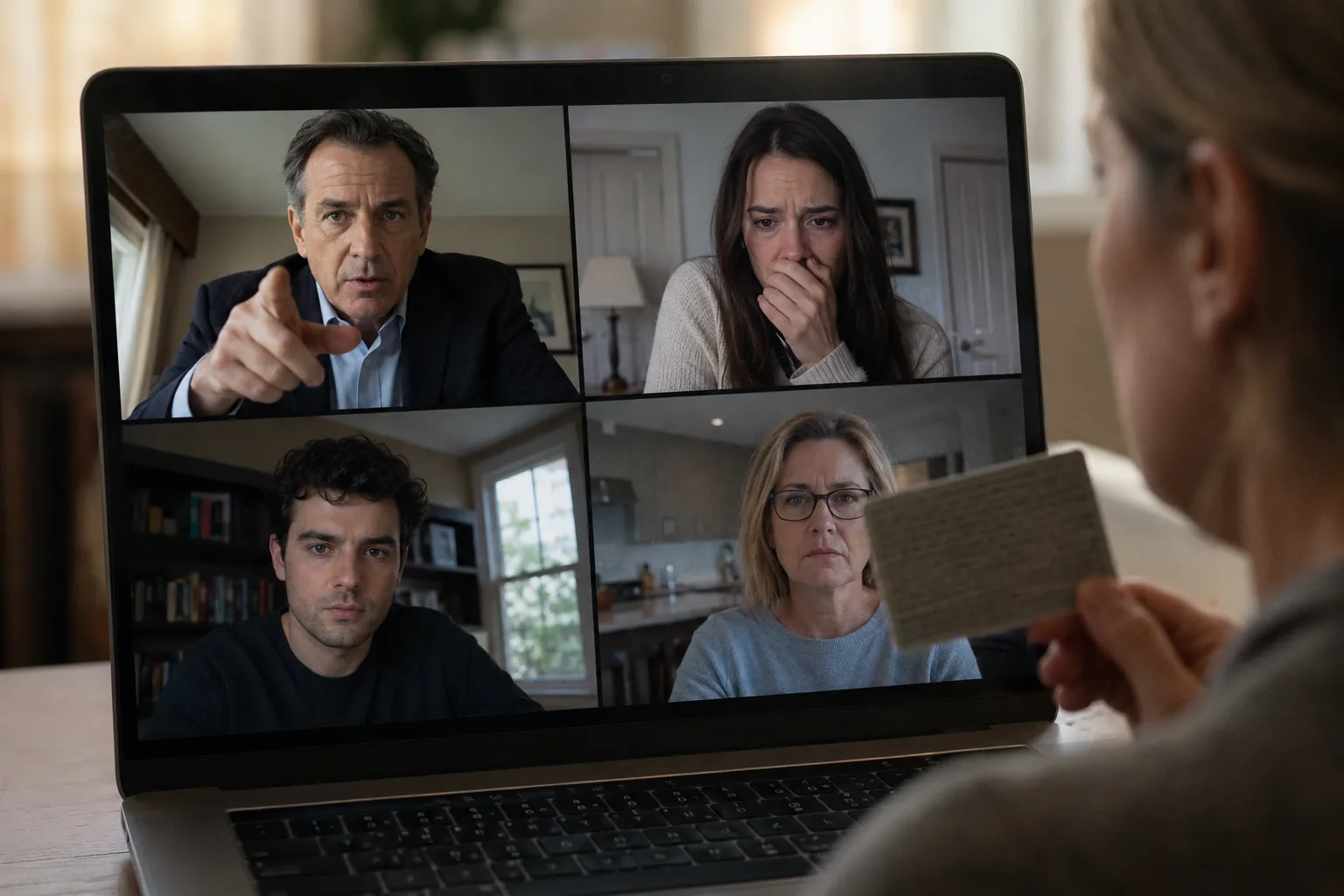
Part 4: The Record Got There Before His Explanation Did
The verification office stayed on the line while Renee asked for the case number, the asset type, and the exact claim being made on the call. I kept the call open in gallery view so everyone could see the same squares, the same clock, the same record indicator. Grant tried to step in twice before Renee finished the first question, and both times she told him to let the live test run. Dana had the private key card flat on the table now, one hand resting over the lower edge of it. Eli leaned close to his screen without speaking. I could hear a faint office hum through Renee’s line and the soft tap of keys. Nobody was making this dramatic. That made it worse. Renee said, “The claim presented to the family is an immediate exposure event tied to same-day loss if the private key card is not displayed or used now. Confirm or deny that language.” The voice on the other line did not rush. “I can confirm there is no active emergency notice on this estate account. There is no timed loss event in the system record. Any transfer or recovery step requires standard review and direct authorization.” Nobody spoke for a second. Grant moved first. He lifted both hands, palms out, and started talking fast enough to blur the first few words. “That is not the full context. The transfer is not what you think it is. The window was described to me as a preservation matter, and I was trying to keep the family from freezing access.” Renee did not turn away from the verification office. “Ask him to repeat the deadline claim in the simplest words possible.” I did not have to. The line was already recording everything. The verification office said, “I can repeat what I see: there is no active emergency requiring immediate display of a private key card on this call. If anyone is asking for that, stop and use the standard process.” Dana pushed the card a few inches away from her laptop, not toward Grant, just out of the center of her own frame. Eli let out one short breath and said, “So there was no deadline.” Grant cut in. “You are taking one office view and treating it like a final ruling. That is not responsible.” Renee kept her voice level. “It is enough to stop the emergency language.” He started a second explanation, and this one went nowhere faster than the first. He said there had been a misunderstanding of the platform. He said the family had been told to act before a lock event. He said he had not intended anyone to break policy. But the line from the office was still open, still clear, still saying the same thing with the same calm voice: no active emergency, no timed loss event, standard review only. That was when Grant tried to stop the help he had asked for. He turned toward me and said, “Drop the outside line now. This is not appropriate for a live family call.” Renee answered before I could. “The live test is already in the record.” Grant looked directly into his camera and then off it again, trying to find a side channel in the same room. “Do not continue that statement,” he said. “We need to preserve privacy.” The verification office replied, “There is no active emergency to preserve by urgency. Remove the pressure and submit through the normal estate process.” Grant shook his head once, then twice, as if the motion itself might erase the transcript. He asked if the office was sure. He asked whether they were looking at the right file. He asked whether there might be a separate hold not visible to front-line staff. Each question came with less force than the last. Renee answered him with the same procedural calm. “You brought them into the call to support the deadline. They just said the deadline does not exist in their record.” Dana picked up the private key card, turned it over once, then set it facedown beside the laptop. No one told her to. She simply did it after the verification office spoke. The object had stopped carrying the room. I opened the meeting note field and typed while the voices kept going. Standard review only. No emergency verified. No card display authorized. Pressure based on unconfirmed deadline. I could hear Grant still trying to make the call sound unstable, but the record was already settling into a different shape. Renee asked one final question, and it was the cleanest one of the morning. “Grant, did you have any live confirmation that would justify the emergency language you used on this call?” He did not answer right away. When he finally spoke, the words came slower and more careful, like they had to pass through a narrow door. “I was acting on information I believed to be time-sensitive.” “That is not confirmation,” Renee said. The verification office added, “Please note for the record: any same-day action must be suspended until standard authorization is completed.” That sentence landed as the consequence. Not a fight, not a speech. A status change. The account path that Grant had been pushing the family toward was no longer available under emergency handling. The card on the table stayed there, unused. The call stayed open long enough for Renee to dictate the next note into the record. Grant stopped trying to interrupt after that. He sat with his hands out of frame, his mouth closed, while the meeting note populated on my screen line by line. I read the final entry back into the call exactly as it appeared: no emergency confirmed, no immediate action authorized, estate process returned to standard review. Nobody celebrated. Dana just kept her hand beside the card. Eli looked from the note to Grant and back again. Renee said she would send the administrative follow-up after the call. I clicked save on the record, and the.