Story code: ST-000195
Part 2: The Help He Asked For Could Not Be Allowed In
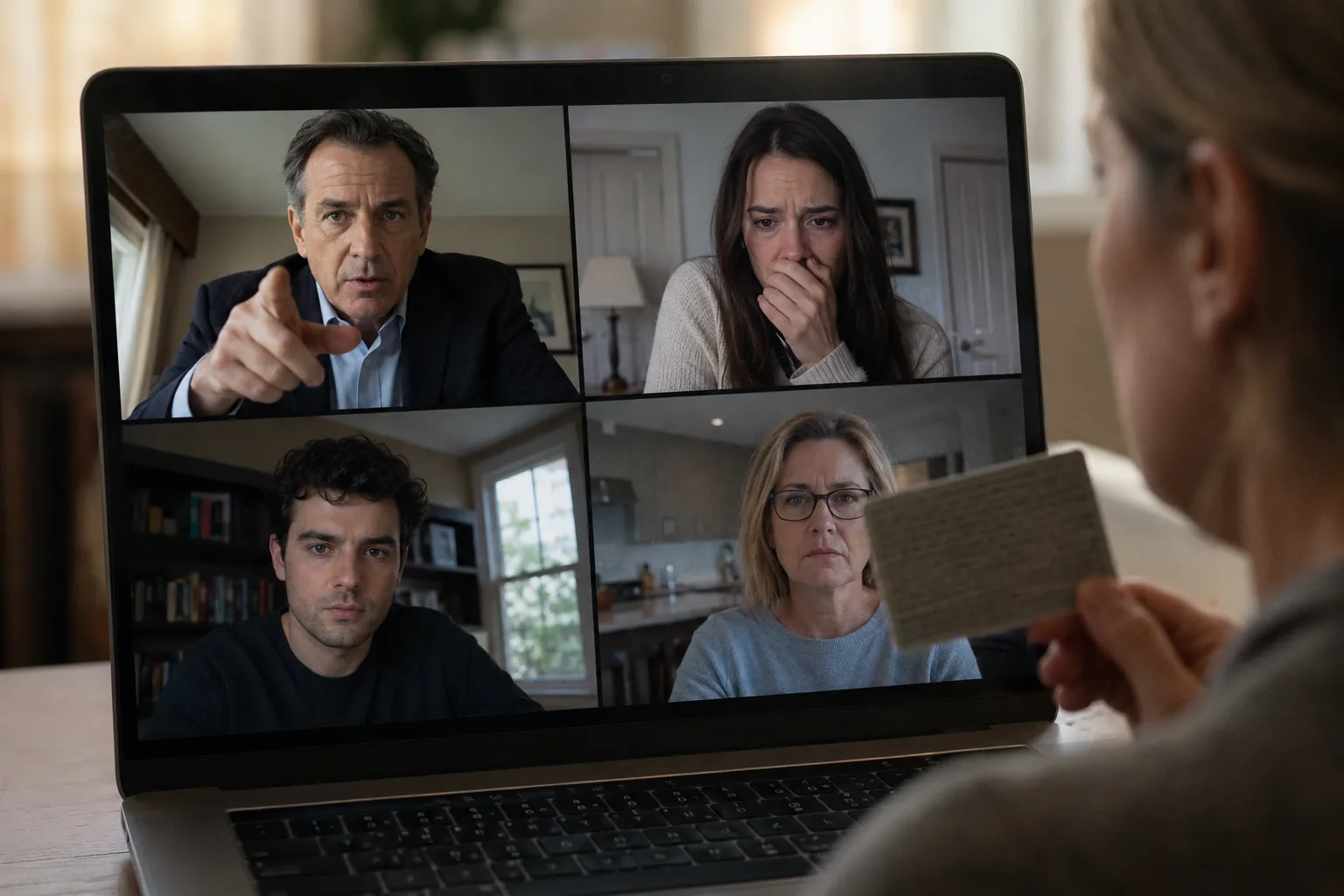
Grant had spent twenty minutes telling the Mercer family a crypto deadline would erase part of the estate unless Dana showed the private key card and followed him immediately. The second the verification office called my line back, he told me not to patch them into the estate video call. I was staring at the participant list, his square at the top of the screen, and the red recording icon while Eli said the contradiction out loud before I could.
“No,” Eli said. “You don’t get to do that.”
Grant lifted one hand toward his camera as if he could settle everybody by flattening the air. “Please let me finish. If Marisol adds a general line without preparation, we risk creating a hold event that freezes access.”
“You just said we needed the verification contact,” Dana said.
“I said there is a contact point,” Grant replied. “That is different from dropping someone blind into a live exposure situation.”
I kept my voice even. “The caller identified the office and gave a case reference. They said they can confirm what kind of event, if any, is attached to the wallet administration process.”
Grant cut in before I finished the sentence. “Do not connect them until I frame the issue properly.”
It changed the pace of the call. Up to then he had controlled the rhythm by talking faster than anyone else. Now every sentence from him had to step around words he had already used. Eli started repeating the timeline with the blunt patience of someone setting cups in a row.
“You said there’s a timed exposure. You said routine steps are too slow. You said outside verification exists. Now the outside verification is calling back and suddenly they can’t come on unless you script it first.”
Grant looked off to one side of his screen, then back. “Because misunderstanding the technical posture can trigger unnecessary restrictions.”
Dana had the card in her hand now, but she kept it below camera level. She asked, “Is the card even needed for them to answer a basic question?”
Grant answered too quickly. “Eventually, yes.”
“That wasn’t my question,” she said.
I could see the card edge flash white when she turned it in her fingers. It had become the center of everything on the call. Every time Grant talked, he moved the conversation back toward that card, toward showing it, positioning it, confirming it, doing something immediate with it before anybody independent was allowed to narrow the claim.
The verification line was still on hold with me. I told the group, “I can ask one limited question without sharing any credentials or displaying the card. We can keep it procedural: whether there is an active deadline requiring immediate family action on this call.”
Grant leaned closer to his camera. “Marisol, I am directing you not to do that yet.”
There was a short silence after that. Not long, maybe two beats. Long enough for the wording to sit there on the recording.
Eli said, “Directing her under what authority?”
Grant ignored him and spoke to Dana again. “Listen to me. If this window closes while we debate process, that loss sits on the family. I need visual confirmation of the card now.”
Dana shook her head once. “No. If they can answer without the card, they answer without the card.”
I asked Grant a narrow question. “Did the outside office issue the deadline notice to you directly, yes or no?”
He paused. It was the first full pause he had taken all call.
“I was informed of the urgency through the management channel,” he said.
Eli laughed once, with no humor in it. “That is not yes.”
Grant started explaining in bigger and bigger circles. Exposure posture. Platform sensitivity. Escalation risk. Preservation path. He used so many words the original claim got thinner instead of stronger. Dana stopped reaching for the camera. She set the private key card flat on the table beside her laptop and put two fingers on top of it like she was claiming physical custody in plain sight.
I told the room, “I’m going to state the next step clearly. I can either keep the verification office on hold, or I can admit them and ask whether any immediate action on this call is required before standard review. No card image, no screen control, no credentials.”
Grant said, sharper now, “If you do that, you may compromise the estate’s position.”
“If I don’t do that,” Eli said, “we are just taking your word while you try to get her to show the one thing you keep circling back to.”
Dana looked into her camera and said, “Add them.”
Grant talked over her. “Dana, do not authorize that until I explain the downstream consequence.”
“Add them,” she said again.
I moved my cursor to the admit button. Grant was still speaking, but he had lost the room. His voice was louder, his phrases less clean, and now he was trying to narrow what kind of question could even be asked. He wanted the help in theory, not in the call, not on the record, not in a way that could test anything while the private key card stayed out of his reach.
When I brought the line in, a new square appeared with the name Renee Patel. She had a headset on, a neutral background, and a case screen reflected faintly in her glasses. She did not greet anyone with urgency. She asked for the estate reference, the exact wording of the claimed deadline, and whether any private recovery material had already been displayed.
Nobody answered before Grant did.
And the first thing he said to the person he had claimed they needed was, “This isn’t really the forum for that question.”