Story code: ST-001344
Part 1: The Signature on the Wall
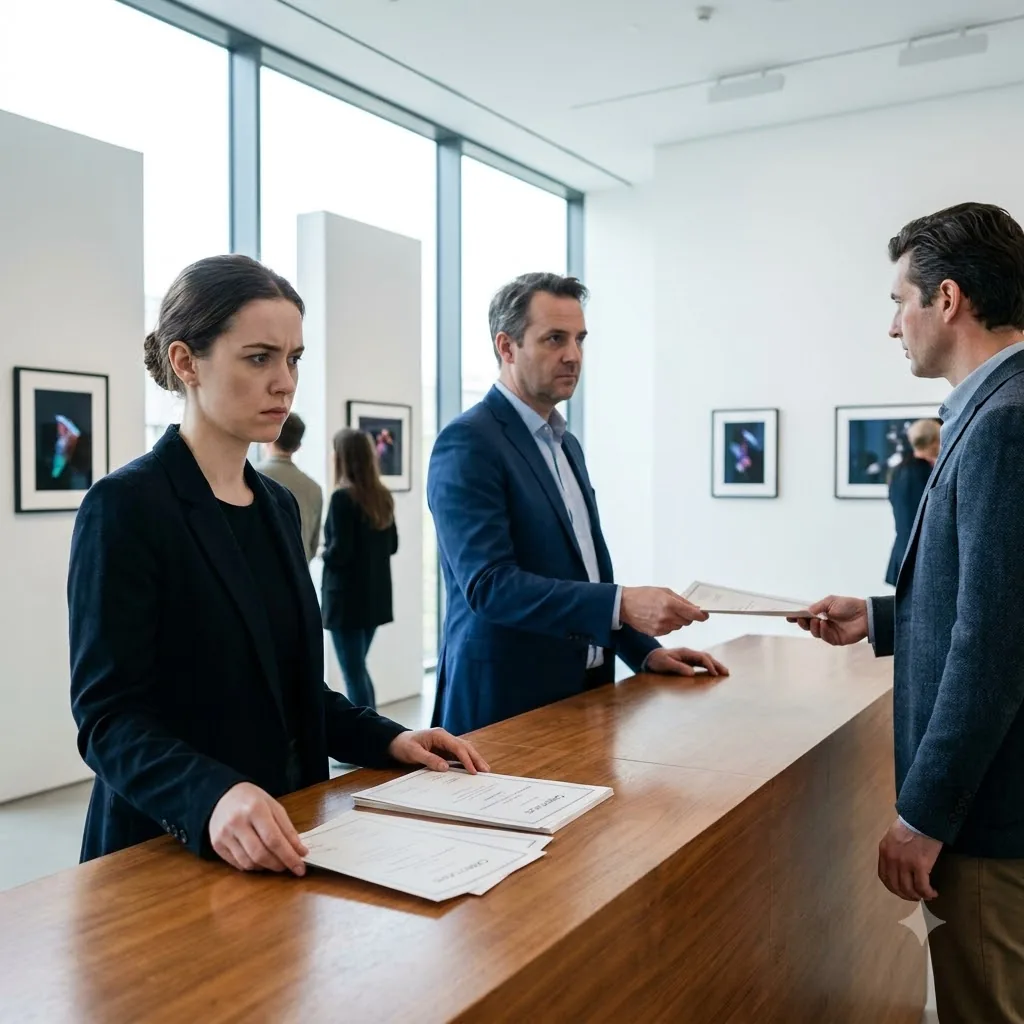
As I laid out the glossy print certificates of authenticity on the mahogany display counter of the Apex Gallery, I watched Julian, our head curator, hand the lead investor a document that credited himself as the sole creator of the revolutionary AI art collection, completely erasing Evelyn’s months of coding and model training right in front of her. Evelyn stood rigid beside the buffet table, her fingers white around her glass, watching Julian point to the high-resolution canvases hanging on the gallery walls. The gallery preview was in full swing, with guests in tailored suits and silk dresses drifting between the glowing screens, murmuring appreciatively. The collection, titled “Digital Terrains,” had already generated massive buzz in the digital art scene.
Julian gestured toward the largest canvas, a swirling vortex of neon copper and deep obsidian that seemed to shift depending on the angle of the light. “I spent weeks refining the latent space transitions,” Julian said, his voice carrying easily over the soft jazz playing through the gallery speakers. “It was a matter of finding the precise prompt syntax to force the model past its usual algorithmic boundaries. I wanted to capture the texture of physical brushstrokes in a digital medium.”
I picked up one of the print certificates from the counter to align it with the gallery wall display. The heavy, gold-embossed paper bore the gallery’s official seal, but the line labeled “Creator and Keyholder” did not contain Evelyn’s name. In bold, printed script, it read: Julian Vance. Evelyn took two slow steps toward the counter, her gaze locked on the certificate in my hands. She did not raise her voice, but her tone was sharp enough to make the assistant curator next to her turn around. “Julian,” she said, “the metadata on the registry still points to my local training weights. We agreed the certificates would reflect the original developer signature.”
Julian did not look at her directly. Instead, he smiled warmly at the wealthy tech investor standing beside him. “Evelyn is our administrative assistant,” Julian told the investor, patting Evelyn’s shoulder with a brief, heavy hand. “She kept the servers running and managed the directory structures while I was generating the core assets. We couldn’t have kept the hardware cool without her.”
The investor, Marcus, nodded, though his eyes remained fixed on the glowing canvas. He was known in the digital art world for his technical rigor; he didn’t just buy art, he bought the underlying code and exclusive rights to the generation pipeline. “The prompt architecture must be fascinating,” Marcus said, stepping closer to the display. “Most models struggle with the mathematical consistency of the lighting in this collection. Julian, how did you handle the weight distribution for the custom LoRA?”
Julian’s smile faltered for a fraction of a second, his eyes darting toward the digital registry tablet sitting on the work counter. “Well, Marcus, it’s a proprietary combination of noise scheduling and seed manipulation. I find that over-complicating the technical explanation sometimes detracts from the emotional reality of the piece.”
Marcus tilted his head, his brow furrowing. “I’m not looking for an emotional explanation, Julian. I’m looking to buy the entire collection and its commercial rights tonight. But before I write a check of this size, I need to see the model run a live modification block. I want to see you adjust the prompt workflow right here on the gallery terminal to verify the authenticity of the weights.”
Julian’s hands dropped to his sides, his fingers twitching against his trousers. He looked at the terminal, then at Evelyn, who stood perfectly still, her face devoid of expression.
As I laid out the glossy print certificates of authenticity on the mahogany display counter of the Apex Gallery, I watched Julian, our head curator, hand the lead investor a document that credited himself as the sole creator of the revolutionary AI art collection, completely erasing Evelyn’s months of coding and model training right in front of her. Evelyn stood rigid beside the buffet table, her fingers white around her glass, watching Julian point to the high-resolution canvases hanging on the gallery walls. The gallery preview was in full swing, with guests in tailored suits and silk dresses drifting between the glowing screens, murmuring appreciatively. The collection, titled “Digital Terrains,” had already generated massive buzz in the digital art scene.
Julian gestured toward the largest canvas, a swirling vortex of neon copper and deep obsidian that seemed to shift depending on the angle of the light. “I spent weeks refining the latent space transitions,” Julian said, his voice carrying easily over the soft jazz playing through the gallery speakers. “It was a matter of finding the precise prompt syntax to force the model past its usual algorithmic boundaries. I wanted to capture the texture of physical brushstrokes in a digital medium.”
I picked up one of the print certificates from the counter to align it with the gallery wall display. The heavy, gold-embossed paper bore the gallery’s official seal, but the line labeled “Creator and Keyholder” did not contain Evelyn’s name. In bold, printed script, it read: Julian Vance. Evelyn took two slow steps toward the counter, her gaze locked on the certificate in my hands. She did not raise her voice, but her tone was sharp enough to make the assistant curator next to her turn around. “Julian,” she said, “the metadata on the registry still points to my local training weights. We agreed the certificates would reflect the original developer signature.”
Julian did not look at her directly. Instead, he smiled warmly at the wealthy tech investor standing beside him. “Evelyn is our administrative assistant,” Julian told the investor, patting Evelyn’s shoulder with a brief, heavy hand. “She kept the servers running and managed the directory structures while I was generating the core assets. We couldn’t have kept the hardware cool without her.”
The investor, Marcus, nodded, though his eyes remained fixed on the glowing canvas. He was known in the digital art world for his technical rigor; he didn’t just buy art, he bought the underlying code and exclusive rights to the generation pipeline. “The prompt architecture must be fascinating,” Marcus said, stepping closer to the display. “Most models struggle with the mathematical consistency of the lighting in this collection. Julian, how did you handle the weight distribution for the custom LoRA?”
Julian’s smile faltered for a fraction of a second, his eyes darting toward the digital registry tablet sitting on the work counter. “Well, Marcus, it’s a proprietary combination of noise scheduling and seed manipulation. I find that over-complicating the technical explanation sometimes detracts from the emotional reality of the piece.”
Marcus tilted his head, his brow furrowing. “I’m not looking for an emotional explanation, Julian. I’m looking to buy the entire collection and its commercial rights tonight. But before I write a check of this size, I need to see the model run a live modification block. I want to see you adjust the prompt workflow right here on the gallery terminal to verify the authenticity of the weights.”
Julian’s hands dropped to his sides, his fingers twitching against his trousers. He looked at the terminal, then at Evelyn, who stood perfectly still, her face devoid of expression.