Story code: ST-001080
Part 2: The Quota Leverage
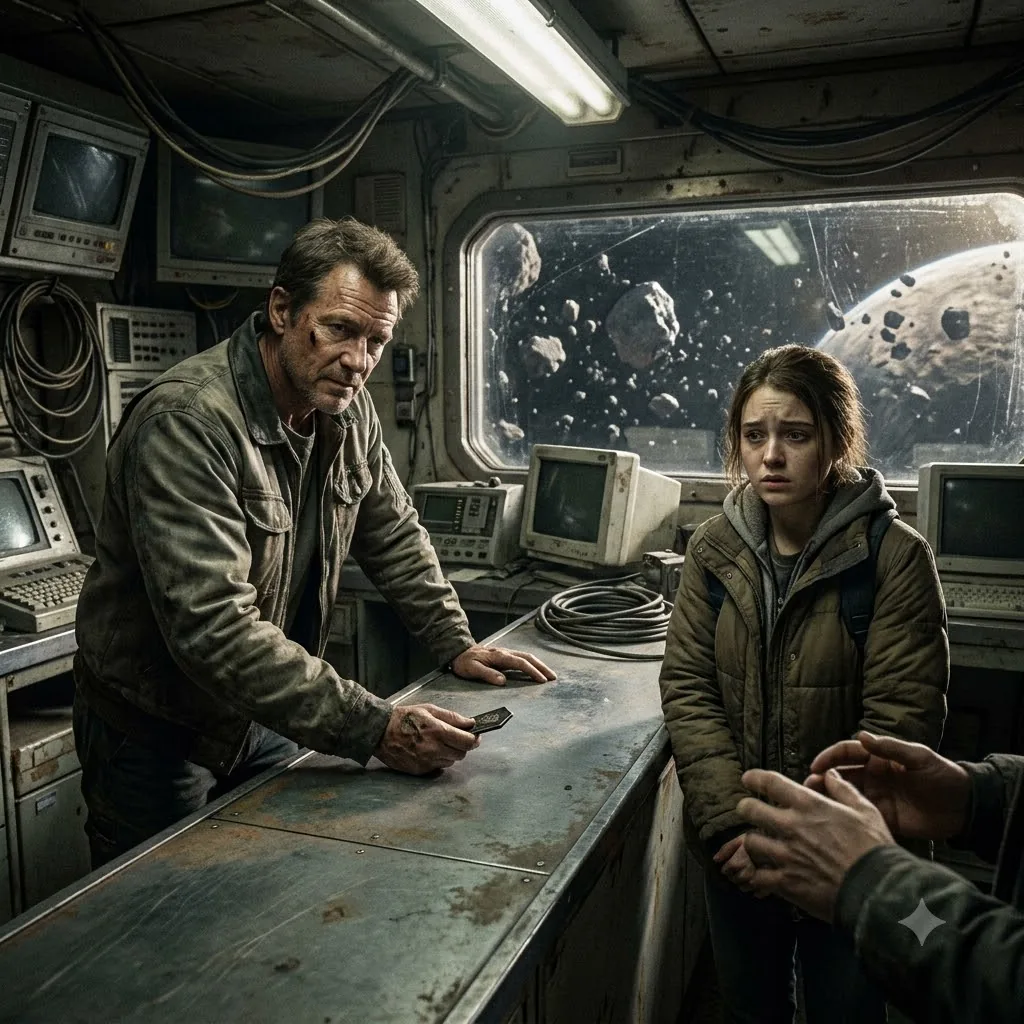
I pulled my portable datapad from my work vest and synced it with the office’s public registry node, bypassing Marcus’s private terminal lock. Marcus didn’t move to stop me; he simply sat there, checking his fingernails, confident that the threat of a registered delinquency would force my hand. Clara shifted her weight, her eyes darting from my screen to the broker, her mouth set in a thin line.
I accessed the historical shipping manifest archives for Caelum Station. Because brokers operated under public licenses, their basic transit logs were open record, even if the financial details of their contracts were encrypted. I scrolled back to December of last year, filtering the search for Marcus’s brokerage registration number.
The registry showed that Marcus’s primary broker license had been under a strict corporate review during that exact quarter. According to the station charter, any broker who failed to maintain a minimum of three active supply runs to the outer sectors every thirty days faced immediate revocation of their shipping lane access.
“Clara, look at the registry timeline,” I said, turning the datapad so she could see the screen. She leaned in, her eyes scanning the columns of dates and cargo codes.
“Look at the fine print on the charter,” I pointed to the station authority’s compliance clause. “A broker must maintain continuous outer-sector logistics or forfeit their docking priority. On December eleventh, Marcus’s status was flagged as ‘pending suspension.’ If he didn’t clear that flag by the twelfth, his creditors would have moved in.”
On December twelfth, Marcus had only logged two outer-sector runs for the month. He had less than twenty-four hours left on his cycle before the station authority ran the automated compliance check. If he didn’t log a third delivery, his entire brokerage operation would have been shut down by the corporate registry before the new year. The fuel he sent us wasn’t a rescue mission or an act of charity. It was a desperate, last-minute flight to satisfy his own licensing quota. He had dumped the fuel on us because we were the closest ship in Sector Four that could sign for a delivery, saving his business from a catastrophic contract default.
Clara let out a short, sharp breath. She looked at Marcus, then back to the datapad. “He didn’t just save his license,” she said quietly. “He used our rig as a compliance shield, and now he wants us to pay for it.”
I looked up from the pad. Marcus was watching me now, his relaxed posture stiffening. He stopped tapping his fingers against the desk.
“You didn’t send that fuel to save us, Marcus,” I said, sliding the datapad onto the counter next to our claim token. “You sent it because if that shuttle hadn’t docked with our rig and logged a cargo transfer before the midnight cycle, you would have lost your broker license.”
Marcus’s eyes narrowed, the friendly warmth vanishing from his face as he reached out to pull the claim token closer to his side of the terminal. The hum of the docking bays outside felt louder in the sudden silence of the office, and I knew we had him cornered by his own history.