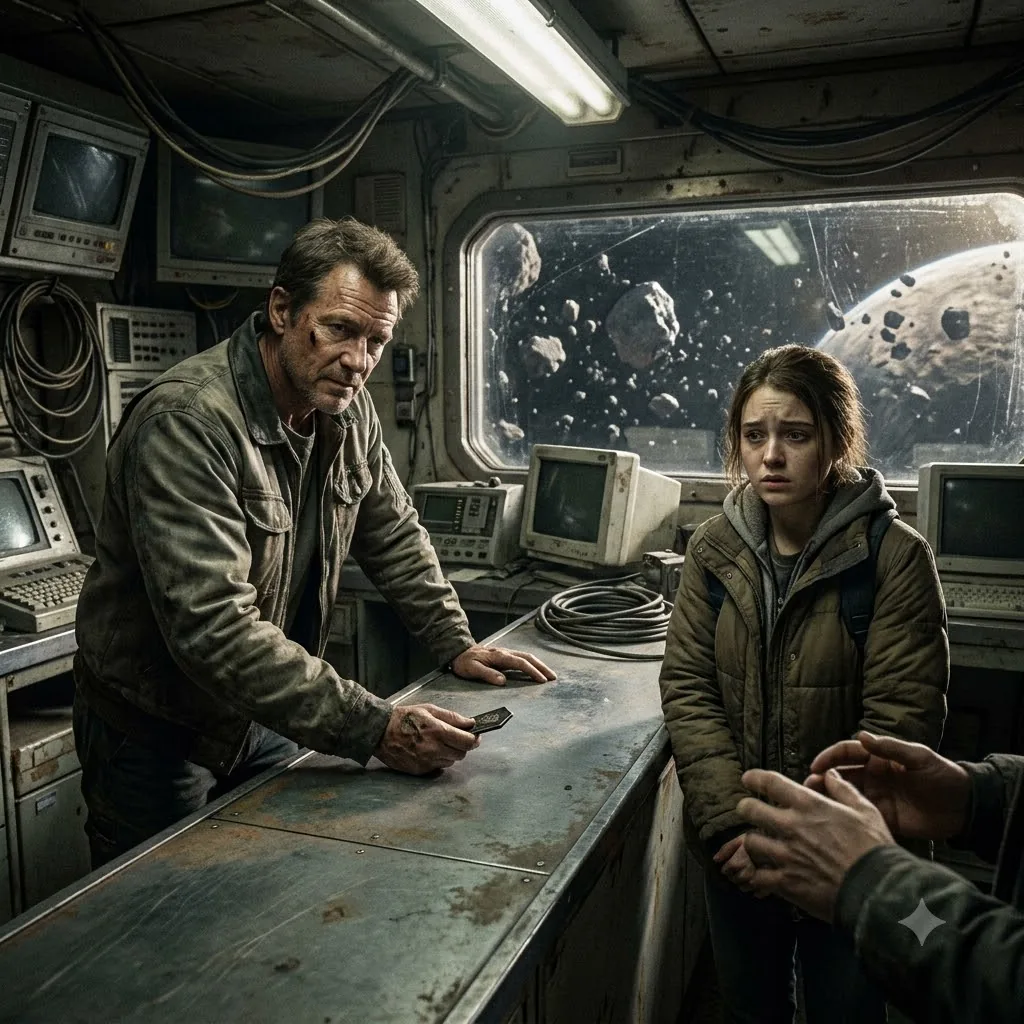
Story code: ST-001080
Part 3: The Quota Trap
Marcus’s fingers twitched over the edge of the terminal. The easy, patronizing smile he’d worn since we walked into the office had completely vanished, replaced by a tight, defensive pull around his jaw. He didn’t look at the datapad. He looked at me, his eyes cold and calculating.
“You’re drawing conclusions from public logs that don’t tell the whole story, Leo,” he said, his voice dropping its neighborly tone, settling into a flat, clipped register. “The station authority has algorithms. They flag compliance all the time. That doesn’t change the fact that my transport hauled fifty thousand credits’ worth of high-grade fuel to your coordinates. You accepted the line connection. You burned the fuel. You owe the brokerage.”
“We accepted the connection because your automated shuttle matched our safety beacons and initiated a standard emergency override,” Clara said, leaning over the counter, her voice sharp. “We didn’t run the pumps. Your system did. And now we know why. You didn’t even wait for a manual signature.”
I tapped the terminal screen, pulling up the detailed system log from the day of the delivery. “Look at the timestamps, Marcus. December twelfth. At 04:00, the station authority issued a terminal alert to your account. Your third mandatory outer-sector run was overdue. If you didn’t have a verified transfer receipt logged by 04:15, your license would have defaulted at the morning system sweep.”
I pointed to the secondary line on the screen. “At 04:02, your automated shuttle left the dock. At 04:10, it forced a docking connection with our rig and dumped the fuel into our reserve tanks. The automated receipt cleared in the station ledger at 04:12. Exactly three minutes before your license would have been suspended.”
Marcus stood up slowly, leaning his hands flat on the desk. He didn’t deny it. Instead, he leaned forward, trying to use his height to crowd us. “It doesn’t matter. The station ledger shows a completed transaction. A delivery of goods to your vessel. If I register a claim dispute over that delivery, the system automatically freezes your mining token until an arbitrator reviews it. That takes three months, Leo. Your crew doesn’t have three weeks of operating capital. You’ll go under before the registry even assigns a mediator to the case.”
He was right about the timeline. The station bureaucracy was notoriously slow, designed to favor established brokers over independent miners. He was trying to use the threat of the system’s sluggishness to force us to hand over the token anyway.
“I’m offering you a clean slate,” Marcus said, his voice dropping to a low murmur. “Give me the claim token. I’ll clear the winter ledger, and you can keep working the lane. Otherwise, I file the dispute right now, and you can watch your crew starve while you wait for a hearing.”
He reached out, his hand hovering inches from the magmatic silicate mineral claim token sitting on the steel counter. The heavy slab of rock, etched with the registry codes of our new claim, lay between us like a physical boundary. My hand rested near it, my fingers catching the cold, rough texture of the silicate.
I didn’t pull the token back, but I didn’t push it toward him either. I kept my eyes on his terminal screen, where his broker account details were still active. I had one card left to play, a direct rule in the broker code of conduct that he had overlooked in his rush to secure his license. I reached for my datapad, ready to input the system override command.