Story code: ST-000735
Part 2: When the Story Changed Shape
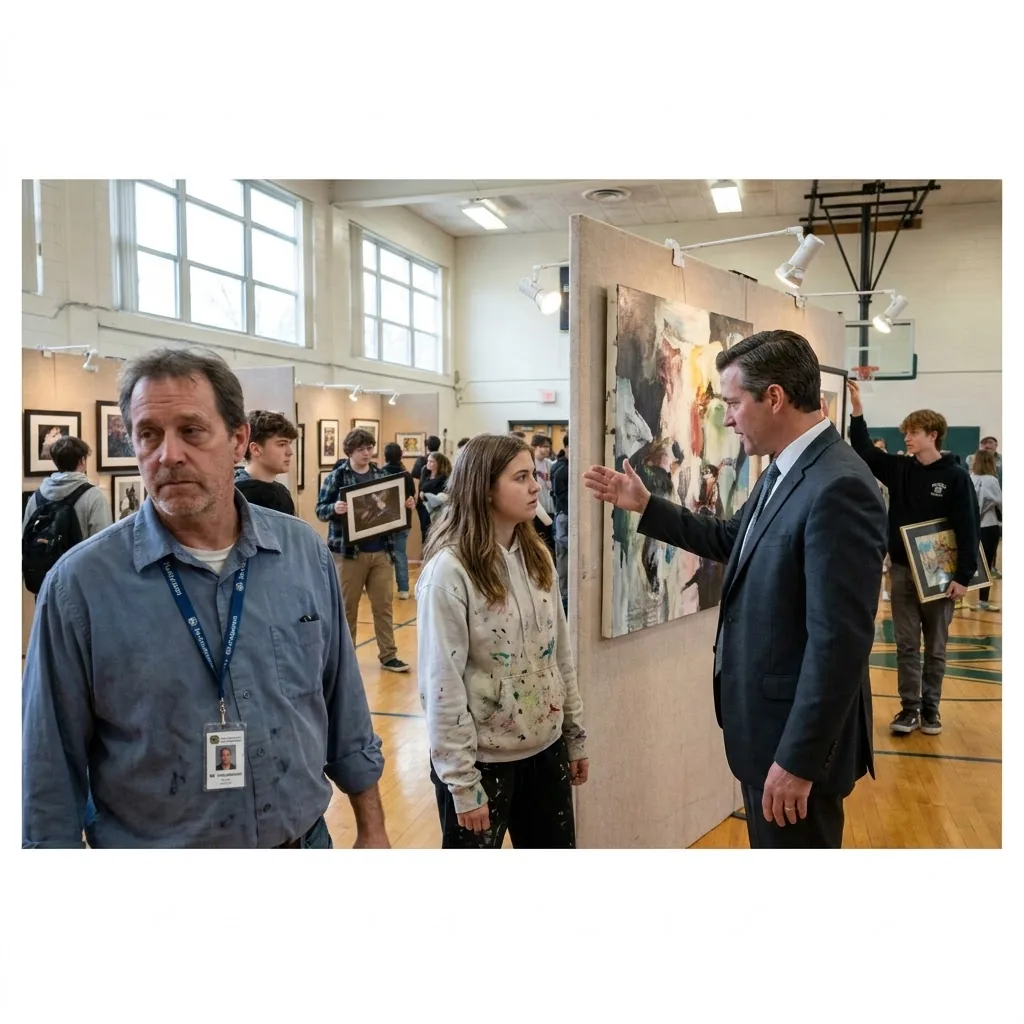
By the time Ms. Ortega reached the center table, the whole room had gone quiet enough that I could hear the tape dispenser clicking in my hand. Mr. Hale was still standing beside Dina and the canvas roll, but he had shifted his weight back onto one foot and folded his arms so tight they pressed flat against his shirt. He kept glancing at the doorway where the front office staffer had stopped, radio still in hand, waiting for Ms. Ortega’s next word.
Ms. Ortega did not raise her voice. She asked the same question twice: what exactly was the emergency, and who had asked for it to be handled this way. Mr. Hale answered with fragments. He said there had been a problem. He said it needed immediate attention. He said he had been trying to keep things from getting worse. Every time Ms. Ortega asked for the same claim in plain language, his answers got shorter and less useful. He looked at the canvas roll, then at the display wall, then away from both.
Dina still had one hand on the roll. She did not move it. She looked at the clock again, then at the front office staffer, then at Ms. Ortega. Ms. Ortega asked Dina to step back from the wall and keep the roll exactly where it was until the situation was clear. That was the first time in the whole exchange that anyone gave an instruction that did not depend on Mr. Hale’s version of events. Dina stepped back one pace and kept her eyes on the roll.
The staffer at the doorway lifted the radio and said a name into it, then repeated the same call in a flat, careful voice. Not urgent. Not loud. Just exact. The words were enough to change the room. Two parents at the far end of the display area stopped talking. One volunteer quit stacking program sheets and looked over. The room had gone from reacting to Mr. Hale’s pace to waiting on Ms. Ortega’s.
That was when the first crack showed in his story. Ms. Ortega asked whether anyone had verified the problem he was describing. Mr. Hale answered too quickly that it was already handled, then immediately said it still needed attention, then said no one should make a scene in front of students. He kept talking, but none of it lined up with the earlier demand to leave right away. The more he talked, the more he sounded like he was trying to move the room away from the question instead of answering it.
Ms. Ortega wrote something on the clipboard she had brought from the teacher table. I could see her pen moving, but not the page. She asked for the time Mr. Hale had first made the call, who had been present, and what had been said when he asked for help. She did not argue. She did not repeat his language back to him. She just kept the questions narrow and close to the facts everyone in the room could hear. He answered some of them and skipped others. When he skipped them, he looked at the doorway again.
The staffer finally stepped all the way in with the radio and said she had no record of the kind of emergency Mr. Hale was describing. She did not say it with drama. She said it the way someone says a line from a checklist. Mr. Hale opened his mouth, closed it, and then tried to pivot back to Dina and the art show deadline, as if the pressure had always been about the display and not the call he had made. But now he was the one who had to explain why he had pulled half the room into a fake rush over the canvas roll.
Ms. Ortega told him to stay where he was and let her finish documenting the sequence. That is when he stopped looking at the doorway and started looking at the floor. The canvas roll was still beside the display wall, untouched except for Dina’s hand at the end of it, and the staffer’s radio had already made the first claim wobble in front of everyone. I was still holding the tape, and for the first time all night, nobody was asking Dina to move the work. The question hanging in the room was simpler and worse: if there was no real emergency, what exactly had he been trying to force her to abandon?