Story code: ST-000735
Part 4: The Line on Paper
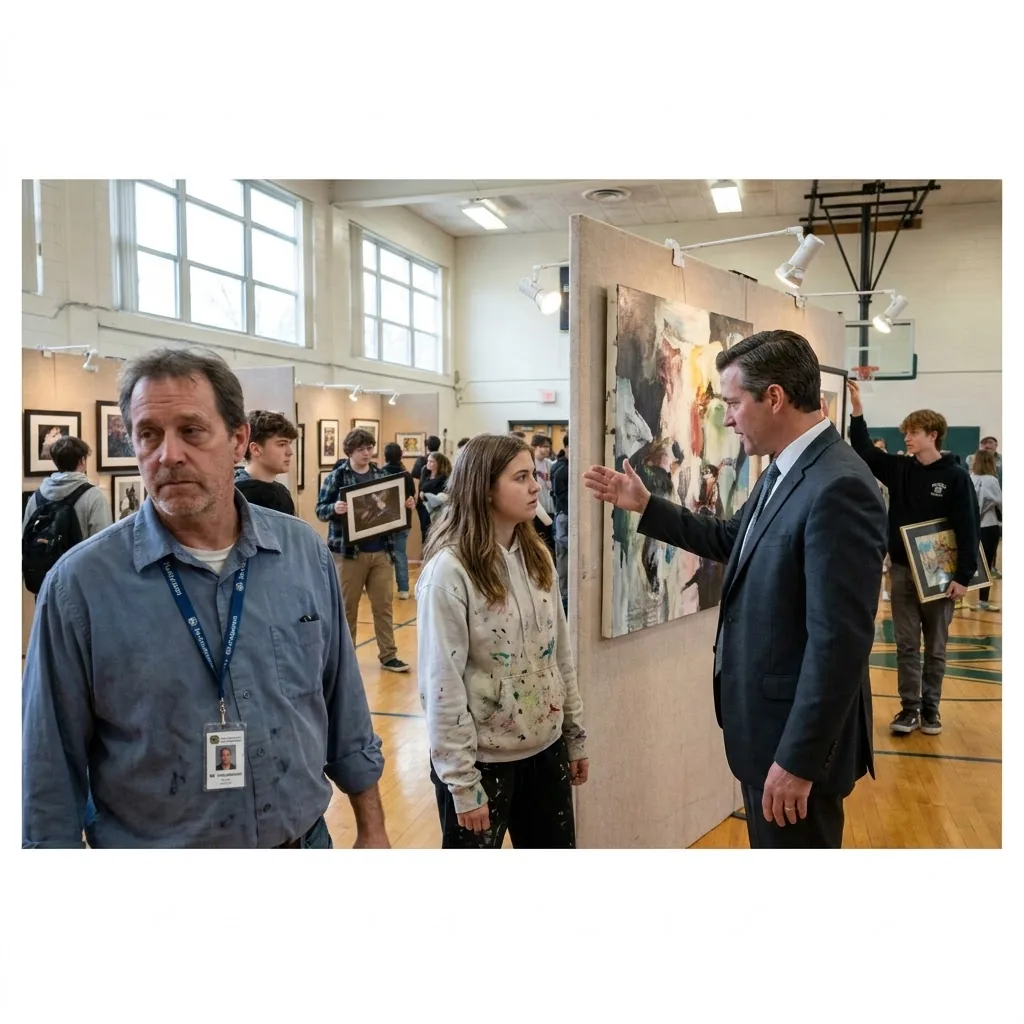
Ms. Ortega asked everyone to give her space at the teacher table, and she moved one chair over so the clipboard sat flat under the light. The front office staffer stayed beside her, and the second staff member stood just inside the doorway with the phone still in her hand. Mr. Hale did not get to stand over Dina anymore. He was guided back a few feet, into the open strip between the display wall and the art show table, where everyone could see his hands when he spoke.
Ms. Ortega read back the sequence line by line. Time of call. Name used. Location given. Claimed emergency. Staff arrival. Contradicting instructions. Each line came out even and plain, the kind of voice that takes the heat out of a room because it refuses to chase anybody. Mr. Hale tried to interrupt twice. Both times she lifted one finger and kept reading. When she finished, she asked him whether he wanted to correct anything in the written record. He started to talk and then stopped when the front office staffer set the radio down beside the clipboard like a weight.
That was the moment the exact help he had requested turned into the thing he could not control. The staff member who had first entered the room said the call would be noted as a non-emergency misuse of school response time unless he clarified it right then. He looked at her, then at Ms. Ortega, then at the canvas roll in Dina’s hand. He tried one last time to soften it by saying he had only been trying to avoid embarrassment in front of students. Ms. Ortega did not answer that. She asked whether he wished to stand by the record as written or withdraw his request for intervention and leave the art show area alone.
He did not answer fast enough. So she made the next step concrete. She told him, in the same steady tone, that his visitor role for the evening was removed and that he was not to approach the display wall, the setup table, or Dina until the matter was reviewed with the school office. The second staff member wrote that restriction on a yellow note card and slid it across the teacher table where everyone could see it. It was not dramatic. It was worse for him because it was official.
Ms. Ortega then turned to Dina and asked her, in front of the room, whether she wanted the canvas roll moved back onto the display line and the show continued without interruption. Dina nodded once. No speech. Just the nod. Two volunteers from the other end of the room came over, one holding gloves and the other a fresh strip of tape. They took the roll carefully and set it against the wall the way it should have been from the start. Mr. Hale watched them do it, but he did not step in. The note card stayed on the table.
The front office staffer used the radio again, this time to cancel the response she had been sent to verify. Then she picked up the phone and made a separate call while Ms. Ortega finished writing the boundary into the incident log. I could see the pen move across the page. I could see the yellow card with his restricted visitor role on it. I could see Dina’s shoulders lower a little once the roll was back in place and the display line was being reset around it.
After that, the room changed speed. Not all at once, but enough. People started moving again without circling the center of the problem. One parent went back to the program stack. The volunteer nearest the door started checking tags again. Mr. Hale stood where he had been placed, looking from the note card to the doorway and back, while Ms. Ortega closed the clipboard and told him the matter was documented and done for the night. The art show lights stayed on. The canvas roll stayed where it belonged. And the only thing left of his emergency was the paper boundary sitting on the teacher table, plain enough for anyone to read.