Story code: ST-000875
Part 3: Code Red
Sarah’s palms scraped against the sharp, frozen clumps of earth, her blood mixing with the dark soil as she desperately smeared mud over the exposed curve of metal. The faint, hollow humming beneath her hands finally ceased as the backhoe operator cut his auxiliary power, but the damage was already done. The barricade-thick, heavy-gauge steel culvert half-pipes she had hauled in from an industrial salvage yard and buried under tons of topsoil-was partially visible.
She couldn’t let them see the steel. If they saw it, they would realize it wasn’t just a landscaping failure. They would realize it was a structural fortification. They would start asking questions about her state of mind. Worse, they would ask questions about Leo.
A black-and-white cruiser turned onto Oak Creek Drive, its tires crunching loudly over the pristine asphalt. It didn’t use its siren, but the flashing red and blue lights painted the manicured neighborhood in harsh, alarming strobes, reflecting off the dew-soaked lawns.
“Time is up, Sarah!” Richard called out, his voice thick with vindication. He stepped off the curb, walking alongside a tall deputy who emerged from the cruiser. The neighbors on the sidewalk-Mrs. Gable, Mr. Henderson, a few others-huddled closer together, arms crossed against the cold, eager for the spectacle of her removal.
Sarah didn’t stand up. She stayed on her knees in the wet grass, placing her body between the approaching men and the jagged gash in the dirt mound.
“Ma’am,” the deputy said, his boots stopping at the edge of her ruined lawn. He rested a hand casually on his utility belt. “Mr. Hayes here says you’re interfering with a contracted work crew on a foreclosed property. You need to step away from the machinery.”
“It’s my property,” Sarah breathed, her chest heaving. “The bank hasn’t taken it yet. He has no right.”
“She is creating a public hazard!” Richard interjected, pointing his clipboard furiously at the mound. “Those piles violate a dozen sightline and safety ordinances. And she just threw herself under heavy equipment. She is completely unhinged, Officer.”
“Ma’am, get up,” the deputy said, his tone dropping its polite veneer. “If I have to physically remove you, you’re going in the back of my car.”
Sarah looked at the deputy, then at the massive yellow tire of the backhoe. She couldn’t fight the police. If they took her to jail, Leo would wake up alone in the house. He would come downstairs looking for her, and the front door would be open, and the yard would be full of strangers.
“Please,” Sarah whispered, her voice cracking as the cold finally seeped into her bones. “Just give me until the end of the week. Please. You don’t understand what these are for.”
“They are piles of dirt!” Richard barked. “They are an eyesore!”
The backhoe operator, clearly eager to leave the scene before the paperwork started, climbed back into his cab to back the machine off the driveway. He turned the ignition key. The massive diesel engine roared to life with a deafening rattle. As it caught, the exhaust pipe let out a sharp, cracking backfire-a loud *POP* that echoed off the brick walls of the cul-de-sac like a rifle shot.
The heavy oak front door of Sarah’s house flew open.
Sarah whipped her head around. Leo stood in the doorway, his small frame trembling inside oversized Spider-Man pajamas. He was eight years old, but right now, with his eyes wide and fixed on the flashing police lights and the heavy machinery, he looked entirely fragile.
“Leo, stay inside!” Sarah screamed, scrambling to her feet. “Go back to your room!”
He didn’t look at her. His eyes locked onto the backhoe, the flashing strobes, and the crowd of adults standing on the street. The loud pop of the exhaust was still hanging in the morning air.
Leo sprinted off the porch. He didn’t run toward his mother. He didn’t run toward the police officer to ask for help.
He bolted straight for the freshly dug gash in the lawn.
“Leo, no!” Sarah cried, lunging toward him, but her mud-slicked feet gave out on the wet grass.
Leo dove headfirst into the jagged trench the backhoe had torn open. He hit the freezing dirt hard, scrambling backward until his spine was pressed firmly against the exposed curve of the corrugated steel pipe. Instantly, his knees pulled up tight to his chest. He laced his small fingers together, locking them rigidly over the back of his neck, tucking his head down between his knees.
It was a perfect, textbook execution of a “Code Red” active-shooter lockdown drill.
He pressed his body into the concave recess of the steel, making himself as small a target as humanly possible, completely shielded by the thick earth and heavy metal on all sides. His lips moved in a rapid, silent count. *One, two, three. Breathe. One, two, three. Breathe.*
Sarah scrambled to the edge of the trench, dropping to her knees, but she didn’t touch him. You weren’t supposed to touch them during a lockdown. It could break the protocol.
“I’m here, baby,” she sobbed softly, hovering her muddy hands over his shaking shoulders. “Mommy’s here. It was just a truck. It was just a loud truck.”
On the sidewalk, the murmurs of the neighbors abruptly died. The backhoe operator killed the engine, leaving the yard in a sudden, suffocating silence.
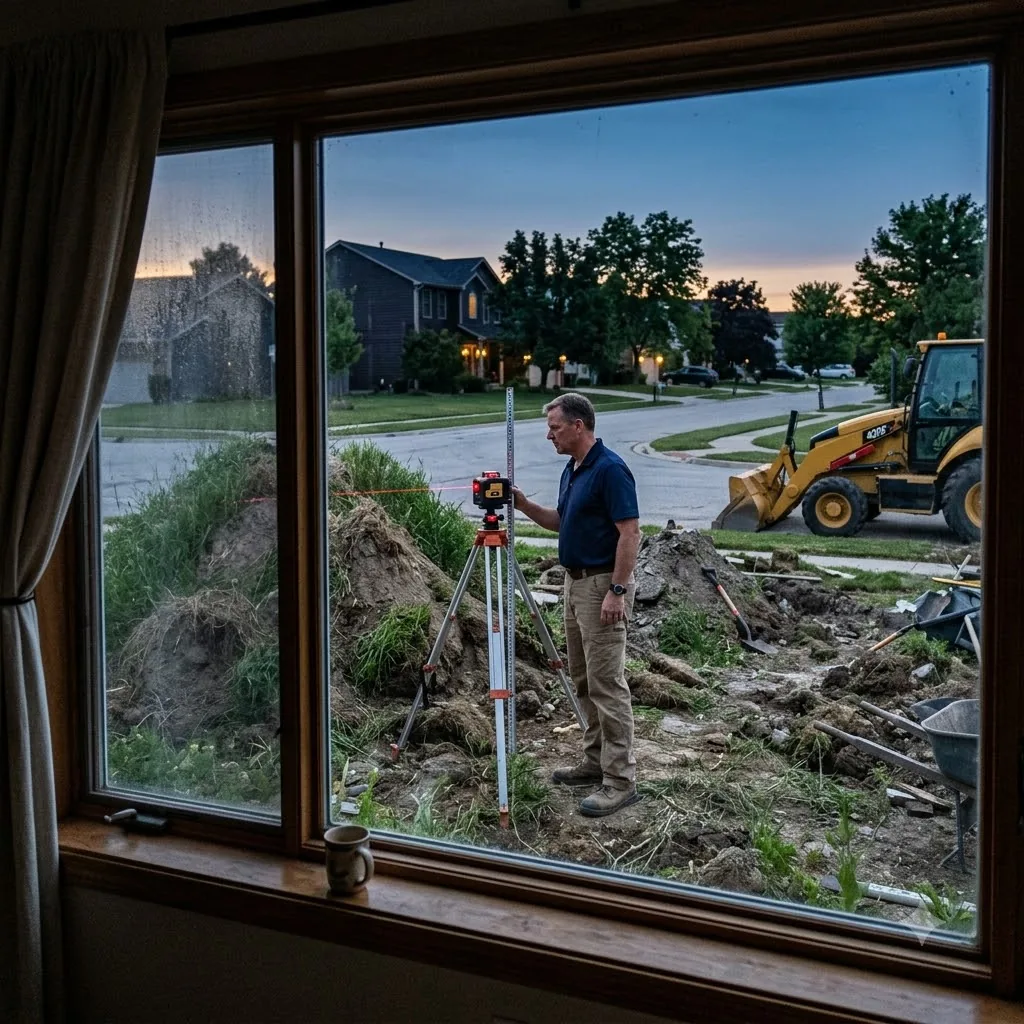
Richard stood frozen, his hand still gripping his clipboard, his laser level tripod slung over his shoulder. He stared into the trench. He looked at the boy curled into a defensive ball against the steel plating, and then he looked up at the house.
From the street, the line of sight across the lawn was perfectly clear. Without the mounds, anyone standing on the sidewalk had an unobstructed view straight through the low, expansive bay windows of Sarah’s living room. But with the earthen berms in place, the lower half of the house was entirely shielded. There was no line of sight to the living room floor. No line of sight to the couch. No line of sight to an eight-year-old boy trying to watch Saturday morning cartoons.
The deputy slowly lowered his hand from his utility belt, the color draining from his face as the geometry of the yard suddenly made horrifying sense.
They weren’t landscaping features. They weren’t an act of suburban rebellion.
Sarah hadn’t buried the steel to ruin the neighborhood. She had built a barricade. A defensive line of earthen berms, carefully measured and densely packed, designed for the sole purpose of stopping a high-velocity rifle round from entering her front window.
Richard’s mouth opened, but no sound came out. The bright red laser pointer in his pocket, the one he had used just an hour ago to prove the dirt obstructed the street view, suddenly felt like a lead weight. He stared at the terrified boy hiding in the trench, the boy who had learned that the safest place in the world was behind three feet of compacted earth and steel, while Sarah kept her muddy hands hovering protectively over her son’s head, refusing to look at any of them.