Story code: ST-000767
Part 2: What the Workflow Would Not Hide
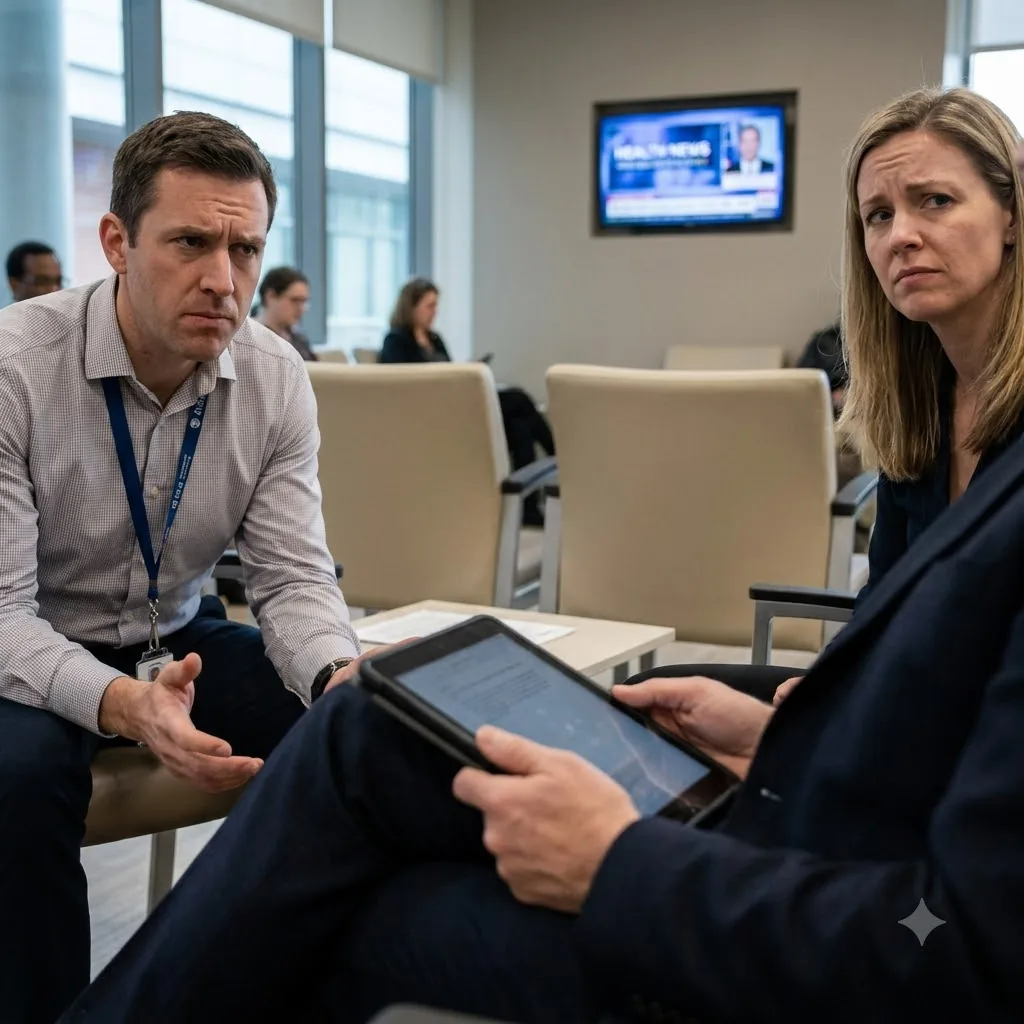
Dr. Soren did not hand the tablet back right away. He kept it in both hands and walked us three steps down the hall to the consultation bay with the glass wall and the round table nobody ever sat at for long. Tessa moved with us because she had to, one slow step at a time, still holding the cold paper cup. I stayed on her left side. Evan followed on the other side of the glass like he belonged in the middle of the whole thing.
The bay was busy in the ordinary clinic way. A pair of monitors blinked in the corner. A cart sat parked by the wall with spare leads and disinfectant strips. Someone at the far desk was printing labels fast enough to make the machine rattle. Nobody in the clinic looked surprised to see a consent tablet up close. That was the part that made Evan’s complaint so easy to dress up as concern.
Dr. Soren set the tablet on the table and said, “Mara, step back a little. Tessa, stay where you are.”
I stepped back one pace. Tessa did not sit down. She kept standing with one hand on the chair back and her eyes on the screen.
Evan pulled out his own stylus and pointed at the top of the display. “The patient’s signature is the issue, not the support presence. The workflow needs to stay clear.”
Dr. Soren ignored that and opened the care log. I could not read every line from where I stood, but the headings were clear enough. Consent started. Support entered. Consent paused. Care note added. Support confirmed. Then another line appeared under that, one that had not been visible before because the tablet was angled away during the hallway walk.
Dr. Soren touched the screen once more. The line expanded.
I saw the words care assistance logged, patient requested caregiver, and then a time stamp that matched the moment Tessa’s hand had started shaking in the first room. Right under it was another note. Technician override denied.
Evan said, “That note is incomplete.”
Dr. Soren looked at him. “Incomplete how?”
Evan lifted one shoulder. “The patient was distressed. A family member can create dependency. We have to be careful about that.”
Tessa turned her head toward him. “I asked her to stay,” she said.
He answered too quickly. “And you were in a heightened state.”
I could see the color rising in Tessa’s face, not all at once, just enough to change the way she held the cup. She set it on the table with both hands, carefully, like she was afraid it might spill if she let go too fast.
Dr. Soren scrolled again. The care log kept going. Every line was time stamped. Every line showed the same pattern: I helped read the tablet aloud when the font shrank, I held the support tray steady when Tessa’s wrist sensor slipped, I stepped back when Evan told me to, I came forward again only when Tessa asked me to because the room had become too fast for her to keep up.
None of that was said by me. It was all in the log.
Evan looked at the screen, then at me, then away again. “The log doesn’t show context,” he said.
Dr. Soren kept his voice even. “It shows enough.”
That was the first plain line of protection I had heard all morning, and it still did not feel like a win. He was already tapping at a side menu I had not noticed, and the tablet made a soft chime when he opened the review detail. A second note appeared at the bottom of the care log, and this one had Evan’s initials next to it.
Tessa saw it before I did. Her head moved toward the screen, and she read it out loud in a voice that came out smaller than before. “‘Remove family assistance flag after patient signs.'”
Evan did not speak.
Dr. Soren looked up from the tablet. “You entered that?”
Evan finally said, “It was standard procedure.”
“Then why did the log mark it after the patient asked for help?” Dr. Soren asked.
Evan’s hand went to the edge of the table and stayed there, flat and tense. He opened his mouth, closed it, then said, “That field was supposed to be temporary.”
Tessa gave a short, tired laugh that had no humor in it. Not a big sound. Just enough to cut through the room.
Dr. Soren closed the review detail and turned the tablet toward me for the first time. The support note, the patient request, the override denial, all of it sat there in a neat clinic font that nobody could argue with without sounding foolish.
“Mara,” he said, “you stayed within the request.”
I nodded once.
He said, “And you,” he looked at Evan, “did not document the support change the way you described it out loud.”
Evan’s face stayed blank, but his throat moved when he swallowed.
Dr. Soren did not raise his voice. He did not need to. “For today, Mara stays with the patient. Evan, you step out of the consent workflow.”
That should have been the end of it. It was not. As Evan reached for the tablet, Dr. Soren pulled it back just far enough that Evan’s fingers missed the edge. The screen brightened, and for one brief second I saw another line in the lower corner of the log before Dr. Soren covered it with his hand.
It was a late correction timestamped after the accusation had already started.
I looked at Dr. Soren. He looked at the tablet. Evan looked at neither of us.
Whatever that line said, it was new enough to change what came next.