Story code: ST-000662
Part 2: The Denial Only Worked One Way
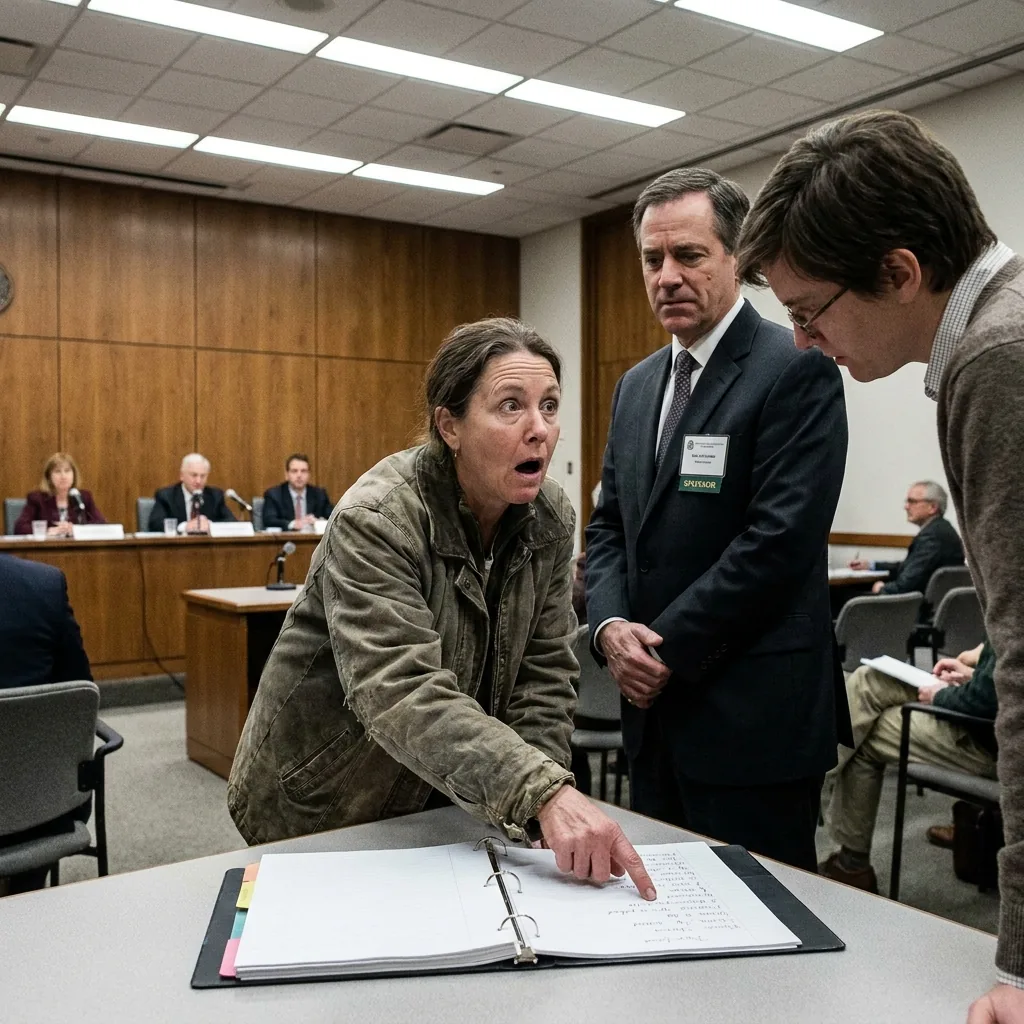
Gavin Vale opened the hearing by thanking the oversight panel for protecting public trust, and I had to sit there listening to him use the language of dignity while my own name sat somewhere behind the witness table on a freezer log. He spoke in that polished donor cadence that makes ordinary words sound preapproved. Progress. Safeguards. Transparency. Community partnership. Every sentence sounded smoother because he got to say it first. I wrote four words across the top of my agenda packet: Ask for the log. Dr. Nisha Benton ran the room tightly at first. She swore in the witnesses, reviewed the time limits, and reminded everyone that allegations from the floor would need to be tied to evidence that could be examined in session. That helped me, even if she did not know it yet. I did not need a dramatic speech. I needed the object in the room that had my name on it pulled into the light where other people had to see what I saw. Gavin finished his opening remarks with a line about how fear should not be allowed to distort ethical science. A few people nodded. Then Dr. Benton called for brief public statements before the first operations panel. I stood before I could talk myself out of it. “My name is Mara Ellison,” I said, and the microphone carried it harder than my own ears had. “I’m listed on today’s agenda as a community participant, but before this hearing started, I saw a freezer log attached to the demonstration unit outside this room. It included my last name and a participant code tied to a prior health study I joined under limited consent. I have never consented to any cloning program using my biological material.” The room changed in the small visible ways rooms change before they fully turn. Pens stopped moving. A phone came up in the back row. One of Gavin’s staffers leaned toward him. Leah, seated along the side aisle, went very still with both hands wrapped around her bag straps. Dr. Benton looked directly at me. “Are you asking this panel to examine the material you referenced?” “Yes,” I said. “Before anyone here tells me what I think I saw.” Gavin clicked on his microphone. “Chair, if I may, I think this is exactly why public demonstrations can create confusion. Sample displays often use mock identifiers or composite training references.” I turned toward him. “Then bring it up here.” He gave me a patient smile meant for the room, not me. “Mara, I understand why seeing something formatted like a lab record might be upsetting.” Formatted like. Upsetting. He was already trying to move the problem from the freezer to my reaction. Dr. Benton held up one hand before I could answer. “Mr. Vale, the request is simple. Was there a live or historical log attached to the freezer outside this room?” There was a short pause. Not long enough to be dramatic, but long enough to notice. “One of our operations staff can address what materials were used in the display,” Gavin said. “Then we will hear from operations now,” Dr. Benton said. That was how Evan Ruiz got moved up in the schedule. He came to the witness table carrying a binder and wearing the strained expression of a man who had not expected his name to matter until much later in the day. Dr. Benton asked him to explain, in plain language, what should normally appear on a freezer log and who should have access to it. Evan cleared his throat and answered carefully. “A legitimate freezer log would usually contain a sample identifier, storage location, dates of movement, and initials or credentials for the person handling transfer. In a regulated setting, names are typically minimized, not highlighted. Public-facing demos should not display active or traceable personal data.” “Should a demo log be hanging in open view outside a hearing room?” Dr. Benton asked. “No,” he said. The reporter in the back was typing with both thumbs now. I asked for recognition, and Dr. Benton gave it to me. “If a person’s identifier from an older study appears on a clone program log,” I said, “can that happen by a simple formatting mix-up?” Evan looked down at the binder before answering. “Not by formatting alone.” Gavin leaned into his microphone. “Again, we don’t even know whether Ms. Ellison is describing an authentic internal document.” Evan shifted in his chair. “If the notation included transfer initials and viability review language, that would not match the kind of dummy sheet we use for training.” A low murmur moved through the audience. Dr. Benton asked the obvious next question. “Can the display log be produced right now?” One of Gavin’s staffers stood from the side wall and said they were locating the materials. Locating. Not retrieving. Not handing over. Locating, as if the clipboard had developed legs. I said, “It was on the freezer until your staff removed it when I took out my phone.” Nobody at Gavin’s table contradicted me directly. They just started using legal-sounding phrases without being lawyers: chain integrity, context, preliminary assumptions. The words had one job, and it was to keep the room from following the simplest line. If my identifier was real, then somebody with access put it there. If somebody put it there, this was not an abstract debate about cloning. It was about who got close enough to me to take something they had no right to take. I kept my eyes on the witness table, but the question had already started widening in my own head through plain facts I did know. I had not mailed samples anywhere. I had not checked into any clinic tied to Gavin’s program. I had not left anything behind in a place strangers could casually collect. That left private space. I turned slightly toward the public seating again when I heard the scrape of a chair leg. Leah had shifted forward, one hand pressed.