Story code: ST-000992
Part 2: He Needed Someone Else to Say It
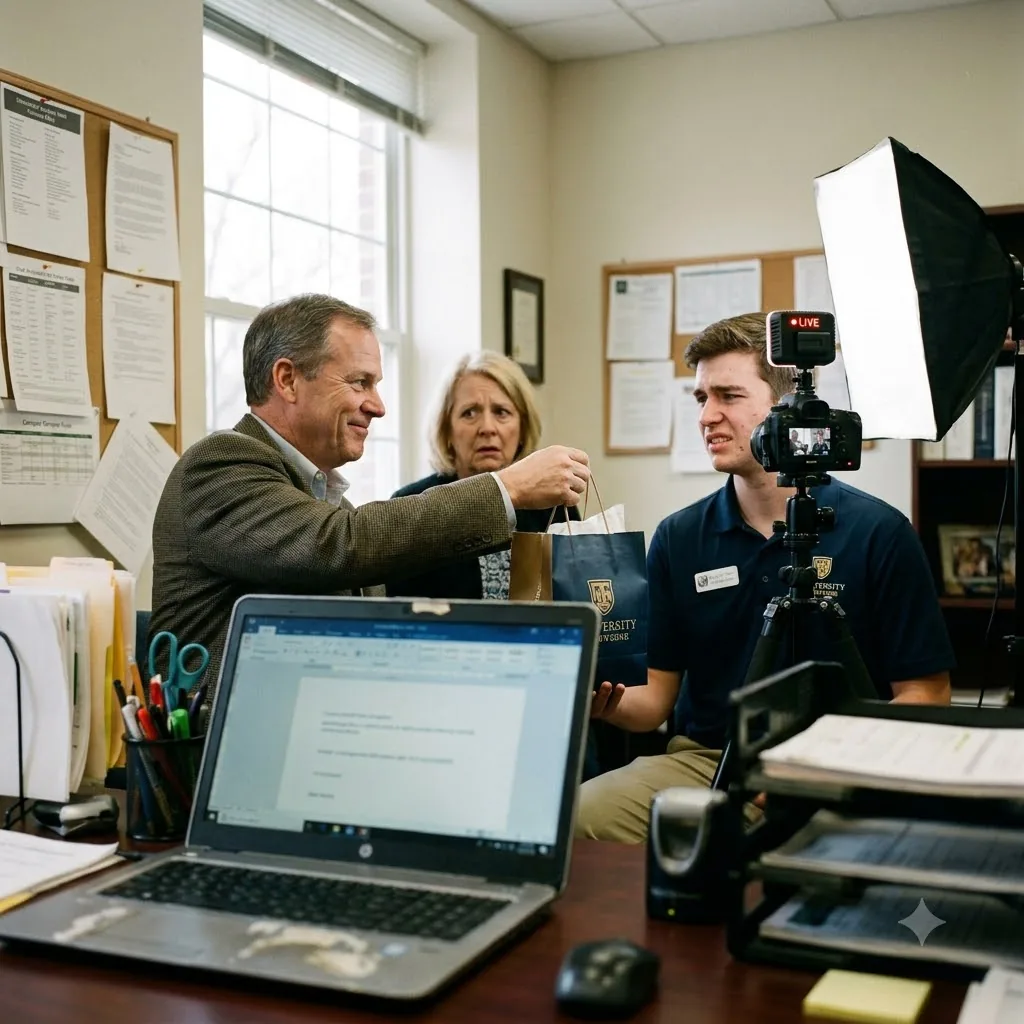
By the time the ceremony host started testing the mic in the next room, Graham Whitfield had told three different versions of the same essay story in our tour office, and none of them matched what he told Evan in the side hall. He kept polishing it in public like a speech, but every private instruction made it narrower, cleaner, and less believable. The lie stopped being vague the second he decided our staff should repeat it for him. The office was still trying to function like an office. Families were checking in for the four o’clock tour. A student ambassador needed replacement name tags because the printer had chewed the first set. Someone from advancement rolled in a tray of sparkling water and left it on the brochure counter where our route sheets were supposed to go. Through all of it, the tablet on the stand kept streaming a close shot of the donor backdrop and anybody who wandered too close. Graham used that camera the way some people use a mirror. He stood near the front desk with Sloane beside him and told a gray-haired couple, “She insisted on doing the hard part herself. That’s who she is.” He tapped the folder in her hands. “Hours at the kitchen table. We barely touched a comma.” Not ten minutes earlier, in the side hall, I had heard him say, No mention of coaches. That line stayed in my ear because he repeated parts of it without realizing he was repeating them. When a development staffer asked whether Sloane would mention her writing process on the stream, Graham said, “Keep it about discipline. Don’t overcomplicate it.” Then he saw me carrying fresh name tags and switched to the soft public tone again. “Nina, you all make these events look effortless.” I set the tags down and said, “We still need the side hall clear for tour traffic.” He gave me a smile that lasted one beat too long. “Right. Absolutely.” Evan was by the route sheets, pretending to reorganize them even after they were squared. A family of three approached him and asked whether the donor walkthrough was part of their campus tour. Before he could answer, Graham stepped in with one of his gift bags. “You might get a little extra today,” he told them. “Our daughter just went through the same admissions gauntlet your kids are facing now. That’s why authentic stories matter.” He turned to Evan like he was passing a microphone. “Tell them what you were just saying about her essay.” Evan had not been saying anything about her essay. I watched his grip tighten on the papers. He looked at me once, then at Marcy, who had come out of her office with her headset pushed down around her neck. Marcy said, “Evan needs to get that group moving in two minutes.” Graham laughed for the family, but he did not move his eyes from Evan. “It’ll take ten seconds.” Evan swallowed and gave the kind of answer students use when they are trying not to step on a mine. “We don’t usually discuss individual applications on tours.” The family’s mother nodded like that made sense. Graham did not let it land. “General inspiration, then,” he said quickly. “That hard work still matters here. That this place recognizes real effort.” He said it to the family, but the order was for Evan. Sloane shifted the folder from one arm to the other. The clip loosened, and two pages slid halfway out. I was close enough to see margin notes on the exposed page in at least two different handwriting styles, one heavy and blocky, one thinner and slanted. Graham snatched the pages back into line before the family noticed and pressed the stack flat against Sloane’s chest like he was fixing a crooked tie. “Hold it from the bottom,” he told her under his breath. Then, louder: “She’s humble.” The family got an awkward smile, a gift bag, and a redirected path toward the check-in sign. Evan finally escaped with them and the route sheets. Graham watched him go, jaw set, then immediately turned toward the tablet camera because the livestream host called his name from the ceremony doorway. That should have been the end of it for a minute, but he came back thirty seconds later because he had forgotten the essay pages. He picked them up from the brochure counter and saw me noticing the marks. “Drafting is normal,” he said. “Let’s not make ordinary mentoring sound sinister.” I hadn’t asked him anything. Marcy heard that. She stepped between him and the desk just enough to make him stop walking. “Graham, we need your party either in the ceremony room or outside the tour lane. We cannot keep pausing student operations for side coaching.” He lifted one hand like he was calming a room he had not yet lost. “Nobody is asking for anything unreasonable. We are donors, not invaders.” Marcy’s voice stayed plain. “Then you’ll understand why our guides will not script applicant stories for guests.” For the first time all afternoon, Graham did not answer immediately. He looked past her toward the ceremony doorway, where the host was now stalling into a microphone, and then toward the front windows, where two more visiting families had just walked up to check in. He was running out of room to keep his public speech and his private instructions separate, and he knew it because he lowered his voice again and said, very carefully, “We can discuss tone later. Right now I need Evan available after the walkthrough.” Marcy said, “For the tour, yes. For your talking points, no.” Graham’s face stayed camera-ready, but he squeezed the essay pages so hard the top corner bent. Then Sloane spoke for the first time in more than an hour. She looked at the bent corner instead of at any of us and said, “Dad, that’s the copy with all the notes on it.” He froze with.