Story code: ST-000580
Part 4: I Left His Basket On His Table
Once I saw the shape of it, I stopped trying to win the argument.
That changed the room more than raising my voice would have.
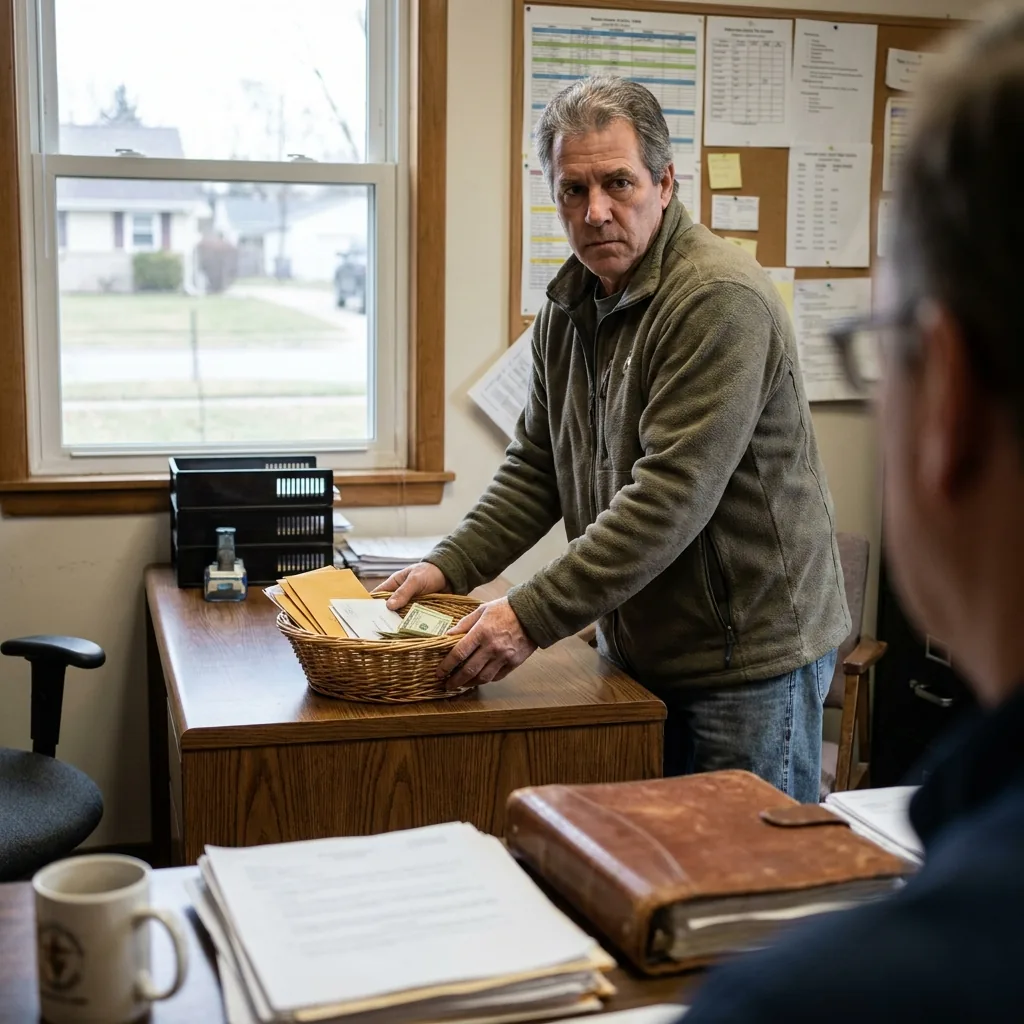
Deacon Paul was still standing behind the worktable with the offering basket, the deposit slips, and the loose cash spread in careful rows. The office smelled like paper dust and copier heat. Marlene moved somewhere in the next room, close enough that we both kept our voices measured. The door was still nearly closed, leaving a narrow strip of hallway light across the floor.
“So that’s it?” he said. “You are just going to turn your back on service because you dislike how a difficult conversation feels?”
“No,” I said. “I’m turning my back on your version of debt.”
He let out one short breath through his nose. “You are being dramatic.”
“No. I’m being exact.”
I stepped to the end of the table, not closer to him, closer to the chair where I had left my purse. I picked it up and set the strap on my shoulder. I wanted every next movement to say the same thing before I said it out loud.
His eyes dropped to my purse and came back up. “We’re in the middle of count work.”
“You are in the middle of count work,” I said. “I came to volunteer. I did not come to be collected on.”
“Rachel.”
He said my name like a warning and a plea had been pressed flat together.
I looked at the basket, then at him. “You don’t get to tell me my mother taking your pantry notice was rescue. You don’t get to turn that into open-ended labor. And you do not get to put me near church money while speaking to me like I owe you obedience.”
He lifted one hand from the table. “That is not what I said.”
“It is exactly what you said. You just used stewardship words around it.”
His face went still. “If you leave right now, I will make a note that you declined further count responsibility.”
That was the concrete thing in the room. Not a sermon. Not a moral cloud. A note. Access. Role. He wanted that to sound like a punishment.
It sounded like release.
“Do that,” I said.
He blinked once. “Excuse me?”
“Write it down.” I nodded toward the deposit slips and volunteer paperwork stacked beside his hand. “Make whatever note you need. I won’t count offerings with you again. I won’t carry deposits for you. I won’t fill a shortfall you dressed up as gratitude.”
The copier started again in the next room. Marlene’s footsteps paused, then moved on. Paul kept his voice low. “You should think very carefully before separating yourself from trusted service in this church. People notice patterns.”
“Then let them notice this one,” I said. “I will help where help is actually help. I will not work under a private debt you invented.”
He looked toward the partly open door again, then back at me. “There is no need to phrase this so harshly.”
“There is no need for me to stay.” I pointed once at the basket. “That belongs to the church. Your story about it doesn’t belong to me.”
He reached for a volunteer sheet clipped under the deposit log. In thick, deliberate strokes, he wrote a line under my name. I could not see every word from where I stood, but I saw enough: REMOVED FROM COUNT / DEPOSITS – DECLINED. Then he underlined it once.
He wanted me to watch him do it.
I did.
That single line was the visible cost. No more count room. No more deposit bag in my car. No more reason to stand in his office while he turned soft church words into a chain.
When he finished writing, he set the pen down and said, “I hope you don’t regret taking this posture.”
“I won’t,” I said.
I walked to the door and opened it the rest of the way. Marlene looked up from the copy machine with a stack of youth flyers in her hands.
“You heading out?” she asked.
“Yes,” I said.
That was all. I did not explain. I did not point back into the office. I did not hand anyone a secret to carry for me. I had already taken the only thing he had been trying to keep from me all afternoon, which was the right to decide where the conversation ended.
Behind me, Paul said, in that same careful church-office tone, “We’ll finish up here.”
“I’m sure you will,” I said.
I kept walking past the bulletin rack, past the wall calendar with the potluck dates circled in red, past the folding chairs stacked by the fellowship hall door. My phone buzzed once in my purse, probably nothing important. The afternoon light outside the office windows looked plain and hard.
I did not stop at the sanctuary. I did not stop at the parking lot to rehearse what I should have said better. I got in my car knowing my name would not be on his count list again, and that was the first honest thing he had given me all day.
He could keep the basket, the slips, the underlined note, and every speech about faithfulness. What he could not keep was me standing there long enough to let him rename his convenience as my debt.
I started the car and left before he could turn one more favor into a chain.