Story code: ST-000580
Part 3: He Needed My Silence More Than My Thanks
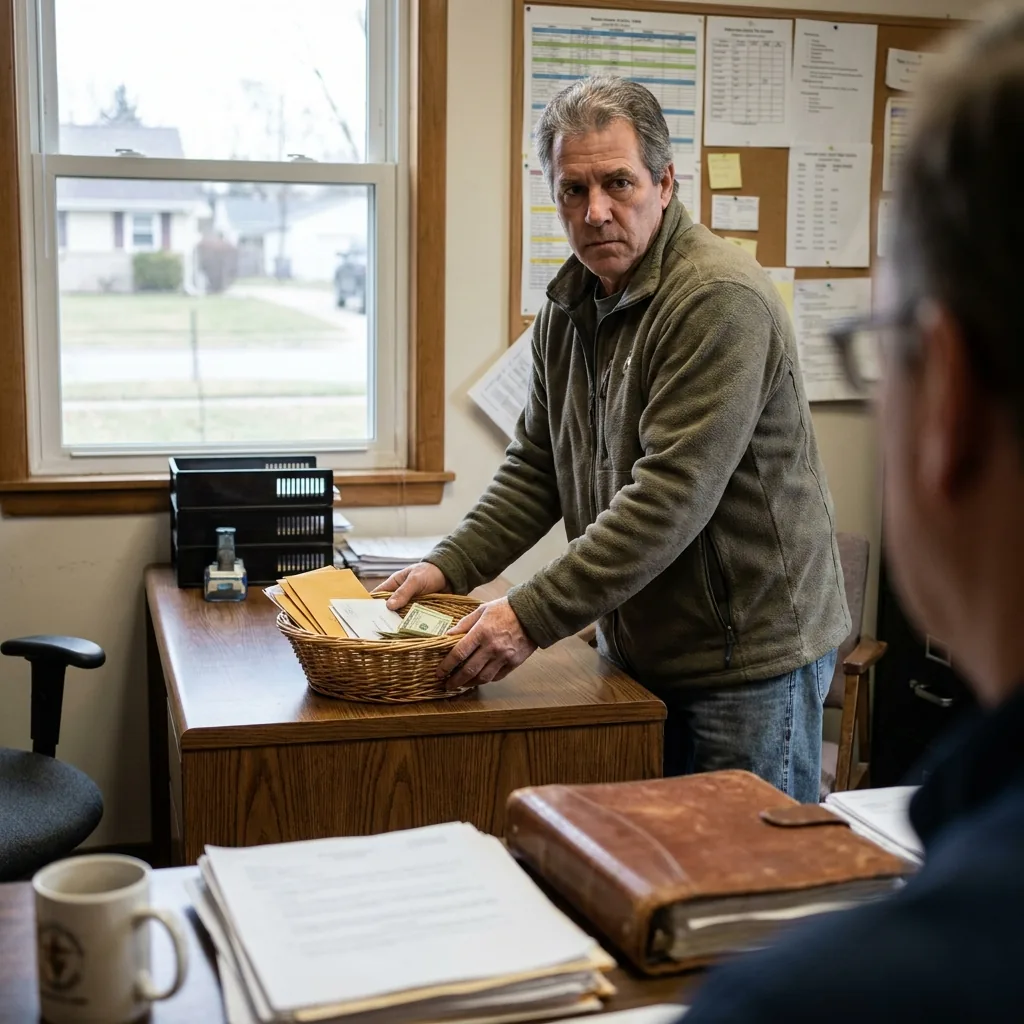
I kept looking at the offering basket because it was doing more work for him than his words were. Every time he touched it, every time he lined up another stack of bills beside it, he was trying to borrow honesty from the people who had dropped money into it on Sunday.
“You don’t understand the full picture,” Deacon Paul said again.
“Then explain it without preaching at me,” I said.
He did not sit down. He stayed standing with the worktable between us, one hand near the basket and the other on the deposit slips. “There were timing problems,” he said. “The pantry utility account had to be kept active, and your mother was willing to let us use her name temporarily. We made sure the charge did not fall on her in the end. We handled it. Quietly.”
I let that sit there a second.
“You just changed your story,” I said.
“No, I clarified it.”
“You said the church covered my family. Now you’re saying my mother covered your pantry account until you could clean it up.”
His mouth tightened. “That is a hostile way to describe ministry administration.”
“It’s the plain way.”
He reached for the basket and turned it a few inches, like squaring it with the edge of the table mattered. Under the basket sat one of the yellow routing slips they used for cash count nights. I could see my own handwriting on the top line from a volunteer shift two months earlier, where I had written the time we finished and the initials of everyone present. Under that was a newer note in Paul’s blocky pen: PANTRY METER – HOLD UNTIL TRANSFER CLEARS.
I stared at it.
He saw me looking and moved the basket back over the slip too late.
That one note did not tell me everything, but it did tell me enough to lock his own sequence together. The meter had been a church problem. The hold had been his problem. My mother’s name had kept that hold from becoming a visible office mess while he bought time. What he kept calling help to us had started as cover for them.
“How long was it held?” I asked.
“That isn’t your concern.”
“You made it my concern when you started billing me for it.”
He flattened his palm over the basket rim. “Rachel, listen carefully. Your family was shown grace in a delicate situation. I am asking for mature cooperation now, not an argument over office mechanics.”
“Office mechanics are exactly what this is.”
He shook his head like I was missing something holy on purpose. “No. This is about whether you honor what was done for you.”
“What was done for me,” I said, “was that my mother’s name got attached to your pantry meter so the notice would stop landing where people could ask questions.”
He cut his eyes toward the partly open door.
That small glance told me more than another speech would have. He was the one measuring who might hear.
Marlene’s paper cutter thumped once in the next room. A copier started, then stopped. Normal office noise. Normal afternoon. And in the middle of it he was trying to make me carry his cleanup as if it were gratitude.
“Lower your voice,” he said.
I had not raised it. “Then stop saying I owe you.”
“I am saying the church remembers who received help.”
“No.” I pointed at the basket and then at the slip peeking from under it. “The church gave freely. You are the one turning it into leverage. And if that note means what it looks like it means, my mother’s mailbox bought you time before anybody else saw that pantry account was sitting wrong.”
He pulled the routing slip free, folded it once, and tucked it under the deposit slips. The movement was quick, neat, practiced.
“You are reaching,” he said.
“Am I? Then answer one thing straight. If my mother had said no, who would have been standing here explaining why the pantry utility was still in limbo?”
He did not answer.
He adjusted the stack of twenties again. He picked up the pen again. He set it down again. The whole performance had started to look different now that I knew where to watch. The basket, the slips, the careful church tone, the pressure about staying late, taking deposits, covering shortfalls. He had not pulled me in because I owed a debt. He had pulled me in because I already knew enough of the old mess to recognize the shape of a new one.
“You want me near the money because then this becomes service,” I said. “It looks cleaner if I keep helping.”
“That is offensive.”
“It is true enough that you won’t deny it.”
He leaned forward. “Be very careful what you imply in this office.”
“I’m not implying anything. I’m refusing the invoice.”
For the first time all afternoon, his calm looked strained around the edges. He glanced at the hallway again, then back at the table, then said, very measured, “If you walk away from this spirit, don’t expect me to put you on count teams again or hand you deposit work in the future. Trust has to mean something.”
There it was. Not just pressure. A real consequence he could control.
I looked at the basket, the slips, and his hand resting over both like he could bless one story and bury the other.
Then I understood exactly what Part 4 had to be: I did not need to prove him false to the whole church. I only needed to stop leaving my hands anywhere near his basket.