Story code: ST-000507
Part 3: The Record Narrowed Around Him
Dr. Patel let that unfinished sentence hang for half a breath, then set her pen down flat on the folder. “But the existence of an attached administrative note makes the timing relevant,” she said. “We are staying narrow. Mr. Alvarez, do not interpret it. Read only fields you can see directly if I ask you to.”
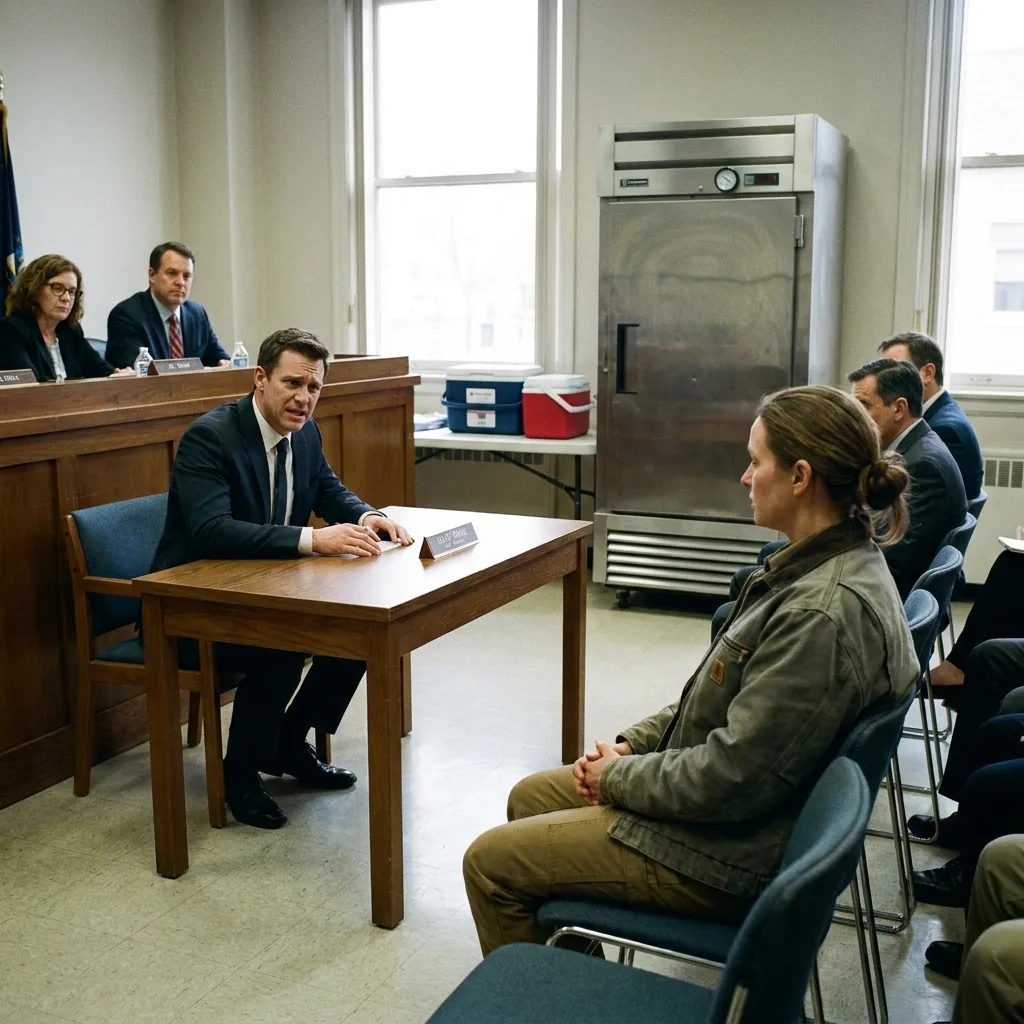
Elliot had one hand on his tipped placard now, straightening it with two fingers. “This is becoming a hearing about credentialing mechanics,” he said. “My concern has always been Ms. Jensen’s inability to maintain professional distance.”
“You keep returning to that phrase,” Dr. Patel said. “I keep returning to care tasks. That is not an accident.”
The clerk’s keys started again.
Dr. Patel turned to Ruben. “Read the visible administrative fields only.”
Ruben angled the tablet toward her and spoke the way he always did in the bay, exact and unadorned. “Access change request entered April 13, 5:42 p.m. Door group: freezer bay two and adjacent sample handling area. Credential affected: Elliot Crane. Status: removed. Effective immediately. Attached admin note present.”
“Read the subject line only,” Dr. Patel said.
Ruben looked once more at the screen. “Subject line says, ‘Repeated sponsor presence during active stabilization events; limit bay access to assigned care and maintenance staff pending review.'”
No one moved when he finished. Even the ventilation hum seemed louder.
Lena pulled her hands back from the table and folded them in her lap. “Pending review,” she said, not to anyone in particular.
Elliot looked toward Dr. Patel. “That language proves my point, not hers. If there were concerns about boundaries in the bay, then staff conduct was already an issue.”
I slid the printed packet a little farther into the center so the date column showed. “Then tie it to a time,” I said.
Dr. Patel gave me a small nod to continue.
“April 3, your comment comes after stabilization. April 14, your comment comes after stabilization. March 29, same thing. You call my checks overinvolvement, but the record keeps showing the same order. Alarm. Physical check. Stabilization. Log entry. Sponsor update after that.”
Elliot’s mouth tightened. “That is your reading.”
“It’s the sequence on the page,” I said.
Dr. Patel turned to him again. “Did you request to be physically present during freezer alarm responses after your access changed?”
He took a drink of water before answering. “I asked to be informed.”
“That was not my question.”
He set the glass down carefully. “No.”
“Did you ever complete training on seal verification, rack alignment checks, or sample stabilization protocol?”
“Those are technical subroutines handled by facility staff.”
“So no,” Dr. Patel said.
Ruben tapped once on the edge of his tablet. “The door group note matches the work practice we use during active issues,” he said. “Too many people in the bay slows the check and warms the room.”
Dr. Patel looked at him. “Did Mr. Crane’s presence ever slow a stabilization event you personally observed?”
Ruben answered without lifting his voice. “April 13, he tried to stay in the handling area while we were reseating inventory after a false-high alarm. I asked for space twice. After that, I saw the access removal on the next day’s credential list.”
Elliot turned toward him sharply. “You are leaving out context.”
“Then give it,” Dr. Patel said.
He opened both hands on the table, but when he spoke, the polished cadence from the morning did not come back cleanly. “My role required me to make sure the family program was not being captured by staff culture. These environments can create loyalty distortions. People start treating access as ownership.”
“People,” Lena said, finally looking straight at him, “or the people who were actually there?”
He did not answer her. He looked at Dr. Patel instead.
I watched the chair make one short note and then another. She didn’t rush. That was the part that changed the room more than any raised voice would have. She was building a line nobody could talk around.
“Mr. Crane,” she said, “here is what I have in front of me. You used Ms. Jensen’s physical response to alarms as evidence of improper control. The admitted records show those responses matched routine care sequence. The admitted records also show you were updated after those responses, not directing them in real time. The access system further shows your freezer bay credential was removed during the same period, with a note limiting bay presence to assigned care and maintenance staff during active stabilization. If there is a narrower factual claim you wish to preserve, this is the moment to state it.”
His fingers stayed spread on the tabletop. “My claim,” he said, slower now, “is that she made herself indispensable to a process that should never depend on one worker.”
“That is not the same as selfishness,” Dr. Patel said.
He did not correct her.
She turned to me. “Ms. Jensen, if you were absent during one of these events, what backup existed?”
I answered directly. “On-call rotation, maintenance escalation, and posted response steps inside the bay door. The system never depended on me alone. It depended on somebody showing up and doing the work.”
Dr. Patel’s eyes shifted back to the packet, then to Ruben’s screen, then to Elliot. “Thank you,” she said. “We will take a ten-minute recess before I state the handling restriction on record. Mr. Crane, leave your credential on the table.”
That was the first truly irreversible thing said all day.