Story code: ST-000807
Part 3: What the Sheet Still Showed
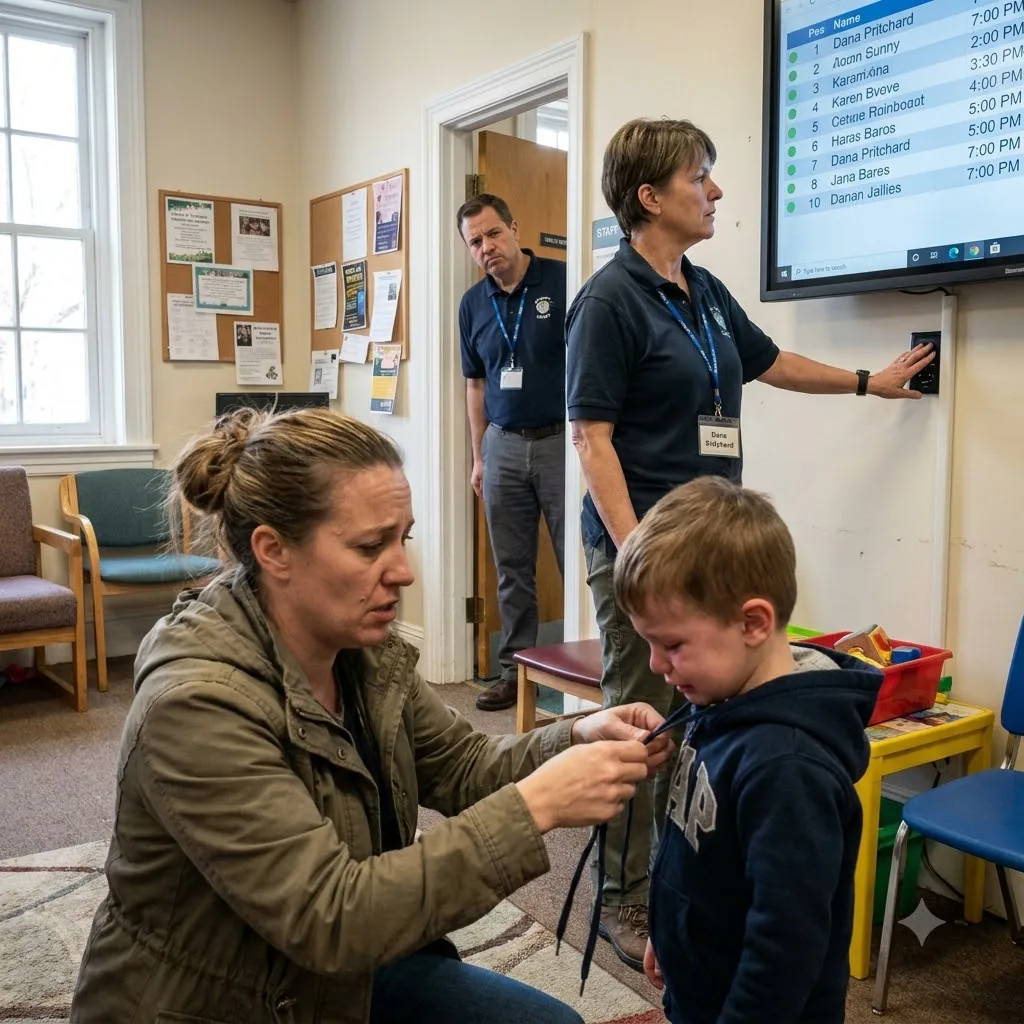
Ronnie was already moving toward the check-in table before Dana answered him. He did not hurry. That almost made it worse for her. He just left his cart where it was, crossed the lobby, and lifted the plastic clip board that held the printed assignment sheet for the night.
Dana said, “Ronnie, that’s for staff use.”
He looked at the page, not at her. “It’s hanging in the lobby,” he said.
That was the whole answer.
People had shifted without meaning to. Parents who had been halfway out the door stayed near the family room. Keisha took two steps closer to the threshold so she could see both me and the sheet. One of the boys tugged at my sleeve again to ask for more crackers, and I handed him the container from the snack counter side shelf without taking my eyes off Ronnie.
He brought the sheet over and held it where I could read it from where I stood.
Family room, 7:00 to 7:30: T. Hollis.
Relief coverage: blank.
Replacement after break: blank.
There was no second name written in. No initials. No note that anybody had taken over after the volunteer left. I heard paper rustle as Ronnie turned the page corner back down with one finger.
“That was posted at the start,” he said.
Dana lifted the mic again, but the room had changed on her. The sound of her own voice coming through the speaker felt too loud now. “The schedule was being adjusted in real time,” she said.
I held up the binder with my entries still open. “Then where is that written?”
She looked from the binder to the assignment sheet. “Not every adjustment makes it onto paper the second it happens.”
“My name made it onto the screen fast enough,” Keisha said.
Nobody reacted with a big sound. No gasp. No outburst. It was quieter than that. A few faces just settled into place. The grandmother by the lobby door folded her arms. The dad by the snack counter stopped pretending he was still busy with napkins. Even the kids had gotten still in that way they do when the adults around them are all listening at once.
Dana stepped closer and held one hand out toward the binder. “Ivy, give me the log. I’ll review it after closing.”
I didn’t hand it over. “No.”
Her mouth tightened. “This is becoming disruptive.”
I looked at the open family room, at the children still inside it, at the parents whose support group had already been cut short by this mess. Then I looked back at Dana. “It became disruptive when you put my name on the wall instead of putting coverage in this room.”
That hit because it was plain, and because the room could test it against what they had seen.
A little girl at the craft table raised her hand again for the restroom. Dana glanced at her, then at me, then toward the hall. She did not move. She did not call another volunteer. She just stood there with the mic and tablet, waiting for somebody else to make the problem disappear for her.
Keisha said, “I’ll walk her if somebody stays with mine.”
“I have the room,” I said.
Keisha nodded, took the girl by the hand, and headed down the hall.
Dana said, “This is exactly why volunteers can’t freelance care decisions.”
Ronnie looked at the assignment sheet again. “Who’s the backup then?” he asked.
She answered too quickly. “We’re handling that.”
“Who?” I said.
She did not say a name.
That was the moment it turned from contradiction into something the whole room could feel. It was not just that the times in my binder did not match the blame on the screen. It was that Dana was still talking about structure while standing outside the structure she said mattered. She had a mic, a tablet, and the wall screen. I had three children, a binder, and a room she still was not willing to enter.
When Keisha came back with the girl, she didn’t return to her old spot by the coloring table. She stayed near me. “So she was the coverage,” she said, looking at the binder, not at Dana.
“Yes,” I said.
Dana’s voice sharpened. “No. She inserted herself when there was a lapse in communication.”
“A lapse in communication doesn’t watch children,” I said.
For a second I thought she might put my name back on the announcement screen. Her thumb moved over the tablet. Instead she said, “If this room is so improperly staffed, then we may have to suspend child-watch for the rest of the night.”
That landed like a dropped tray. Parents looked up at once. One mother near the door said, “My meeting is still in there.” Another asked, “You’re shutting it down now?”
And that was the pressure point I had not wanted but could suddenly see clear as print. I could keep pushing until Dana’s public lie broke all the way open in front of everyone, or I could stop one inch earlier and keep the families from losing the only support block they had left that night.
Dana had finally found the leverage she could still use. If I forced the cleaner win, the families would pay for it first.