Story code: ST-000808
Part 3: The Form Stopped Working as a Threat
The answer to Evan’s emergency was sitting in ordinary records by the time Lauren agreed to meet him again, and that mattered because nothing new had to be invented. The clinic estimate was still the clinic estimate. Nina Alvarez’s email still showed the same dated balance and the same note that embryo consent was voluntary and could wait until questions were answered. The joint account activity still showed no hidden clinic charge large enough to justify the number Evan had demanded. What changed in Part 3 was not the paperwork. It was that Lauren stopped testing whether he would correct the story on his own.
She asked to meet in the parking garage exit at Bright Harbor before her follow-up bloodwork, in daylight, with her manila folder in hand. That location fit the pattern of the whole thing: close enough to clinic procedure that the facts stayed anchored, private enough that no public scene was required. Evan arrived first and stood near the pay machine with his phone face down on the concrete ledge. When Lauren walked up, he opened with the same language he had used at the desk, only stripped shorter. He said they could still get back on track if she would stop dragging everything out.
Lauren did not argue from memory. She pulled out Nina’s email and the printed estimate sheet and held them where both of them could see. She asked one question at a time.
Why did you tell me the clinic needed more than this.
Why did you say we would lose momentum that day when Nina said we had a payment window.
Why did you tie the transfer to the embryo consent form.
He did not answer in the order asked. He looked at the paper, then at the garage lane, then back at Lauren. He said real life costs more than a single invoice and that she was fixating on technicalities. He said fertility treatment was bigger than one balance, one receipt, one afternoon. It was the same structure as before: move away from the number, move toward duty.
But the proof lane had narrowed by then.
Lauren showed him the printed account page with the sporting goods charge from the same afternoon as the clinic appointment. She set the vending coffee receipt beside it. Then she added what Tessa had helped sort: three earlier purchases from the same retailer, each one landing within a day of a conversation where Evan had pressed hardest about sacrifice and teamwork. She did not announce a grand theory. She only laid the dates beside the clinic paperwork and let the timeline do its work.
His first visible change was not volume. It was precision. He stopped saying the money was for the clinic and started saying he had needed flexibility. Then he said he had planned to replace anything he used before it mattered. Then, when Lauren asked again why the embryo consent form had been brought into that pressure if the clinic did not require same-day action, he tapped the folder and said, “Because every time we get close to a real step, you start acting like there’s an escape hatch.”
That sentence locked the sequence more cleanly than a confession would have.
The form had never been just background paperwork to him. He had used it as leverage because it looked weighty enough to make hesitation seem cruel. He had treated consent and money as if they were one promise. Once the clinic’s actual timing sat on paper, his moral leverage thinned into something plainer: he wanted access to Lauren’s savings, and the embryo decision was the sharpest object available to force it.
Lauren asked him whether there was any clinic bill he could show that matched the amount he had demanded from her. He unlocked his phone, scrolled, turned the screen halfway toward himself, then locked it again. No document changed hands. No screenshot appeared. What he finally said was, “So you’re really going to blow up this whole process over purchases that don’t even compare to what we’ve spent already.”
There it was. Not a correction. Not a clinic proof. A scale argument.
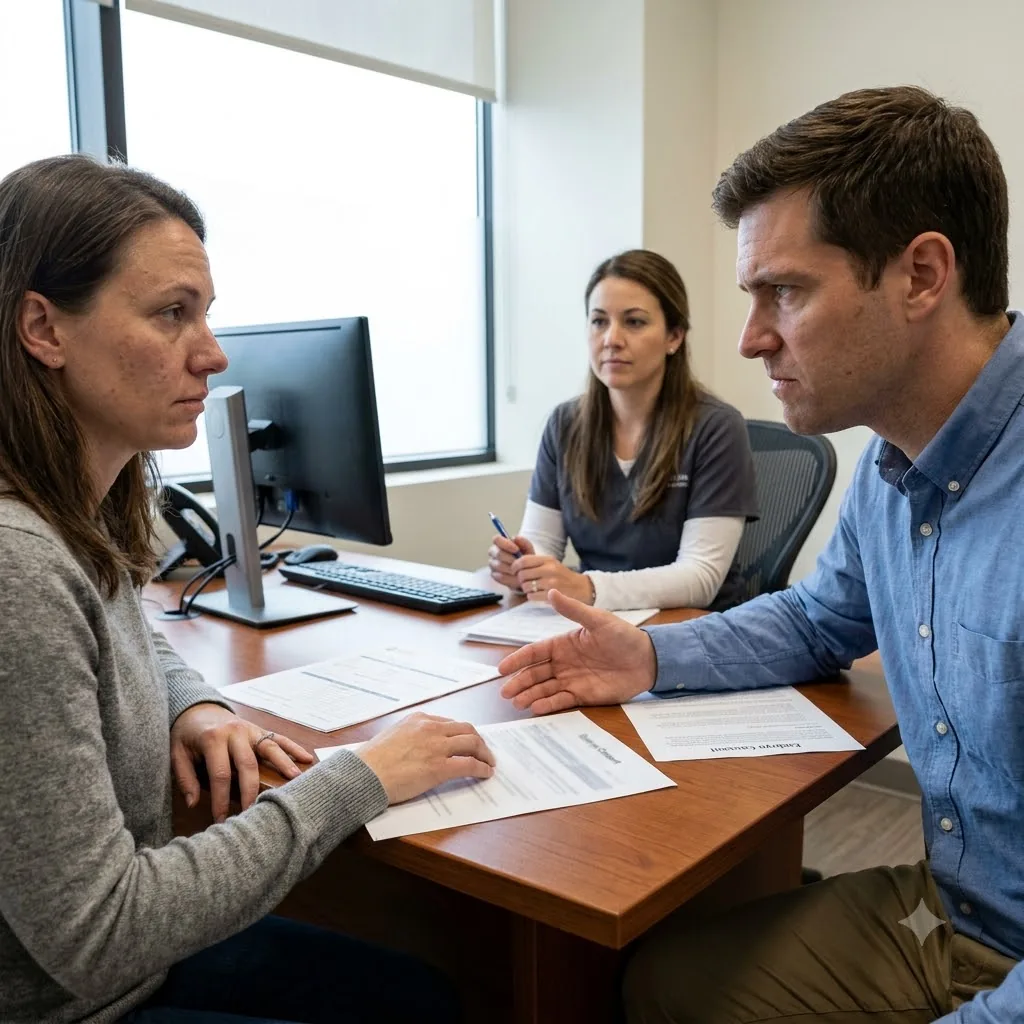
Lauren slid the embryo consent form out of the folder then, the unsigned copy with Nina’s packet markings still on it. She held it by the bottom corner and asked him to say, plainly, whether he expected her to sign it that week. He said yes. She asked whether he expected her to transfer the money first. He said, “I expect you to stop acting separate from me on this.”
It was as close to a clean answer as the record was ever going to get.
Later that afternoon, after bloodwork, Lauren sat in her car and called Bright Harbor again. She asked Nina to place a note in the file that no embryo consent was to be accepted from her unless she delivered it herself after a separate review. Nina did not dramatize it. She said she could document that Lauren wanted additional review time and that no one should treat an unsigned prior copy as current consent.
That was the first practical exit move inside the same proof lane.
When Evan texted that night, his message was shorter than the earlier ones. No more family speeches. No more future-child phrasing. Just: “Send the money tonight or be honest about what you’re doing.”
By then what Lauren was doing had a shape. She had the clinic note, the dated estimate, the receipts, and the one thing Evan could not produce: any actual fertility charge matching the amount he had demanded. Part 4 was no longer about exposing him. It was about deciding what the truth was worth if saying it out loud cost her the last embryo too.