Story code: ST-000765
Part 4: Void on the Clipboard
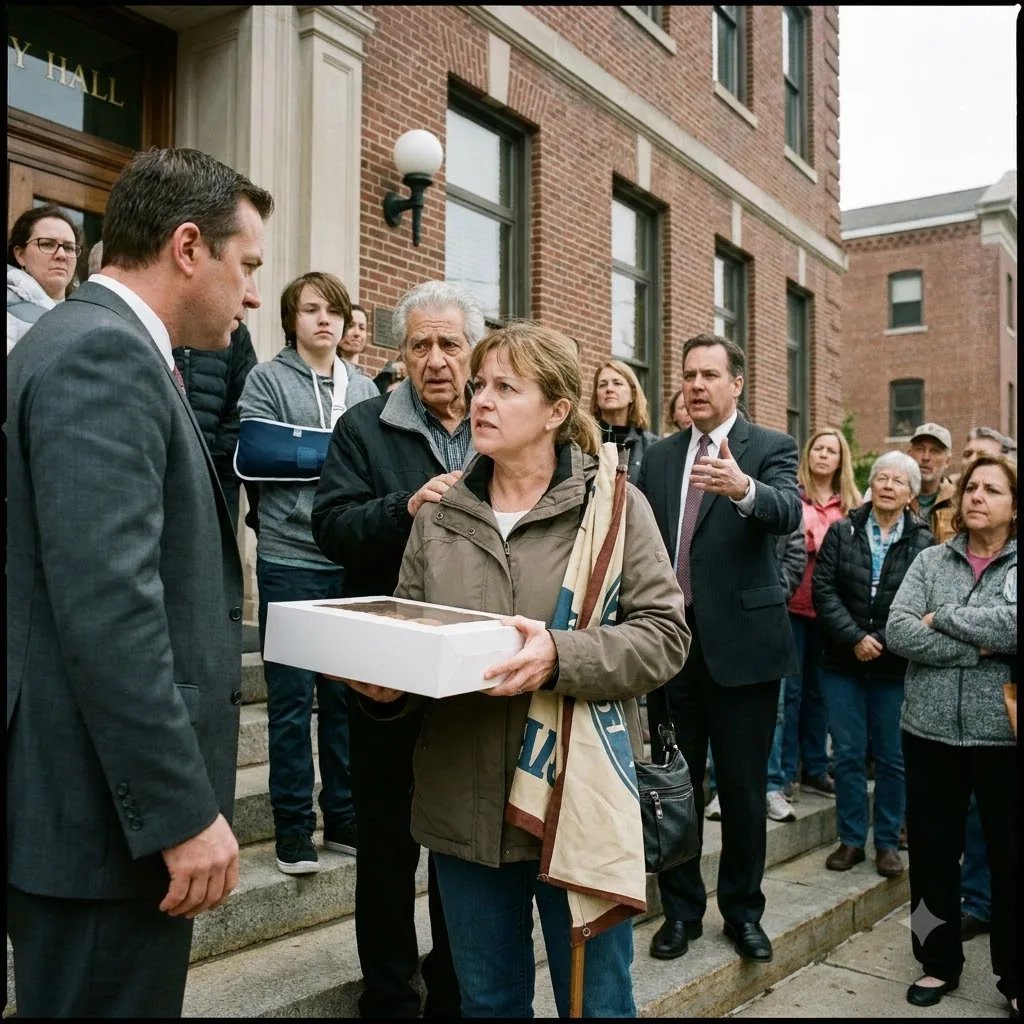
The silence after I asked for the name was worse than any argument. June stood there with the banner pressed to her side, the cake box tilted against her hip, and the volunteer badge half-hidden under her jacket. Tom did not speak. The staffer waited with the clipboard open and a pen resting across the page, ready to make the city version of a decision.
June finally reached into her jacket and pulled out the badge. It was a white plastic pass on a black lanyard, the kind that lets somebody move through a place without being questioned. She held it for one beat, then tried to tuck it back inside like that would help. The staffer saw it anyway.
“Ma’am,” he said, still even, “if that pass is tied to today’s ceremony, I need it here.”
June did not hand it over at first. She looked down at the badge, then at the folded banner, then at Tom. Nobody moved to help her. Nobody spoke up for her. The whole scene had narrowed to the small square of paper in the staffer’s hands and the plastic card in hers.
I watched the staffer run his finger down the roster. He checked one box, then another. He checked the time stamp beside June’s name. He checked the access column. Then he took a red marker from the pocket of his shirt and drew a hard line through the row.
It was such a small motion that I almost missed it. But I saw the line go across her name.
“You’re not active for the steps anymore,” he said. “Turn in the badge.”
June’s hand closed around the lanyard. She gave one short shake of her head, not enough to look like a fight, just enough to show she heard him.
Tom said, “June, give it to him.”
That was the first time he sounded tired instead of sharp. June looked at him like she was waiting for him to take the word back. He did not.
So she unclipped the badge and set it into the staffer’s palm. He did not snatch it. He did not make a show of it. He just laid it on the clipboard, took a thin white VOID sticker from the same pocket with the marker, and pressed it over her name. The sticker covered the line cleanly. No one had to explain what it meant.
I heard somebody behind us say my name, but nobody came closer. The ceremony had not stopped. It had simply moved around us, leaving our little patch of stone exposed.
The staffer pointed to the banner. “That item cannot stay with the group. If you want to take it, take it off the public steps now.”
June’s fingers tightened on the fabric. For a second I thought she might argue. Instead she folded the banner once, then twice, with hard, flat motions that did not look like care. She did it carefully enough that the message disappeared again. That was the last useful thing the lie had left her.
I stepped aside and let her pass me toward the side rail. Not because I was helping her, and not because I forgave her. I stepped aside because I was done standing in front of what she had made. The staffer wrote one more note on the clipboard, tore a small sheet from the bottom, and slipped it into the event packet. That was the routine part. That was the dry process. It broke the whole thing open without raising its voice.
Tom stayed where he was. He looked at the VOID sticker on the clipboard, then at June carrying the folded banner down the side stairs without the badge, without the slot, without the public place she had used to hide inside the family.
No one chased her. No one called after her. The crowd simply returned to its own pieces: paper plates, folded chairs, the cake nobody had cut yet. But the access was gone. Her name was gone from the roster. The role she had taken for herself on these steps was gone with it.
I stood there until the staffer clipped the roster shut and set the pen back in his pocket. That was the end of the lie as far as the city was concerned. Not a speech. Not a scene. Just a name crossed out and a badge surrendered in daylight.
When June reached the bottom step, she did not look back. I did not call her name. I watched the banner edge disappear around the corner, and I understood that some things do not break loudly. They break in clean lines, on paper, in front of everybody, and that is what makes them final.