Story code: ST-000572
Part 2: What the Card Could Not Prove
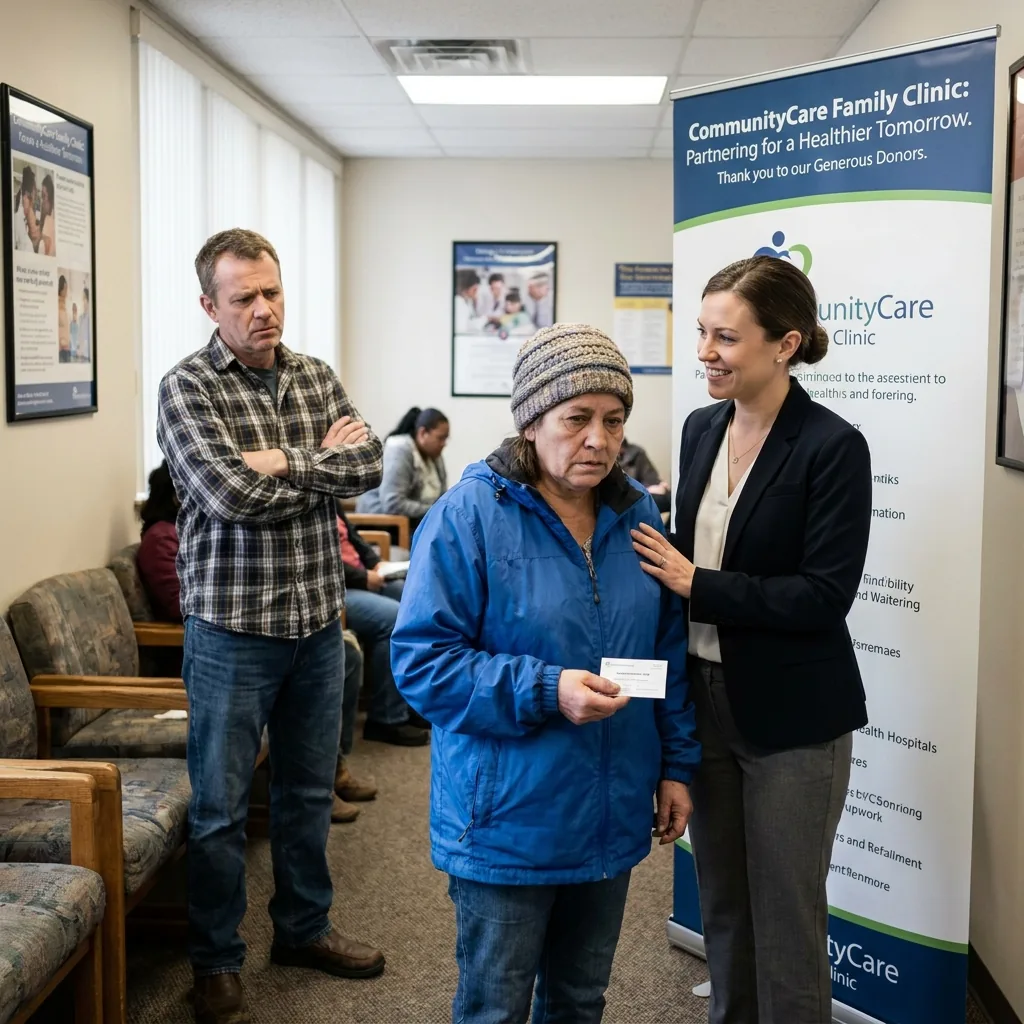
By the time Pam Cross restarted the livestream, the whole waiting room had begun orbiting Renee Holloway’s appointment card as if it were the only thing in the clinic that mattered. Darlene Pike kept calling it proof, but Tessa Morales had already heard enough to know proof was exactly the problem. Pam stepped into the open space between the folding chairs and the refreshment cart, clipped on the microphone, and lifted her practiced fundraiser voice over the ordinary waiting-room noise. A toddler whined near the check-in desk. Somebody’s phone kept buzzing on speaker before it was silenced. The ice in the bottled-water tub cracked when Eli set down another bag. Through all of it, Pam beamed at the ring light and said, “We’re back, and we’re so proud to show how CommunityCare follows through for every patient.” Darlene guided Renee into place again, one hand floating at the middle of her back. The move was soft enough for the camera and too exact to miss from Tessa’s chair. Renee stayed standing but planted her feet wider this time, as if she did not intend to be turned as easily. The appointment card remained in her hand, now creased across the middle. “Renee has her follow-up care secured,” Darlene said. “That’s what continuity looks like.” Tessa looked toward Eli. He stood by the hallway door with the folded chairs stacked beside him, not leaving, not joining in. When a donor with a nametag and a red scarf asked where to put her coat, Eli answered without looking away from the scene. His attention kept returning to the card. Pam smiled toward Renee. “Can you show everyone that card?” Renee lifted it halfway. Darlene touched the bottom edge and raised it the rest of the way so the camera could see. The gesture was small, but Tessa saw two things at once: Darlene wanted the card visible, and Renee was not offering it freely. From where she sat, Tessa still could not read the print. She could see enough to tell the card had a handwritten date, a time, and one thick line where someone had pressed hard with a pen. Darlene kept referring to it like a receipt that settled the room. “This is what support makes possible,” Pam said to the livestream audience. “Real care, real access, real outcomes.” The woman in the red scarf glanced from Pam to Renee. “Was she seen today?” That was the question Darlene had tried to get ahead of. “She is scheduled,” Darlene answered immediately. The donor smiled, still waiting. “Right, but was she seen today?” Before Darlene could answer again, Eli spoke from near the door. He sounded like he was repeating from memory. “Ms. Holloway is all set and already scheduled.” He stopped there. The donor turned to him. “For what?” Eli’s mouth stayed open a second too long. He looked at Darlene before finishing. “For follow-up.” “Today?” the donor asked. Pam cut in with a laugh that landed flat. “And that’s why continuity matters. The important thing is, no one slips through.” Renee lowered the card a little. “I came in this morning because they told me last week to come back and wait,” she said. Darlene’s head snapped toward her, though her smile stayed on for the camera. “And we accommodated you,” she said. Renee looked at the card, then back up. “You told me to hold onto this because people ask fewer questions when they see it.” The room went still in the way waiting rooms rarely do. Even the child by the check-in desk stopped crying for a moment. Pam blinked at the camera and tried to keep going. “What Renee means is that clear paperwork helps patients feel supported.” But the card had stopped behaving like paperwork. It had become an object every eye in the room was tracking, and each person seemed to be reading a different thing into it. Tessa saw the older woman with the cane lift her head at last. The man who had been folding his bill let it stay flat. At the desk, a receptionist pretended to organize clipboards while listening. Darlene reached for the card. “Let me show them.” Renee did not hand it over. She kept both fingers pinched on one corner. That was the first open resistance Tessa had seen from her all morning. Not loud, not dramatic. Just a refusal to let the prop leave her hand. “It says next Tuesday,” Renee said. No one argued with the words right away. Tessa watched Darlene recover by force of volume. “Exactly. Which proves we handled this responsibly.” “You just said she was all set,” the donor in the red scarf said. “People keep asking if she was seen today because you’re standing her in front of a camera like she was.” Pam made a helpless half-turn between them, smile weakening with each second. “We’re highlighting patient journeys,” she said. “Not doing a medical Q and A.” At the edge of the room, another patient walked up to the desk and asked whether walk-ins were still being taken. The receptionist glanced at Darlene before answering. Darlene heard it too. For one second she was trying to run the ceremony, control the card, keep the donor calm, and manage the desk by eye from ten feet away. That was when Tessa saw the shape of the room clearly: ordinary clinic business was being bent around the fundraiser, and the fundraiser was being bent around one appointment card that could not prove what Darlene wanted it to prove. Then Eli made it worse. He stepped away from the folded chairs, held out a paper cup of water toward Renee, and said in the same careful voice, “Ms. Holloway, did you still want me to keep your place for the doctor call list?” Pam stared at him. The donor in the red scarf stared at him. Darlene did too. Because if Renee had already been taken care of, there should not have.