Story code: ST-000572
Part 3: The Script Starts Slipping
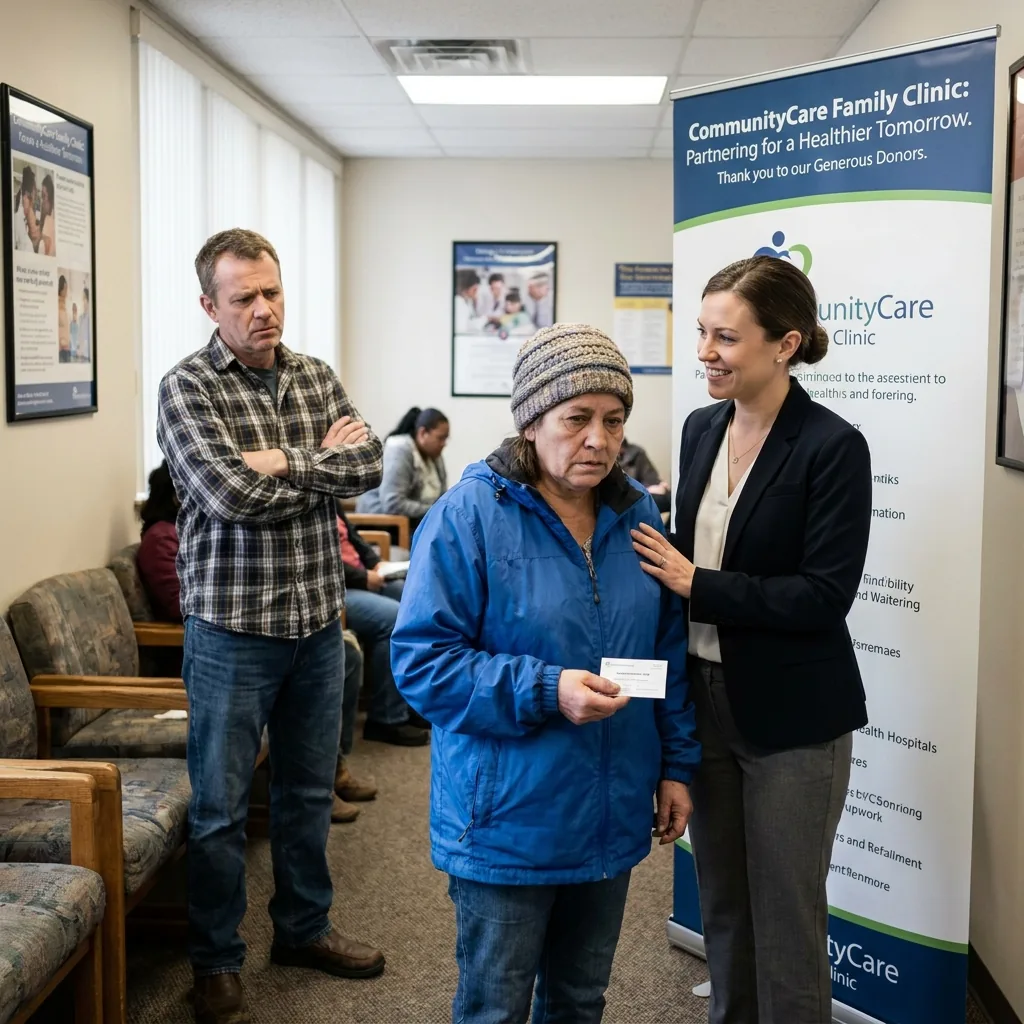
Eli’s question about the doctor call list did more damage than anything Renee had said into the camera, because it sounded routine. Tessa Morales watched the sentence land around the waiting room in small visible ways. The donor in the red scarf lowered her phone. Pam Cross let her microphone hand drop an inch. At the check-in desk, the receptionist stopped shuffling clipboards and looked straight at Darlene Pike instead of past her.
Darlene recovered the only way she had been recovering all morning. She stepped closer to Renee Holloway, put herself half between Renee and the ring light, and raised her voice just enough to reach both the livestream and the chairs.
“What Eli means,” she said, smiling so hard it changed her whole mouth, “is that our staff keeps patients on the list until every detail is settled. That’s diligence. That’s why donors support this place.”
Eli did not nod. He stayed where he was with the paper cup still extended. Renee took it with her free hand but kept the appointment card tight in the other. The card bent again across the middle.
“Then why’d you tell me not to let anybody read it?” Eli asked.
Pam turned toward him fast. “Eli, maybe let’s reset and move to the next segment.”
But he had already said it into the same air as the microphone, and everyone close enough to matter had heard. Tessa saw Darlene’s shoulders go stiff before her bright posture returned.
“Because it has personal information on it,” Darlene said. “Obviously. We protect privacy here.”
The answer might have worked if she had not spent the last twenty minutes using the card as a visual prop. The red-scarf donor looked from the card to the camera to Darlene’s hand still hovering near Renee’s elbow.
“You held it up for the stream twice,” she said.
A laugh came out of Pam, thin and late. “We’re showing support, not details.”
A patient near Tessa muttered, “Support for who?”
The room had begun doing something Tessa had been waiting for. People were no longer treating the fundraiser as separate from their own time there. They were fitting it into what they could plainly see: who was being called, who was still waiting, who kept getting positioned in front of the banner like a display item.
At the desk, the patient who had asked about walk-ins asked again, louder this time, whether the doctor was taking names in order. The receptionist opened her mouth, then looked to Darlene. Darlene answered from across the room without turning fully away from the camera.
“We’re doing our best to accommodate everyone.”
“She came before me?” the patient asked, pointing at Renee. “Or she didn’t? Because now I can’t tell what this is.”
Renee looked down at the appointment card. Then she did something small and final-looking. She folded the top edge back with her thumb so the printed date faced inward toward her palm and no one else could pretend to read it from across the room.
“I was told to stand here,” she said. Her voice was not loud, but the waiting room had gone quiet enough to carry it. “I was told not to make it messy.”
Pam tried to move the program along by clapping once and announcing a donor thank-you, but even she could hear how wrong the timing was. Nobody joined her. The ring light hummed. Somewhere near the front door, the automatic opener groaned and shut again.
Darlene reached for Renee’s forearm. Renee stepped one pace sideways, still inside the half-circle of chairs but out of Darlene’s touch. That movement made the whole setup look different. The smiling supervisor was no longer gently guiding a grateful patient. She was a woman in clinic heels trying to recapture someone who had stopped hitting marks.
“Renee, let’s take care of this privately,” Darlene said.
“No,” the donor in the red scarf said before Renee could answer. “You brought her out here publicly.”
That stopped even Pam.
Tessa saw Eli glance toward the hallway door, then back at the room. He set down the extra chairs, dug into the pocket of his scrub top, and pulled out a second appointment card. It was blank except for a clinic stamp and a line for date and time.
He held it up awkwardly, like he was not sure whether he was helping or making things worse. “These are the cards we hand out at checkout,” he said. Then he looked at Renee’s hand. “Ms. Holloway’s wasn’t written while she was at checkout. Ms. Pike filled it in by the supply cart after the first camera test.”
No one interrupted him. Not Pam. Not the receptionist. Not Darlene.
Tessa did not know anything beyond what she had seen and heard, but she did not need more. If Darlene had written the card after the setup had already begun, then the card had not been proof of care in the way she kept claiming. It had been made to behave like proof in front of donors.
Darlene opened her mouth, smiled at the camera, and started talking too fast.
And Tessa knew Part 4 had already begun before anybody named it.