Story code: ST-000570
Part 2: The Full Clip Started Moving Without Linda
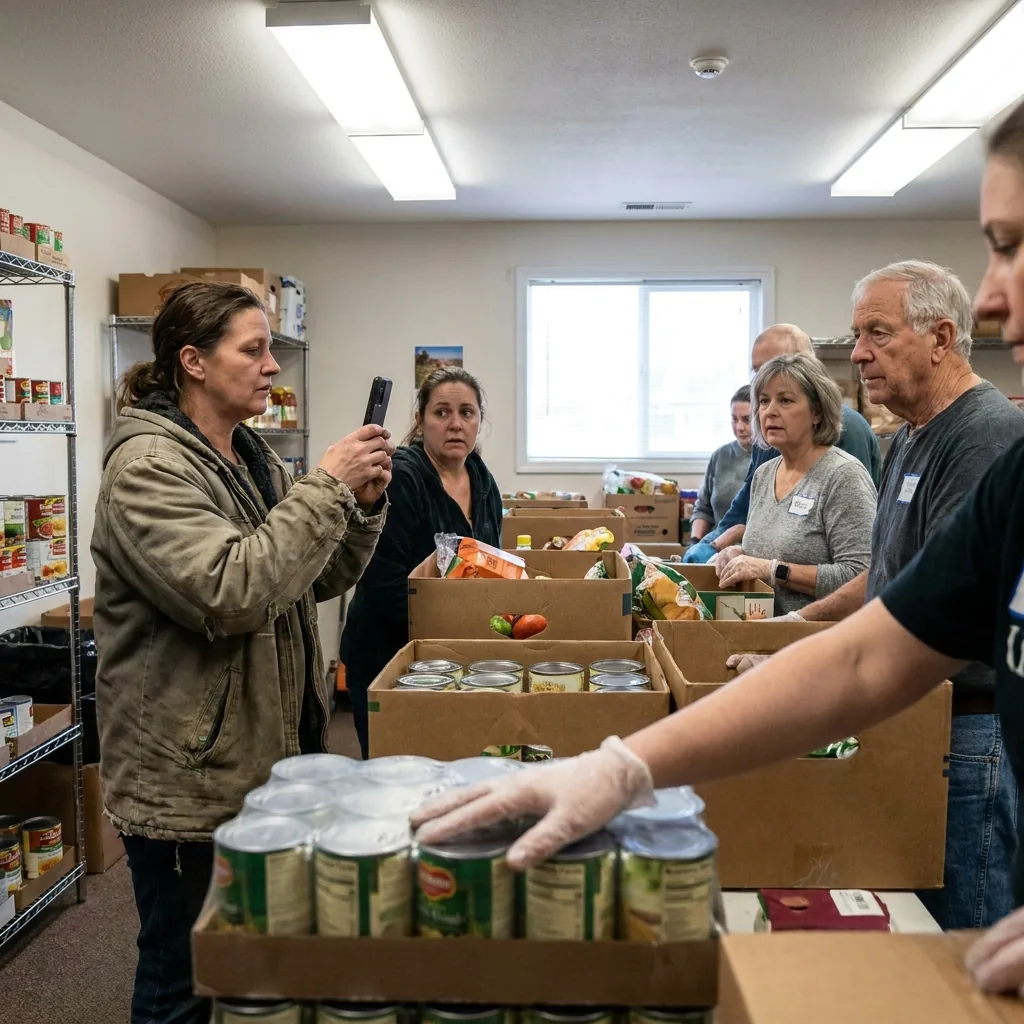
By lunch break, the clip Linda posted had stopped being evidence and turned into a game of who could replay it fastest, but the full version started sliding through the pantry in a different way. People didn’t laugh over that one. They looked down at their phones, went still, and stopped repeating Linda’s words back to each other. I was still at the donation tote tables with packing tape stuck to my wrist when DeShawn came to find me and said, “You need to see where it actually starts.” He didn’t hold the phone out in the air the way Linda had. He kept it low between us near a stack of canned corn flats, screen angled so nobody passing the back doorway could catch it. Even then I glanced over my shoulder first. The floor was busy again on the surface. Clients were moving through. Evelyn was writing on the volunteer clipboard at check-in. Linda was near the shelf aisle, talking too brightly to two church volunteers while still clutching her phone like she expected to use it again. “Make it quick,” I said. DeShawn hit play. The frame was wider than the one going around the room. Same blue donation tote. Same folding chair. Same stretch of concrete floor near the stacked bags. But in the uncropped version, there was more to the left. Enough more to change the whole thing. You could see Tasha beside the tote, turned half away from the camera. You could also see Linda before the moment she had clipped and posted. Linda wasn’t just passing by and catching something in progress like she had implied. She was already there, phone raised, talking at Tasha from a few feet away. The audio was thin and scratchy, but not useless. Linda’s voice came first. “If you have something to say, say it now.” Tasha’s answer was lower. I couldn’t catch every word over the pantry noise around us, but I heard, “Stop filming me,” clear as a bell. Then the camera shifted. Tasha moved sideways with the tote between them, one hand up toward the phone, not lunging, not putting on any scene for the room, just trying to block the lens. The tote wobbled. A bag slid. Tasha bent down fast toward the fallen item, and that bent-over second was the exact piece Linda had cropped and launched into the group chat with her own running commentary over it. DeShawn stopped the video before it rolled farther. I looked up at him. “She cut out the part where Tasha told her to stop.” “And the part where she was already in her face,” he said. That was the accusation change right there. The cropped clip invited everybody to believe Tasha had been sneaking around behind the totes with somebody or doing something hidden. The uncropped one showed Linda pushing a phone into a private moment, getting told to stop, and then packaging the scramble that followed like she had caught misconduct. Not a new story. The same story with the missing part put back. I handed the phone back. “Who sent you this?” He shook his head once. “It’s moving.” That fit the room better than a name would have. Once a video gets loose in a place where every volunteer has three group texts and a church friend who knows another volunteer, ownership stops mattering. Screens become legs. At the check-in table, Evelyn looked over and caught my face. She walked over when the next client stepped away. “You saw it?” she asked. I nodded. “So did I,” she said. Her tone stayed level, but she set the clipboard down harder than usual on the sorting table. “She should never have posted any of it.” Across the floor, Linda was still trying to hold the earlier version in place. I could hear pieces of her voice between the tote stacks and shelf aisle. “The larger point still stands.” “Don’t get distracted by editing arguments.” “I did what I had to do for accountability.” That word accountability had started sounding like costume jewelry on her. A younger volunteer near the canned goods asked, not very quietly, “Then why’d you cut the first part out?” Linda turned so sharply the phone in her hand flashed under the fluorescent lights. “Because I’m not required to post every second of something to address a problem.” Nobody answered that. Which said more than an argument would have. Tasha had stayed near the tote area most of the morning, not making any speech, not chasing anybody for apologies. She was re-stacking a split bag box now with slow, controlled movements. Once, she bent to pick up a tape roll and paused when two volunteers passed behind her whispering over a screen. She straightened without looking at them. I walked over and asked, “Do you want me to get Linda to take it down?” Tasha kept her eyes on the box flaps. “Can she pull back what everybody already saw?” It wasn’t dramatic. Just flat. Practical. The kind of question that makes the room around it feel cheap. Before I could answer, Linda came toward us. She stopped a few feet away, close enough that all three of us were boxed in by donation totes on one side and the sorting table on the other. Her voice was low now, careful for the first time all day. “There’s misinformation spreading,” she said. DeShawn, who had followed me over, let out one short breath through his nose. “Misinformation?” Linda kept her eyes on me instead of him. “Mara, if people are showing you alternate versions, I’d appreciate you directing them to me before this gets uglier than it already is.” “Alternate?” I said. “It’s the same clip with the front left on.” Her jaw tightened. “Incomplete context can distort things both ways.” Evelyn had come up behind us without saying anything. I only knew she was there when she spoke from my left. “So the full context is with you?”.