Story code: ST-001032
Part 2: Structural Debris
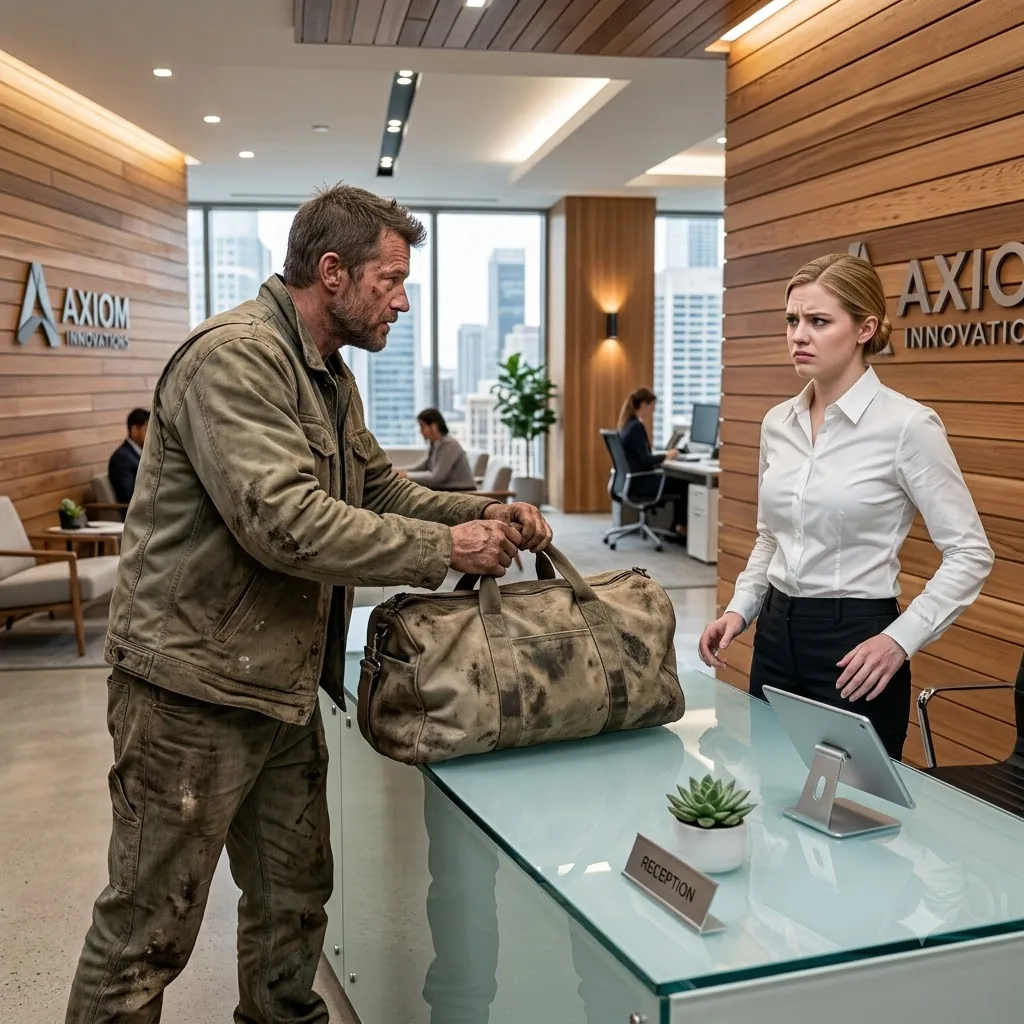
The zipper parted with a harsh, grating screech. Before the guard could unholster his weapon, Elias plunged both hands into the damp, coarse interior of the duffel bag. His fingers brushed against loose soot and damp earth, finding the jagged, familiar edges he had dug out of the smoldering ruins of his life just six hours ago. He gripped the heavy objects tight, ignoring the sharp, carbonized splinters biting deep into his palms. With a heavy grunt, he hauled the contents upward.
The first item he slammed onto the pristine frosted glass was a massive, charred section of a wooden support beam. A thick cloud of fine, gray ash puffed outward into the sterile, climate-controlled air, raining down like dirty snow over the clerk’s gleaming curved monitor. Immediately following the beam came a cracked, soot-stained cinder block. The reinforced glass counter groaned under the sudden, immense weight, a web of microscopic stress fractures blooming beneath the rough concrete.
“Hands! Let me see your empty hands!” the guard bellowed, his voice cracking with a sudden rush of adrenaline. A heavy black stun-pistol was now drawn and leveled directly at Elias’s chest.
Elias ignored the weapon entirely. He kept his ash-smeared hands planted firmly on either side of the ruined post. The wood was deeply scorched, radiating a phantom scent of the blaze, smelling violently of chemical accelerant and crushed pine. Bolted to the blackened surface was a warped sheet of municipal aluminum. The stamped metal numbers-4, 1, 1-were perfectly legible, though the metal had blistered from the intense heat. Below the numbers, half-melted but intact, was a municipal zoning barcode.
“There is your structure,” Elias said, his voice a low, gravelly rumble that cut through the clerk’s high-pitched gasps of panic. He tapped a soot-stained finger against the warped aluminum. “Route 4, Marker 11. That is the physical foundation. That is the county registry plate. Scan it.”
The clerk shoved her wheeled chair back so violently it slammed into the frosted glass pillar behind her desk. She pressed her spine against it, her perfectly tailored charcoal blazer wrinkling, holding her manicured hands over her mouth. She stared at the pile of debris as if it were an active explosive. Black ash was already settling over her pristine white keyboard, marring the spotless aesthetic of her workspace.
“You’re contaminating the intake field!” she gasped, her professional, neutralizing frequency completely shattered. “You brought contaminated waste into a Level One center!”
“I said step back from the counter!” the guard shouted. The heavy rubber soles of his boots squeaked as he closed the distance, stopping a cautious eight feet away. A brilliant red laser targeting dot snapped onto the center of Elias’s faded canvas jacket. “Put your hands on your head and drop to your knees! Do it now!”
Elias didn’t move. He felt a drop of cold sweat trace a line down his ribs. He looked down at the red dot resting over his sternum, then slowly turned his head to look at the guard. The young man’s face was pale, sweating under the harsh LED lights. His hands were shaking just enough to make the laser dot vibrate rapidly against Elias’s chest.
“I brought the structure,” Elias said, turning his focus back to the clerk. His tone remained stubbornly conversational, though his heart hammered a heavy rhythm against his ribs. “The registry requires proof of physical residence to process an intake claim. Scan the barcode. It has the deed embedded in the micro-etching. It proves I have a domicile. It proves I exist.”
Across the vast atrium, the man in the cashmere sweater was sprinting for the exit, his leather shoes slipping frantically on the polished tiles as he abandoned his tablet on the floor.
“It isn’t waste,” Elias continued, a cold, hard knot tightening in his stomach. “It’s my home. Your enforcement drones burned it to the foundation at midnight, but the registry plate survived. The physical structure exists. I am presenting it. Now process the intake.”
“Code Red, Sector Four primary atrium,” the guard yelled into a radio clipped to his shoulder, never taking his eyes or his weapon off Elias. “Hostile individual. Unidentified contraband on the counter. Sealing the sector.”
A high-pitched, rhythmic klaxon began to wail from the vaulted ceiling. The blinding white LED strips instantly shifted to a pulsing, harsh crimson, bathing the pristine room in the color of a severe emergency. Above the massive glass rotation doors at the front of the building, heavy steel lockdown shutters began to unspool and grind downward, sending a deep vibration through the floor beneath Elias’s boots.
Elias watched the steel descend in his peripheral vision, realizing the devastating trap he had just sprung on himself. He had walked six miles to force a bureaucratic correction, driven by the exhaustion and desperation of a man who had lost everything overnight. He had reasoned that physical, undeniable proof would force the system to acknowledge a clerical error. He hadn’t realized that the system was incapable of recognizing a physical reality that contradicted its digital truth. To the algorithm, he wasn’t a citizen presenting proof; he was an unauthorized variable introducing a physical threat into a secure zone.
“Listen to me,” Elias said, leaning his weight against the groaning glass counter, ignoring the guard’s frantic commands to get on the ground. “If those shutters lock, I am trapped in here, and you are trapped in here with me. My family is sitting in a transit camp right now because your system says they don’t have a home to return to. Pick up your scanner.”
“I can’t!” she sobbed, shrinking away, shaking her head frantically. “The scanners won’t read unregistered debris! The system wiped that sector’s barcode thirty days ago! Even if I scan it, the terminal will just register a dead link! It doesn’t exist!”
The heavy steel shutters hit the floor with a massive, reverberating boom, sealing the atrium entirely. The magnetic locks engaged with a series of sharp, metallic clacks.
“Get down on the ground!” the guard screamed, his finger tightening on the trigger, the stun-pistol emitting a high-pitched whine as its internal capacitors reached maximum charge.
Elias stood anchored at the counter, bathed in the pulsing red light. He looked at the melted numbers on the wooden post, then at the terrified clerk who was shrinking away from the only proof he had left. The digital system had already erased his life; now the physical system had locked him in a cage. If he stepped back, he lost his family to the transit camps forever. If he moved forward, the guard would fire.
Slowly, Elias shifted his grip on the heavy, soot-stained cinder block.