Story code: ST-001327
Part 4: Load Bearing
The wealthy woman’s perfectly manicured hands began to shake. The heavy diamond on her ring caught the overhead fluorescent light, but the steady, arrogant stillness that had anchored her presence just moments before was entirely gone. Marnie watched the color stay completely drained from the woman’s face, leaving her looking hollow and suddenly very old under the harsh supermarket lighting. The air horn of the county bus blared again, a deafening vibration rattling the glass of the storefront, but the woman didn’t blink. She fumbled blindly into her oversized designer leather handbag, her acrylic nails scraping frantically against the expensive lining until she produced a sleek, silver smartphone.
Marnie saw the phone’s screen light up. Several missed calls from a number labeled with a construction company’s name. The woman’s breath hitched, a sharp, ragged gasp that carried over the low, mechanical hum of the refrigerated coolers. She didn’t look at the pipefitter again. She didn’t look at Marnie. Without a single word of her former demands, she turned on her heel. The pristine camel-hair coat flared out behind her as she practically sprinted toward the automatic doors. She abandoned the wedge of artisan brie, the imported sparkling water, the organic asparagus, and-most importantly-the crumpled municipal hardship voucher still resting flat on the scanner glass. The doors slid open, letting in a violent gust of freezing sleet, and then she was gone, swallowed entirely by the dark, wet parking lot.
Marnie stood frozen behind the counter for a second, listening to the wind howl before the glass doors sealed shut again. The silence that rushed back into the store felt heavy, thick with the sudden absence of the woman’s suffocating vanilla and cedar perfume. On the register monitor, the bright green text was still flashing its relentless ultimatum.
*MANAGER OVERRIDE REQUIRED: Y / N?*
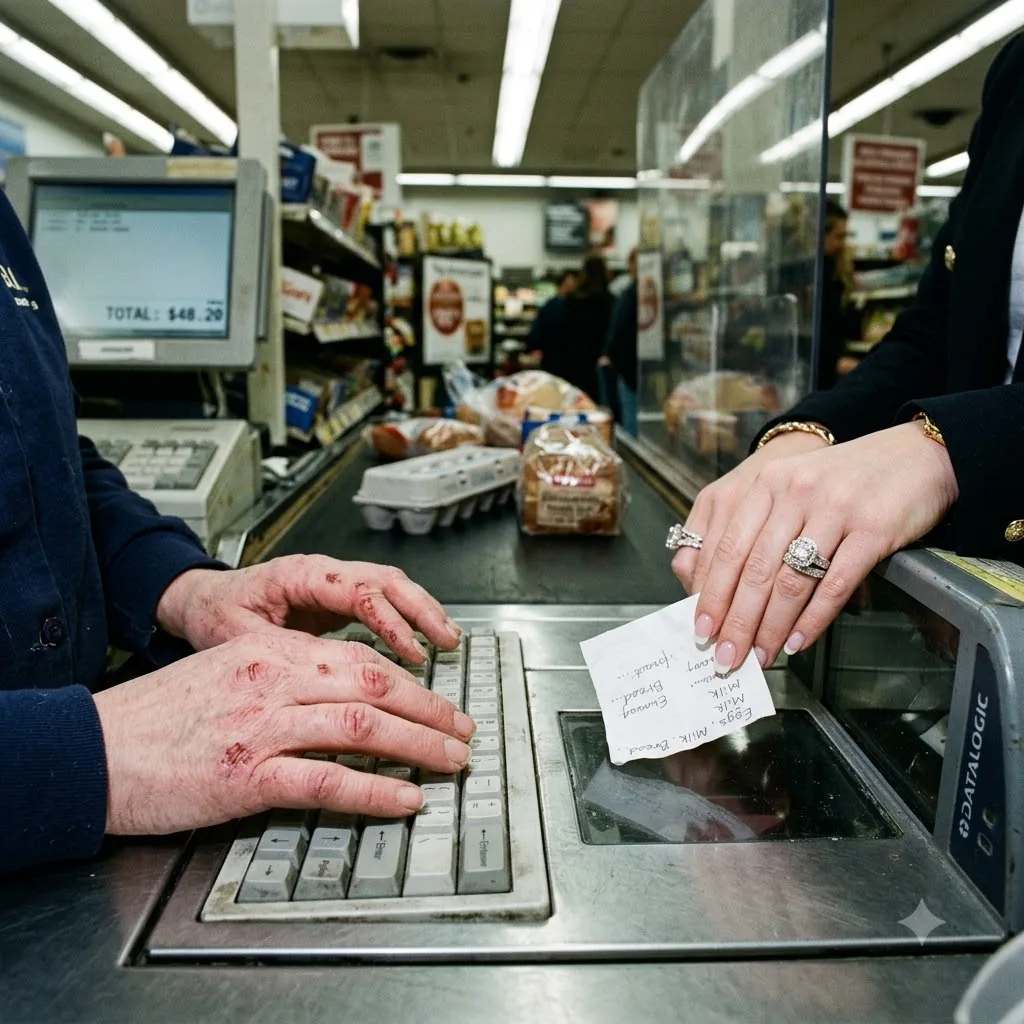
Marnie looked down at her raw, sanitizer-cracked hands. Her thumb throbbed where the bruised blood sat trapped under the nail. She reached out and pressed the gray plastic key labeled ‘N’.
*Beep.*
The harsh, error-red box did not return. The screen simply cleared, resetting to a blank transaction interface. The cash drawer remained securely locked inside its metal casing. The transaction was permanently voided. The woman had paid five hundred dollars cash for the stolen slip, and now she had nothing to show for it but a collapsing two-million-dollar renovation.
Marnie picked up the torn, grease-stained hardship voucher from the scanner glass. She folded it precisely in half, avoiding the damp crease, and slipped it into the red corporate lockbox slot bolted beneath the register. Tomorrow, the absentee manager would find it, log it as an abandoned fraudulent tender, and mail it back to the county relief office. It wouldn’t fix the desperate local family’s immediate problem, but it meant the money wouldn’t line the pockets of a predator.
“Sorry about the mess,” a gravelly voice said.
Marnie looked up. The pipefitter was stepping forward. He didn’t acknowledge the abandoned fancy cheese or the sparkling water. He just used his thick, oil-stained forearm to push the wealthy woman’s discarded items down the black rubber conveyor belt, making room for his own groceries. He set down his plastic gallon of whole milk and his loaf of discounted white bread.
Marnie pulled them across the red laser grid. “Four dollars and eighteen cents,” she said, her voice still raspy, but the tight, suffocating panic in her chest had finally dissolved.
The man pulled a worn leather wallet from his heavy canvas Carhartt coat and handed her a crumpled five-dollar bill. As Marnie counted out his coins, she handed them back, her bruised fingers briefly brushing against his calloused, grease-stained palm. He didn’t smile, and neither did she. They didn’t need to. He just gave her a slow, quiet nod-a silent acknowledgment of the exhaustion in her eyes, a shared understanding of the sheer endurance required to survive in a town that was actively being sold out from under them.
“Have a good night,” he rumbled, grabbing his milk by the plastic handle.
“You too,” Marnie said.
He turned and walked toward the exit, his steel-toed boots scraping a steady, grounded rhythm against the scuffed linoleum floor. Marnie immediately slammed her fist onto the sign-off key. The monitor went black. She ripped her faded polyester grocery smock over her head, grabbed her heavy winter coat from the stool behind her, and sprinted for the front doors.
She burst out into the freezing November rain just as the county bus’s air brakes hissed, the hydraulic doors beginning to fold shut. Marnie waved her arms frantically. The driver, a tired-looking older man who knew her schedule, paused. The doors swung back open with a heavy mechanical groan.
Marnie climbed the rubber steps, her thin canvas sneakers instantly soaking through with icy slush. She swiped her transit pass and collapsed into a cracked vinyl seat near the back. The bus lurched forward, pulling away from the glowing fluorescent box of the supermarket. Marnie rested her head against the cold, vibrating window. As the bus turned onto Route 9, she looked up through the driving sleet toward the dark silhouette of the ridge. She couldn’t see the Wellington Estate from here, but as the bus’s diesel engine rumbled deep into her aching bones, she found herself smiling at the thought of all that expensive oak and plaster, quietly tearing itself apart in the dark.