Story code: ST-000203
Part 2: False Positives
The sharp, metallic scrape of a Kydex holster snapping open tore through the suffocating silence of the high school hallway. Officer Vance drew his sidearm. The harsh, buzzing overhead fluorescent lights caught the matte black slide of his Glock as he leveled it directly at Mateo’s center of mass. The sudden, violent escalation hit Officer Donnelly like a physical blow to the sternum. Decades of ingrained tactical training took over his limbs; Donnelly’s right hand immediately dropped to his own duty belt, unfastening the rigid retention strap and drawing his firearm in one fluid, practiced motion. But unlike his partner, Donnelly kept his muzzle pointed strictly at the scuffed linoleum floor. He stared down the narrow corridor of navy-blue lockers, his eyes desperately tracking the boy’s erratic, frantic movements. Mateo’s narrow shoulders were heaving, his breath whistling through his teeth in jagged, terrible gasps. The kid wasn’t squaring up for a firefight. He wasn’t bracing for an ambush. Donnelly could see it in the wide, terrified whites of his eyes-the boy was suffocating on his own panic.
“Show me your hands right now!” Vance roared, the sheer volume of his voice cracking with pure, adrenaline-fueled aggression, echoing painfully off the cinderblock walls. His tactical stance was textbook perfect-feet planted wide, shoulders hunched, both hands wrapped tightly around the grip of his pistol. Mateo let out a strangled, high-pitched sob and yanked his left hand out of the dark depths of the faded nylon backpack. His trembling fingers were wrapped rigidly around a bulky, cylindrical object made of dark, heavy plastic and dull metal. In the stark, unforgiving shadows of the high school corridor, the silhouette of the item was terrifyingly ambiguous.
“Gun! Drop the weapon!” Vance screamed, taking a quick, sliding step backward to maintain his reactionary distance, his index finger slipping dangerously inside the trigger guard. Donnelly’s breath hitched violently in his throat. His vision tunneled, hyper-focusing completely on the boy’s shaking hands. His brain processed the visual data in fractions of a second. There was no barrel. There was no slide, no magazine well, no hammer. It was a thick, transparent plastic tube attached to a pressurized silver canister-an asthma spacer, oversized and wrapped haphazardly in silver duct tape at the base, completely obscuring its standard medical appearance.
“Hold!” Donnelly barked, stepping laterally to his left. It was a dangerous, heavily discouraged tactical maneuver, but it successfully placed his armored body partially across Vance’s direct line of sight. “Vance, hold your fire! It’s not a weapon! Look at his hands!”
“Step out of my line, Donnelly!” Vance shouted back, his voice trembling with a terrifying, unyielding certainty. “The system flagged him! Look at your damn arm! Look at the threat level!”
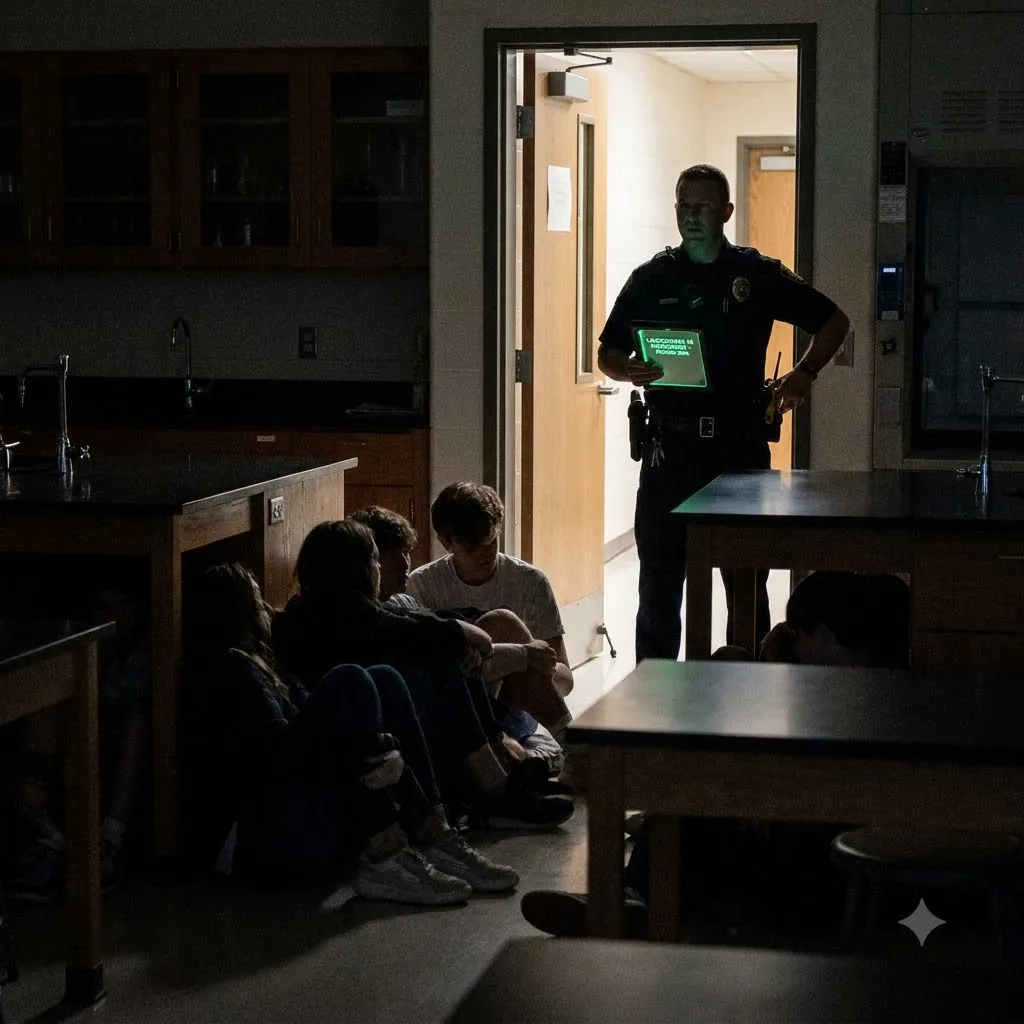
Donnelly didn’t have to look; he could feel the intense, rhythmic vibration against his forearm. The heavy tactical tablet strapped over his uniform sleeve was buzzing frantically, emitting a pulsing, crimson glow that reflected off the polished floor tiles. Donnelly dared a split-second glance at the reinforced screen. The experimental threat-assessment algorithm had updated. The text was no longer a static red warning. It was a rapidly scrolling feed of terrifying, automated deductions: *Chemical/Aerosol Deployment Detected. Escalation Level: Critical. Lethal Force Authorized to Prevent Mass Casualty.*
The sheer absurdity of the data stream clashed violently with the agonizing reality standing just three feet in front of him. The new smart-campus integration system, designed to pull fragmented acoustic data and chemical sensor readings from the school’s grid, was wildly misinterpreting the situation. It was analyzing the pressurized aerosol canister, the metallic shape, and the audio of the boy’s desperate, heavy wheezing, and classifying it as a biochemical attack in progress. It was a localized, high-tech witch hunt, and the sterile machine logic was currently acting as judge, jury, and executioner.
Mateo’s knees finally buckled under the crushing weight of his lack of oxygen. He collapsed against the cold cinderblock wall, sliding down the painted bricks until he hit the floor. The heavy black backpack slipped from his wrist, hitting the linoleum with a loud, metallic clatter that sounded dangerously like loose pipe casings or heavy ammunition. Inside the gaping zipper, Donnelly caught a fleeting glimpse of a tangled mess of copper wires, heavy lithium battery packs, and exposed green circuit boards-a complex, homemade robotics project or engineering assignment. It was the exact kind of dense, metallic anomaly that would have triggered the smart-detectors at the school’s front entrance, silently feeding the boy’s profile into the LAPD threat matrix hours ago.
The sharp clatter of the heavy bag sent Vance completely over the tactical edge. “He’s got a detonator! Get flat on the ground, face down!” Vance closed the distance, stepping aggressively around Donnelly’s blocking maneuver to re-establish a clear, unobstructed line of fire. Donnelly could see his partner’s eyes were wide, completely absorbed by the flashing red light reflecting off the lockers, treating the digital mandate on his own wrist screen as absolute gospel.
Mateo brought the taped medical spacer to his mouth, his lips turning a faint shade of blue. His chest violently spasmed as he tried to trigger the canister. Donnelly watched the boy struggle, recognizing the desperate need for air, but Mateo’s shaking fingers lacked the strength to properly depress the stiff metal valve. The boy let out another horrible, wet gasp, looking up at the black muzzle of Vance’s gun with wide, tear-filled eyes, entirely paralyzed by the shouting officer.
“He’s deploying it!” Vance yelled, his arms locking out straight as he took up the final millimeter of slack on the trigger. The tablet on Donnelly’s arm emitted a high-pitched, continuous digital tone-the final algorithmic confirmation of an active, lethal threat. The sterile intelligence of the machine had entirely rewritten the reality of the scene in Vance’s mind, transforming a dying, terrified teenager trying to take a breath into a hardened tactical target initiating a massacre.
Donnelly realized with a cold, sickening drop in his stomach that shouting verbal commands to his partner was no longer an option. Vance was less than a pound of pressure away from ending a high schooler’s life over a catastrophic technological false positive. With the drone of the tablet’s kill-order ringing in his ears, Donnelly slammed his own sidearm back into its holster. His hands were suddenly empty in the middle of a lethal standoff, and he shifted his weight, driving his heavy tactical boots into the linoleum. He braced his shoulders, preparing to cross the ultimate, unspoken line of the badge and physically tackle the man he had trusted with his life to the ground.