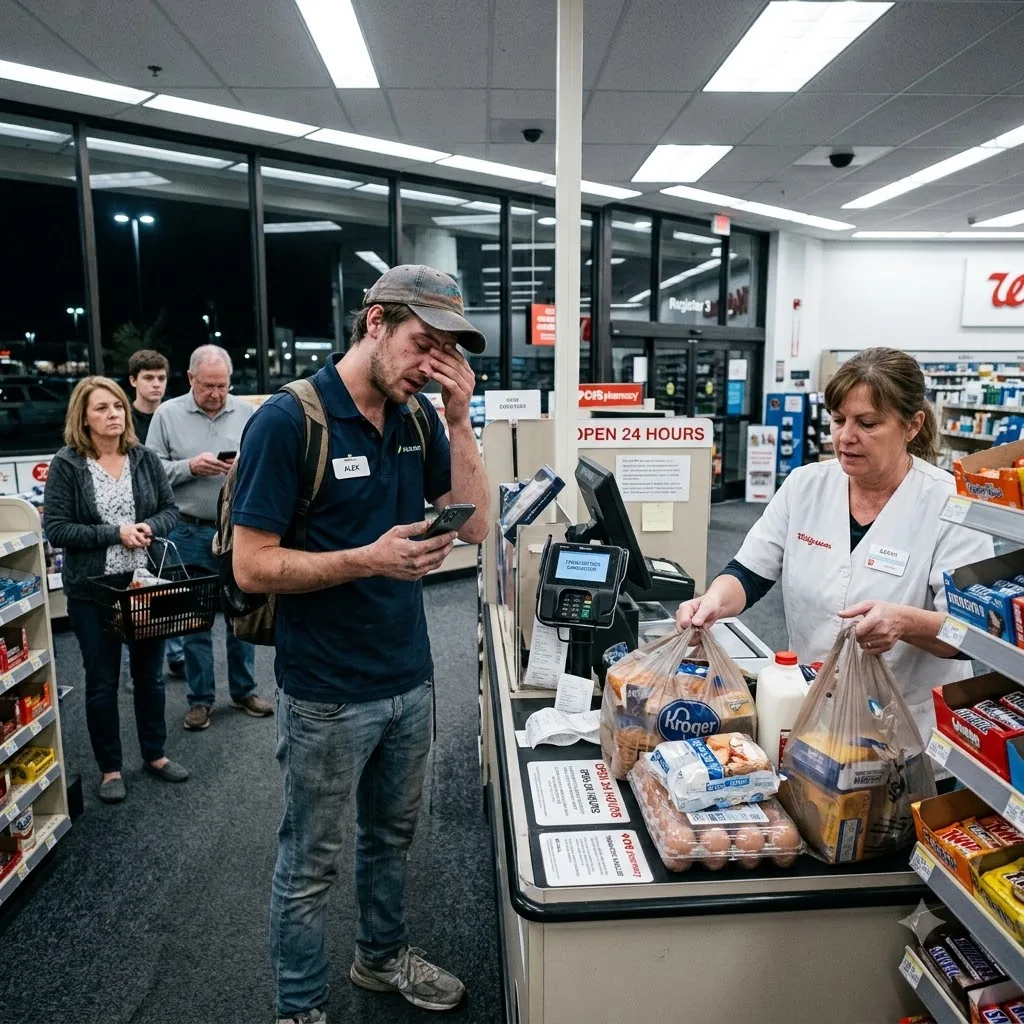
Story code: ST-001594
Part 2: The Rule Inside the Appeal
The music ran for another full minute before the line clicked and a different voice came on.
“Driver support, this is Mel. Can you confirm your name and the phone number on the account?”
Ramon shut his eyes for a second. He gave the information again, slower this time, while the automatic doors breathed open and closed behind him. Cold air slid over the back of his neck and was gone.
“Thank you,” Mel said. Her voice was flatter than the first agent’s, less polished, more tired. “I do see a restriction on your account tied to an appealed customer report. Before we proceed, I need to advise you this call may be monitored and notes from this conversation may be added to the case file.”
Case file. Like he had done something that belonged in one.
He shifted the phone tighter against his ear and looked toward the register. His order was still split behind the counter and under it, paper bags on one side, cold items in the handbasket below. The cashier had stopped glancing at him. That was somehow worse. He had gone from problem to fixture.
“Fine,” he said. “Just tell me what happened. I was in the middle of paying.”
“I understand. Please hold while I review the appeal notes.”
He almost laughed again, but there was no room for it.
A shopping cart clipped his ankle as somebody squeezed past. He muttered sorry and moved deeper toward the wall of vitamins, away from the lane, away from the register where his night had broken open. Above the coolers, a security mirror showed the front half of the store in a warped silver bubble. In it he looked smaller, bent at the shoulders, phone glued to his face.
Keys clicked on the other end.
“Okay,” Mel said. “The restriction is attached to a delivery from earlier this evening. The customer states the order was not delivered to the agreed location and that the driver created an unsafe condition at the property. Because the customer disputed the delivery outcome and selected safety concern language during the appeal, the system applied an automatic temporary hold.”
Ramon stared at the mirror until his own reflection blurred. “Unsafe condition?”
“That is the language in the appeal.”
“No. There was already something unsafe there. That’s what I was trying to tell the other agent before the line dropped.”
He could hear her breathing, hear the tiny pause that meant she was deciding whether to interrupt.
“You can provide your statement,” she said at last. “But I need to make you aware of policy first. When a customer appeal includes potential property hazard, threat, or bystander risk, support cannot simply remove the restriction during the initial contact. We have to document the driver’s statement and escalate to Trust and Safety.”
The words landed one after another, dry and bureaucratic, but together they formed a trap. Not simply remove. Initial contact. Escalate.
“So you can’t unlock it.” He already knew the answer from her silence.
“Not from this line, no.”
He looked at the handbasket under the register, at the frost collecting on the frozen dinners. The customer was waiting somewhere for groceries that were now neither paid for nor canceled. His own things were in the same pile. Every minute made all of it worse.
“Then cancel the order,” he said. “Or transfer it. I can’t stand in a pharmacy all night while your system investigates me.”
“Because the order is connected to an active account restriction, I can’t release it to reassignment until the store transaction status is clarified. Did payment complete?”
“No. The app locked before checkout.”
“Then the order remains open but unfulfilled.”
“What does that even mean for me?”
“At this stage it means you should not attempt to complete the purchase or proceed with delivery unless directed by support.”
Ramon pressed his thumb against his forehead. He could feel a headache trying to start behind one eye. “The store is not going to hold this forever.”
“I understand that.”
But she said it in the way people did when they understood nothing except the shape of the sentence they were supposed to say.
At the register, the cashier crouched, lifted the frozen items from the handbasket, and carried them toward a freezer case near the pharmacy counter. She was putting part of the order back.
Ramon straightened at once. “Wait. Wait.” He raised a hand at her, phone still to his ear. “Those are for the order.”
She looked over from halfway across the aisle. “I can’t keep cold stuff out indefinitely.”
“I’m on support now.”
“Good for you,” said the man she was ringing up, not bothering to lower his voice.
Heat climbed up Ramon’s neck. He turned away before he said something stupid and got himself thrown out on top of everything else.
“Sir?” Mel said. “Are you still there?”
“Yeah.” He kept his voice down by force. “Yeah, I’m here. Listen. The customer had a side door. In the notes it said side entrance, leave on the mat. I got there and there was something by the door that wasn’t in the photo from the app. I texted the customer because of it. I told them there was-”
He stopped himself.
The thing by the side door came back all at once: the weak yellow light over the frame, the narrow concrete strip wet from an earlier rain, the little wedge of darkness between the trash bins and the siding. The shape had been ordinary for half a second and wrong the next. Not the sort of detail a person forgot. Not the sort of detail you wanted frozen into a transcript if you said it badly.
“There was what?” Mel asked.
He swallowed. Around him, the pharmacy hummed and clicked and breathed, painfully normal.
“Something that made me not want to leave the bags there,” he said. “So I messaged. The customer answered fast. Too fast, almost. Told me to put them down anyway and go.”
Mel was quiet long enough that he knew she was typing it exactly as he said it.
“Did you take a completion photo?” she asked.
“Yes.”
“Did the customer retrieve the order while you were on site?”
“I don’t know. I didn’t stay to watch them eat their groceries.”
Another pause. “I’m asking because the appeal notes say the customer observed the driver remain near the side entrance after drop-off.”
Ramon gripped the cart handle so hard the metal bit into his palm. “I remained there because I was texting about the thing by the door. And because I was deciding whether I needed to call somebody other than the customer.”
That changed something. Not much, but enough that he heard her inhale.
“Call somebody such as emergency services?”
He glanced toward the front windows. The parking lot outside was black glass with a few smeared reflections. His own car sat beyond the reach of the pharmacy lights. It suddenly felt very far away.
“I don’t know,” he said. “Maybe. I left before I did.”
“Why did you leave?”
Because the customer had opened the inner door without unlatching the screen. Because a voice from inside had told him, sharp and low, to put the order down and get off the property. Because the hair on his arms had lifted even before he stepped back.
But if he said any of that now, to a stranger reading boxes off a monitor, it would sound like either panic or performance.
“Because I had another order after that,” he said. “Because this job punishes you for stopping. Because I thought reporting it in chat would be enough.”
“Did you report it in chat?”
Ramon went still.
He had opened the customer thread. He had typed. Then a new batch offer had flashed across the top of the screen before he hit send. The route timer, the payout, the stupid constant pressure to keep moving. He remembered telling himself he would send the message from the car, then from the next red light, then after the next pickup.
He could not remember ever seeing the message go through.
“Sir?” Mel said again.
He looked back to the register.
The cashier was separating his own items from the customer’s order now, scanning for the receipt he no longer had, preparing to void whatever could be voided. If she finished, the open order in the system would no longer match the groceries in the store. If it did not match, support would have another note, another discrepancy, another neat little reason to believe the customer first.
And then his phone buzzed against his ear with a new sound layered over the call: a text notification from an unknown number.
He pulled the screen away just enough to see the preview.
I saw you leave. You need to tell them the whole thing this time.