Story code: ST-001813
Part 2: Institutional Violence
Arthur stared at the plastic storage bin resting against the baseboard. Inside, he could see the spine of his battered Oxford English Dictionary and his ceramic coffee mug, hastily shoved against a stack of dry-erase markers. The visual confirmation that strangers had already rummaged through his private workspace sent a cold spike of adrenaline directly into his chest.
He forced his hands to unclench. If he raised his voice, if he showed even a fraction of the raw panic flooding his system, Dr. Vance would weaponize it as proof of his instability. He had to fight back using the only remaining leverage an adjunct possessed: the bureaucratic machinery of the university itself.
“A wellness check of a license plate,” Arthur said, keeping his voice deliberately flat, “is a matter for campus parking enforcement, not academic affairs. Furthermore, you do not have the authority to clear my office. My contract mandates a formal review with a Human Resources representative present before any suspension of duties.”
Dr. Vance did not blink. She offered a slow, pitying nod, as if humoring a child who had just recited a meaningless rhyme. “I hear your need for procedural rigidity, Arthur. Clinging to rules is a very common grounding technique when we feel our reality shifting. But HR is for disciplinary actions. This is a care-based intervention. We are not terminating you; we are transitioning you to a season of mandatory healing.”
“It is an unpaid suspension,” Arthur countered, leaning forward. “You are stripping me of my only source of income because I cannot afford rent. How does pushing an unhoused employee into total poverty align with the university’s core values of community care?”
He watched her face, waiting for the rhetorical trap to close, hoping the stark hypocrisy of her actions would force a retreat. Instead, Dr. Vance pressed her hands over her heart, projecting a sickening aura of profound sorrow.
“Arthur, it is an act of institutional violence to demand academic labor from someone in active survival mode,” she said softly. “Your housing insecurity creates an inherently unbalanced power dynamic in the classroom. You are bringing unhealed survival trauma into a sacred learning space. It is not fair to the vulnerable scholars who look to you for emotional safety.”
Arthur felt the breath leave his lungs. She had perfectly inverted reality. His poverty was not a crisis for the institution to help solve; it was a toxic contaminant from which the wealthy student body needed to be shielded.
“I want to appeal this,” Arthur said, his voice trembling despite his best efforts to suppress it. “I want a formal grievance hearing with the provost.”
“You have every right to self-advocate,” Dr. Vance murmured, sliding a pre-printed form across the bamboo desk. “However, to initiate an appeal for a care-based leave, our bylaws require you to submit a comprehensive fitness-for-duty evaluation. It must be conducted by one of our partnered psychiatric specialists to ensure you are emotionally regulated enough to return to the classroom.”
Arthur stared at the form. “And who pays for this evaluation?”
“As an adjunct faculty member, you fall outside our premium wellness coverage network,” Dr. Vance explained, her tone dripping with rehearsed sympathy. “The out-of-pocket cost is typically around fifteen hundred dollars. Or, you can sign this Community Transition Agreement. It provides a one-time severance of five hundred dollars, provided you agree to step away quietly and prioritize your healing.”
It was an execution disguised as an act of grace. He had seventy-four dollars in his checking account. He could not afford a psychiatric evaluation, which meant he could not appeal, which meant he was fired.
“I am not signing an NDA disguised as a transition agreement,” Arthur said. He reached for his leather satchel, intending to retrieve Tyler’s heavily red-inked essays to prove he was still doing his job, but stopped. He needed to get to his car. If they knew about his license plate, the commuter lot was no longer safe.
Dr. Vance sighed, a heavy exhalation of pure disappointment. “I was hoping we could partner in this process, Arthur. But I respect your choice to resist. I have asked Campus Safety to assist with your emotional offboarding. They will escort you to your vehicle to ensure a seamless transition off university grounds.”
She pressed a discreet button on her standing desk. Almost instantly, the door opened behind him. A campus security officer in a high-visibility yellow vest stepped into the room, holding Arthur’s plastic storage bin.
Arthur stood up, his knees stiff and aching. He did not look at Dr. Vance again. He walked out of the eucalyptus-scented office, flanked by the security guard, enduring the agonizingly slow march across the sunlit quad. Students he recognized from his seminars averted their eyes, pretending not to see their literature professor being marched off the premises like a criminal.
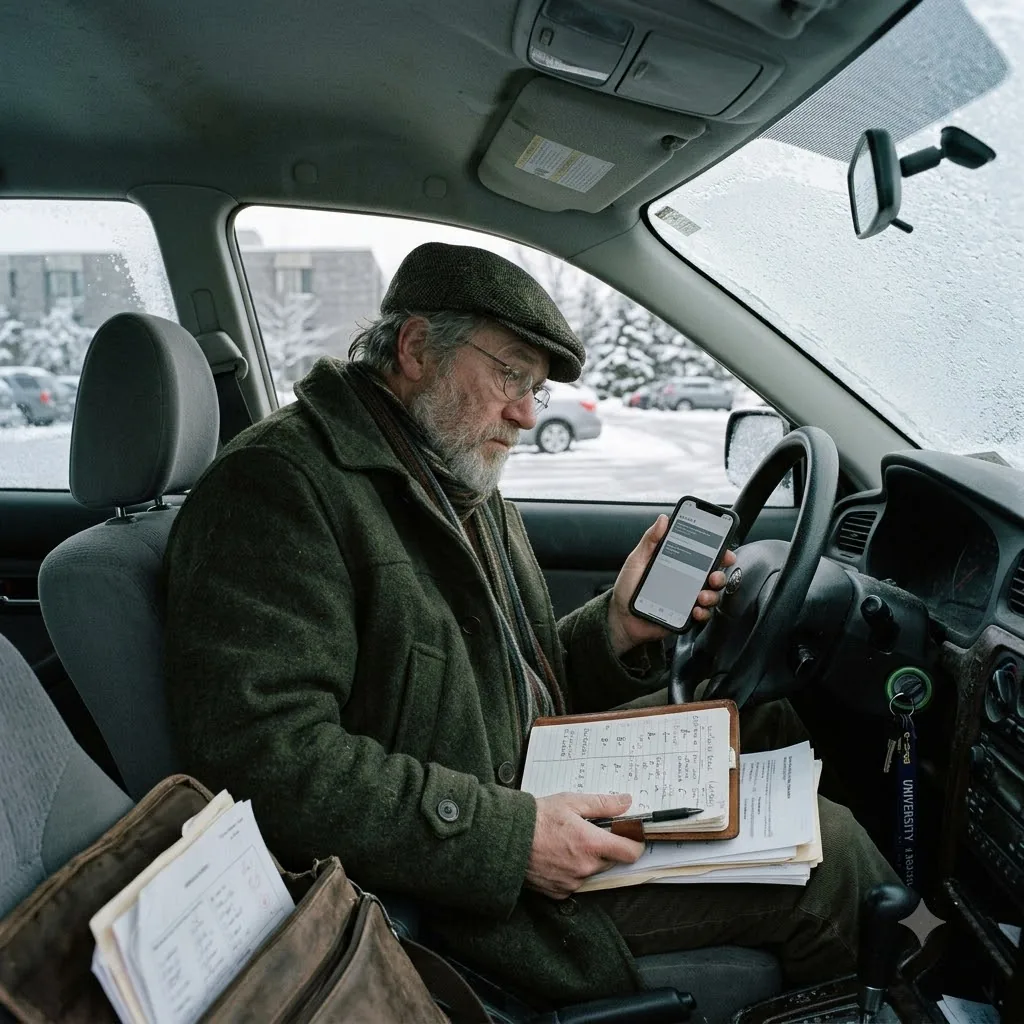
They reached the far edge of the commuter lot. The silver Subaru looked pathetic in the morning light, frost still clinging to the roof. Smeared across the driver’s side window was a massive, neon-green adhesive sticker: TOW WARNING – UNAUTHORIZED RESIDENCE. REMOVE BY 5:00 PM OR VEHICLE WILL BE IMPOUNDED.
The guard set the plastic bin on the asphalt next to the bumper, offered a tight, uncomfortable grimace, and walked away.
Arthur sank against the side of the car, scraping at the edge of the neon sticker with a numb thumbnail. The adhesive was industrial; it wouldn’t peel. He looked down at the plastic bin to check if his coffee mug had survived the drop.
His mug was there. His dictionary was there. But as he frantically dug through the markers and loose pens, his stomach plummeted. His leather-bound grading ledger and the stack of Tyler’s failing essays were missing. Security hadn’t just cleared his desk; someone had confiscated his records. The anonymous complaint hadn’t just cost him his job and his home-it had erased the only proof that his poorest-performing student was failing.