Story code: ST-000072
Part 2: What the Tablet Was Proving
I did not need to guess what I heard, because Evan repeated part of it when he saw me turn. He kept his voice low, but not low enough. “Just keep the pages together,” he told Tessa. “We are not stopping the stream over wording.”
Noah’s hand stayed on the rim of the trash can. Tessa froze for half a beat, then tucked a loose strand of hair behind her ear and looked past all of us toward the ceremony lights. A nurse wheeled a vitals cart between exam rooms without slowing down. The ordinary clinic kept moving, which made the hallway feel even narrower.
“What pages?” I asked.
Evan shifted the tablet flat against his chest. “A media acknowledgment. Standard event coverage.”
“You said to put it behind the implant page and tell them it’s the same acknowledgment.”
“Because families don’t need three separate explanations during a live fundraiser,” he said. “This is exactly why we try to keep liaison staff from freelancing in public.”
He said it calmly, like he was correcting a scheduling error. Then he stepped back through the curtain line before I answered, returning to the stage with the same polished half-smile he had been wearing all evening.
I followed more slowly. Once I was back in the ceremony area, the sequence was easier to see because I was no longer looking at the event as one big gesture. I was looking at the gaps.
The daughter’s water had finally arrived, set on the floor beside the wheelchair where she couldn’t reach it without letting go. The patient had the tablet balanced on his lap, screen angled upward. Tessa was kneeling beside him with one finger on the lower corner, as if helping him hold it steady. From the aisle, it would read as support. From where I stood, I could see she was also controlling when the screen advanced.
Dr. Sethi had finished thanking donors and moved into a Q-and-A posture near the podium. She wasn’t watching the screen itself. She was watching the room: cameras, sponsor table, two board members by the wall, a local health reporter edging closer. Every time the daughter opened her mouth, someone with a clinic badge spoke first.
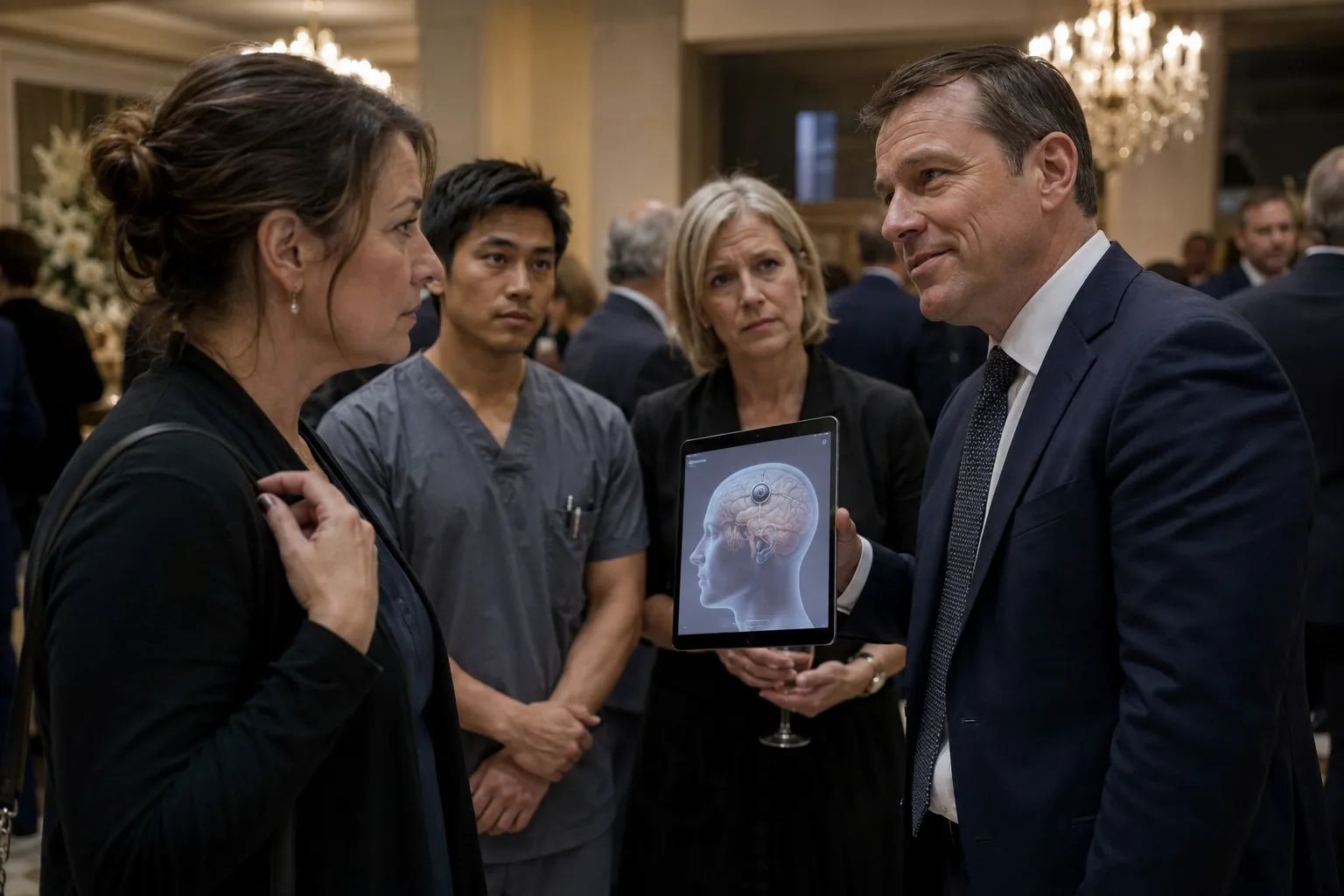
I came up on the patient’s left side and looked down at the tablet. The privacy filter cut the angle, but I was close enough now. The implant consent page was open, with the signature box waiting at the bottom. A narrow sliver of another page sat tucked under it in the queue, enough to show a separate header line and a camera icon in the margin.
“Don’t scroll yet,” Tessa said without looking at me.
“Why is that there?” I asked.
“Mara,” Dr. Sethi said from the podium area, voice warm and public, “could you help our guests find the refreshments?”
That was answer enough on its own. Not proof of everything, but proof of what needed to stay out of sight.
The daughter looked up at me. “He already signed something in pre-op last week,” she said. “Now they said there was one more form because of the stream. Then he got tired and they said maybe just hold the tablet for a photo first. I don’t understand which part is medical and which part is publicity.”
Her father did not speak. He tapped the stylus once against the bezel and let it rest.
Noah had moved back to the edge of the ceremony area. He wasn’t trying to join in. He was watching the same way he had in the hallway, fixed on the tablet instead of the speeches.
Evan crouched next to the wheelchair again, blazer pulling tight at the shoulders. “We’re doing this in order,” he said. “Medical acknowledgment, then optional event media. No one is forcing anything.”
“Then separate them,” I said.
He gave me a quick glance, then nodded toward the audience, where the reporter had started taking notes. “Please don’t create confusion.”
That phrase kept getting used as if confusion were something I was bringing into the room instead of something already built into the setup.
I asked the daughter, clearly enough for the nearby donors to hear, “Did anyone tell you the camera release was optional before they placed the tablet in his lap?”
She said, “No.”
Tessa stood up so fast the chair legs beside her scraped the floor. The sound carried farther than any raised voice would have.
Dr. Sethi crossed back from the podium. “Let’s pause,” she said, smiling at the outer ring of guests. “These moments are emotional, and we always want families to feel fully supported.”
Supported. The word landed in the open space like another prop.
Evan reached for the tablet. The patient did not hand it over right away. That small delay mattered more than a speech. His daughter put one hand over the top edge of the screen and said, “We’re done with cameras.”
Tessa looked at the operator and made a cutting motion with two fingers. The livestream camera dipped toward the clinic logo banner, then to a tray of sponsor cupcakes. Anyone watching online would have seen a graceful pause. In the room, it was less graceful. A board member whispered to another. The reporter stopped writing and started watching faces.
I took the water from the floor and handed it to the daughter. She thanked me without taking her hand off the wheelchair handle for long.
Evan straightened and started talking too much. He explained workflow, audience education, community trust, donor transparency, public misunderstanding, all in one breathless run that didn’t match the neat expert posture he had opened with. He said the implant page had to stay visible for compliance optics, then corrected himself to “clarity,” then said the event team had gotten ahead of the order of operations. He was still trying to keep it all inside the room, but the room had already shifted.
I did not need a confession. I had the visible sequence: a patient brought forward as reputation cover, a consent tablet used like a stage object, a hidden media page tucked behind a medical page, and an offstage instruction telling staff to blur the difference.
Then the patient lifted the stylus, not to sign, but to tap the back button.
The media release page came fully into view, and the local reporter stepped close enough to read the header from three feet away.