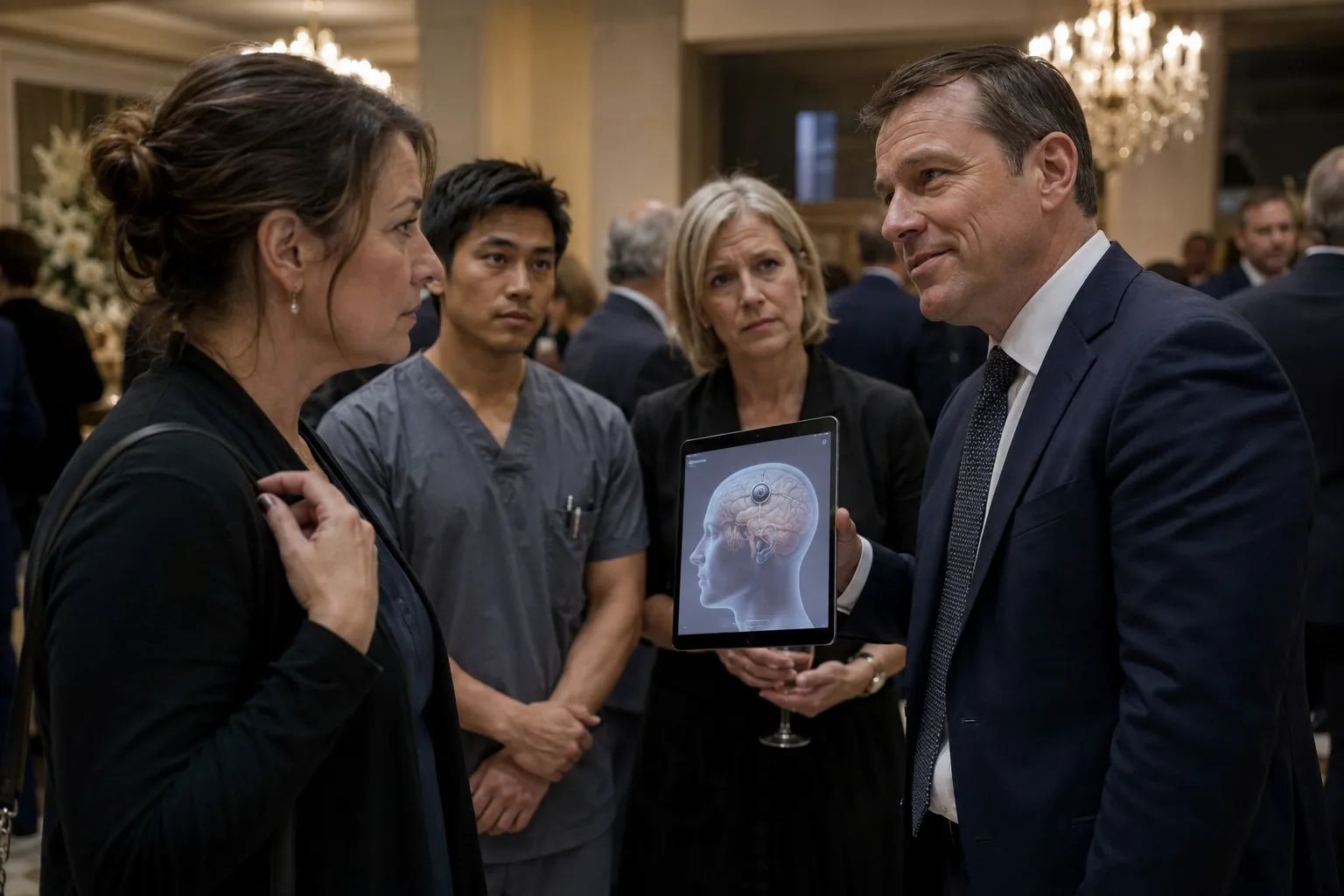
Story code: ST-000072
Part 4: After the Lights
The implant consent was finished in Exam Room 4 with the door half closed and no camera in sight.
That was the part people might try to tell cleanly later, so I paid attention to the details that did not fit a clean story. The room still smelled like disinfectant and paper gowns. A pulse ox clip sat coiled on the counter beside unopened gauze. The daughter read each screen before her father touched the stylus. I stood where she could see me. A floor nurse witnessed the medical page only after the media release had been removed from the queue entirely. When the signature box was finally signed, it looked like what it should have looked like in the first place: specific, slow, private.
Outside the room, fundraiser noise kept trying to restart. Applause rose once, weakly, and stopped. Someone rolled a bin of sparkling water back toward the donor area. Tessa’s voice came through the hall in clipped bursts, no longer pitched for cameras.
When the daughter and her father were taken to discharge, the visible part of the damage had already started settling into place. The reporter stood at the check-in counter with her notebook open and the tablet details written across two pages. A board member spoke to Dr. Sethi near the sponsor screen with one finger pressed against his own event badge. Tessa was carrying a coil of camera cable in both hands like a task she had not expected to be doing herself.
Evan was not at the stage anymore.
I found him at the side workstation outside the corridor, where staff usually dock tablets between appointments. The implant consent tablet was locked into the charging cradle. He was holding his lanyard in one hand. The clip was bent where it had been pulled loose.
The screen at the workstation showed the event dashboard. His name had been stripped off the stream controls and replaced with a generic admin label. He tapped once, then again, harder. Access denied sat in a white box across the page.
That was the concrete consequence first: not an apology, not a speech, just a locked account in the middle of the clinic while people walked past and saw it.
Dr. Sethi came up behind him with the board member and said, “Turn in the donor room keycard.”
He set it on the desk without looking at her.
“Tonight?” he asked.
“Now,” she said.
Nobody raised a voice. The blood pressure cuff request came over the hall speaker again. A transporter asked to get by with a wheelchair. Evan stepped sideways to clear the path, still in his blazer, no credential on, one hand flat against the desk edge.
The reporter did not crowd him. She only looked once at the locked dashboard, once at the tablet in its cradle, then back to Dr. Sethi. “Is he still overseeing implant consent demonstrations?”
“There will be no further demonstrations tonight,” Dr. Sethi said.
That answer was careful, but careful did not mean harmless. Three donors were close enough to hear it. One of them quietly folded the pledge card he had been carrying and put it back into his jacket pocket.
I signed the family out through the service exit because the daughter asked not to go back past the banner wall. Noah met me there with my coat over his arm. He did not ask for a rundown in the hallway. He had already heard enough to know what shape the night had taken.
At home, the truth landed the way late truth does. Not with a confrontation. With logistics.
Noah set his keys in the ceramic bowl by the door and missed on the first drop. I put my event flats under the bench and found one of the clinic stickers stuck to the sole. He was the one who pulled it off and set it on the counter beside the mail instead of throwing it away.
The kitchen light over the sink had burned out two days earlier, so the room was lit by the stove hood and the lamp in the next room. He filled the kettle, then forgot to turn it on. I hung up my blazer and took my staff badge from the pocket. The lanyard smelled faintly like hand sanitizer and stage makeup.
“You heard all of it,” I said.
He nodded once.
“More than enough,” he said.
That was all for a while.
My phone buzzed on the counter with one email preview from the clinic: Event access updated. A second came in while I was looking at the first: Donor walkthrough reassigned. I did not open either one right away. The subject lines were enough to show what kind of repair the clinic had chosen first. Not justice. Containment with names attached.
Noah finally turned on the kettle. Water began knocking softly against the metal.
“You still work there tomorrow?” he asked.
“Yes,” I said. Then, because clean words mattered now, “But not for that. Not like that again.”
He slid my badge across the counter to me instead of handing it over, as if both of us were being careful with small official things.
The house stayed quiet while the kettle heated. Outside, a car door shut somewhere down the block. Inside, the only bright screen was my phone with the clinic emails waiting.
Relief was there, if that was the word for the camera being off and the family gone home without signing the wrong thing. But it sat beside the rest of it: the reporter’s notes, the locked dashboard, the keycard on the desk, and the fact that I would still have to walk back into that building under daylight.
Noah set two mugs on the counter and left one near me without speaking.
I opened the first email at last.