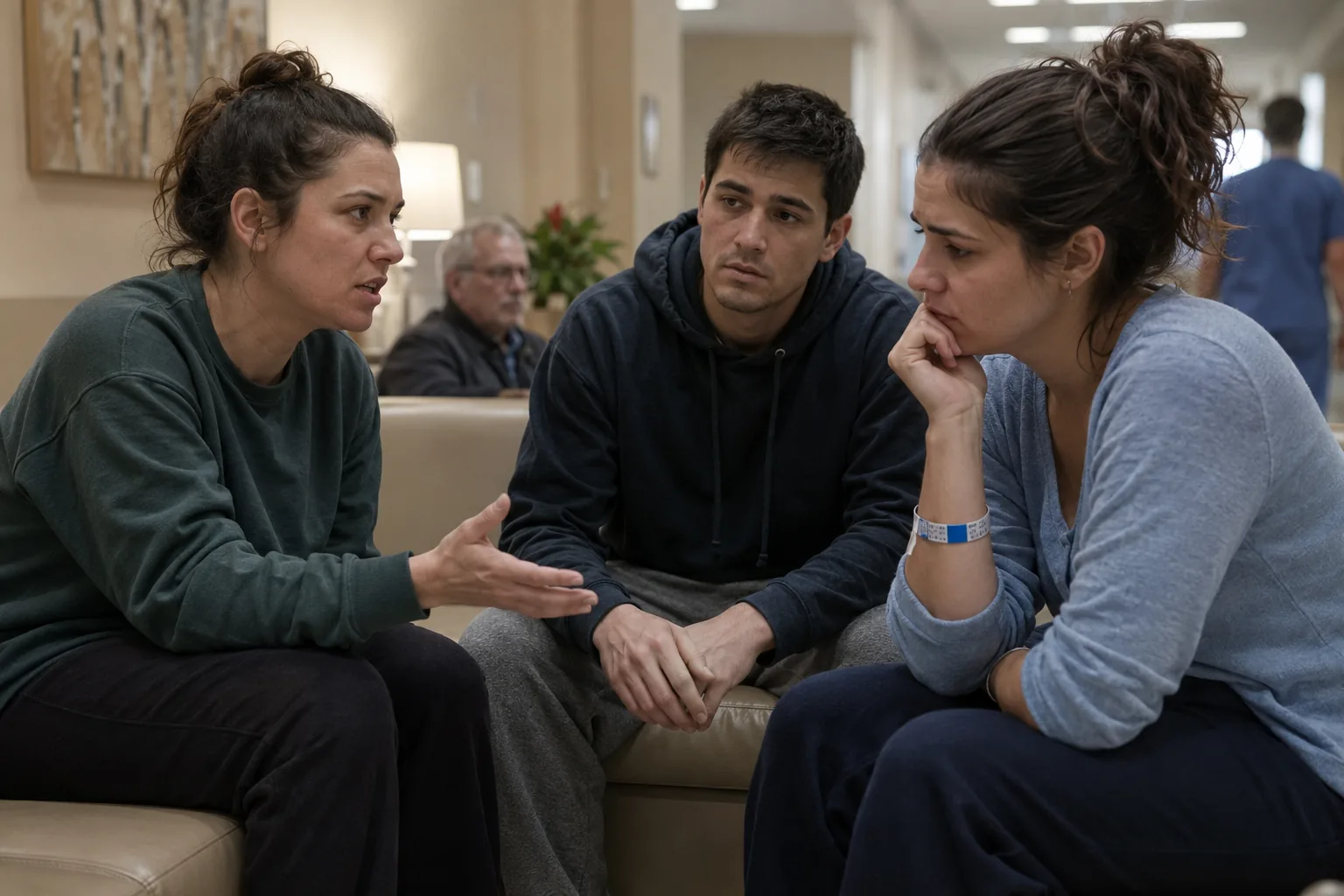
Story code: ST-000100
Part 3: She Needed Me to Stand Under Her Story
After Denise said she had made it possible for me to be sitting there like the hero, she picked up her coffee cup, found it empty, and crushed the rim with her fingers.
I looked at her hand, then at my wrist again. The bracelet sat there bright and ugly against my skin, a plain strip of plastic that did not care about anybody’s version of family history.
“Explain that,” I said.
My mother made a tired sound under her breath. “Kayla.”
“No,” I said, still looking at Denise. “She said I was only here because of her. Explain it.”
Denise glanced toward the surgical doors like she was checking whether anyone was close enough to hear, then lowered her voice half an inch. Not soft. Just tighter.
“You think all this happened in a vacuum?” she said. “Who kept your mother from falling apart the first time Eli got sick? Who kept bills from drowning this family? Who made sure there was gas, food, rides, somebody to sit with him, somebody to sit with her? You were able to do this because other people carried the load long enough for you to come in at the end and do the dramatic part.”
The words landed, but not the way she wanted them to. She kept trying to place herself at the front of the chain. Every sentence put her before me, before my mother, before the day. But the surgical floor around us kept giving the order back its real shape. Eli was behind those doors. I had the donor bracelet on. I had the soreness, the fasting headache, the tender pull in my side when I shifted in the chair. She had a coffee cup and a list.
“A ride is not a kidney,” I said.
My mother looked up fast. Denise’s mouth opened, then closed.
I didn’t raise my voice. I didn’t have to.
“Groceries are not a kidney,” I said. “Breakfast, gas, Christmas food, sitting in an ER, helping Mom when things were bad. None of that is a kidney. None of that buys my time, my money, or my life after tonight.”
The man across from us stopped pretending not to listen. My mother stared at the floor between our shoes.
Denise leaned forward so hard her purse slid off her lap and knocked against her knee. “Nobody said it bought your kidney.”
“You said your help made this possible,” I said. “You said I owe you because you carried us. You keep pointing at this bracelet while you do it. So say it straight or stop circling it.”
Her jaw worked once. She looked toward my mother instead of answering me.
“Rosa, are you hearing this?”
That was part of it too. She kept reaching around me, like I was a door she could open from the other side.
My mother rubbed her forehead. “I am hearing too much from both of you.”
Denise pounced on that. “Fine. Then let’s make it simple. Eli is going to need weeks of follow-ups. Your mother is going to need help. I cannot keep doing what I’ve been doing while she acts like I am some kind of collector. If Kayla wants to be treated like she did the biggest thing, then she can take over the whole load after surgery. All of it. Rides, meals, prescriptions, whatever comes up. And she can stop acting offended when I expect some consistency for once.”
There it was. Not gratitude. Assignment.
The cost of all her old favors had a shape now. She was trying to bill me into becoming permanently available.
My phone buzzed in my hand. Marcus: Still here if you need out. I can circle back anytime.
I stared at the screen a second too long, and Denise saw it.
“Please tell me you are not planning to run off after this,” she said. “Because that would say everything about you.”
I put my phone facedown on my thigh. “No. What says everything is you picking this moment to hand me a lifetime job I never agreed to because you once bought coffee and gave rides.”
She laughed once, sharp and small. “Lifetime job? Listen to the exaggeration. I am asking you to stand where family stands.”
“Under you,” I said.
She went still.
That was the first sentence that hit clean.
I saw it in what she did next. Not in anything hidden. In the way she sat back, then started talking faster, stacking examples on top of each other like speed could fix the order.
“I stood under everybody,” she said. “For years. And now when it’s your turn, suddenly there are rules. Suddenly there are boundaries. Suddenly the girl with the bracelet can’t possibly answer her phone or help her own mother without making a speech about autonomy.”
My mother flinched at the word boundaries like it had broken a glass somewhere.
Another set of surgical doors opened. A nurse stepped out and called for us by name. All three of us stood up at once.
“The surgeon will update you in consult room three,” she said.
We moved down the hall together, Denise close enough beside me that her sleeve brushed mine. Right before we reached the small room, she said from the corner of her mouth, “After this, we are settling expectations tonight. I am not carrying your share anymore.”
I looked at the bracelet one more time before I pushed through the door, and I knew exactly what Part 4 was going to cost her.