Story code: ST-000100
Part 4: I Took Her Out of the Middle
The surgeon told us the transplant had gone well.
Those were the words that mattered first.
He stood in the little consult room with blue scrub cap strings hanging at the back of his neck and gave us the careful hospital version of good news. Eli was in recovery. They were watching output. The first hours mattered. There would be pain control, monitoring, and a lot of waiting still, but the kidney was pink and working.
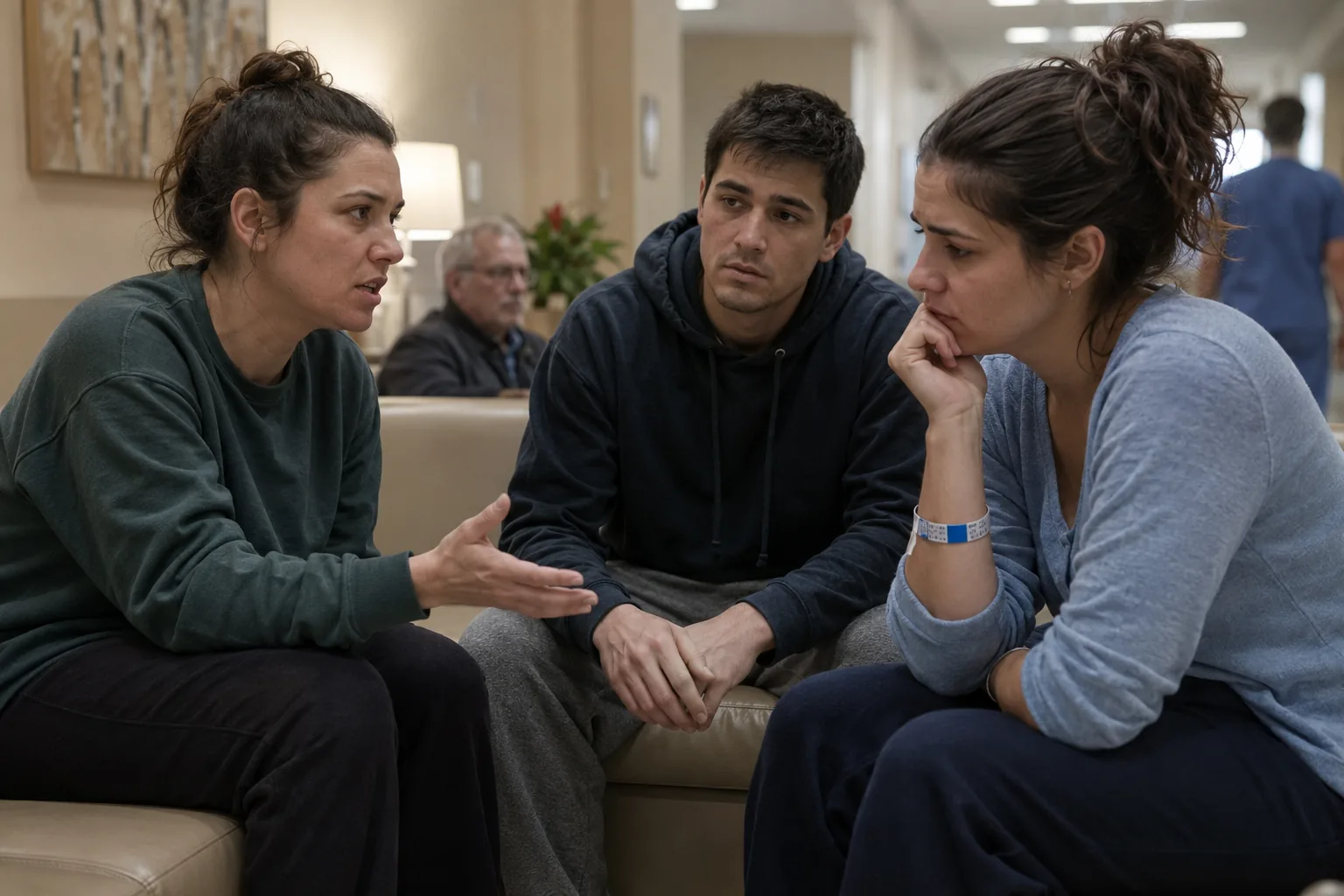
My mother covered her mouth and bent forward. Denise put a hand on her shoulder. I sat there with my own hand over the bracelet and listened for anything that sounded unstable. The surgeon asked if we had questions. My mother asked two. Denise asked one about visiting. I asked when I could see Eli.
Then he was gone, and the room got small again.
My mother was crying quietly into a tissue she pulled from her sleeve. Denise started rubbing her back in slow circles.
“See?” Denise said softly, like she was trying to slide us back into the old track before the surgeon’s words had even settled. “Now we have to pull together. Recovery is when people prove who they really are.”
I stood up because sitting was starting to make the soreness in my side throb. I took my phone out and stepped into the hallway. Marcus answered on the second ring.
“You need me?” he asked.
“Yes,” I said. “Pickup zone in fifteen.”
“I’m on it.”
I ended the call and opened the rides app on my phone. My mother’s old sedan had been unreliable for months. I had her clinic information saved because I had been helping with Eli’s testing schedule. It took me less than three minutes to book round-trip car service for her next three transplant follow-up mornings, the earliest slots I could guess from the schedule the surgeon mentioned. Then I set grocery delivery credit on her account for the week.
I went back into the consult room and held my mother’s phone out to her.
“Mom,” I said, “I put ride confirmations in your texts for the next three follow-ups, and I loaded grocery money on your account for this week. If you need me after that, call me directly.”
She blinked up at me and took the phone with both hands.
Denise’s face changed by degrees. First confusion. Then a flattening around the mouth.
“What is that supposed to mean?” she asked.
I turned to her then. Not loud. Not for the hallway. Just for that room.
“It means you don’t get to stand in the middle anymore,” I said.
She gave a short laugh that didn’t carry. “Middle of what?”
“Me and Mom. Me and Eli. Anything you plan to convert into debt later. If she needs a ride, she asks me or uses what I already set up. If I help, I help her directly. You don’t get to count it, assign it, or collect on it.”
My mother looked from me to Denise and back again, tissue still in one hand, phone in the other.
Denise straightened. “This is ridiculous. I have done nothing except help this family.”
“You can help whoever you want,” I said. “But you are done using me as your repayment plan. You do not get my money, my schedule, or my choices because you brought casseroles and kept score. And you do not get to talk about my bracelet like it made me your property.”
The room stayed very quiet after that. Not the waiting-room kind of quiet with coughs and TV captions. A shut-door quiet where every word had somewhere to land.
Denise looked at my mother again. “Rosa?”
My mother lowered her eyes to the phone in her lap. She did not answer right away. When she finally spoke, her voice sounded rubbed thin.
“I can call Kayla myself,” she said.
That was it.
No speech. No confession. No crowd. Just one line, and the old arrangement broke in the place where Denise used to keep her hands on it.
Denise picked up her purse in one quick movement. “Fine,” she said. “Do whatever you all want.”
I nodded once. “I am.”
I reached under the bracelet with my thumb and loosened it enough to stop it biting into my skin. Then I looked at my mother.
“Text me when they move Eli to a room,” I said. “I’ll come back tomorrow when I can stand up straight longer than five minutes.”
Her lips pressed together, then parted. “Okay.”
I didn’t explain the rest. I didn’t explain why I was leaving that night or why I was done standing there to be tallied up. The good news had been delivered. Eli was out of surgery. My part in this room was finished.
I walked past Denise without touching her shoulder, without apologizing, without offering one more softer version to make it easier to swallow. At the elevator bank I saw my reflection in the brushed metal doors: pale face, visitor sticker half curled, donor bracelet bright against my wrist.
Outside, the air hit cold and clean after the hospital heat. Marcus pulled into the pickup zone and leaned over to push the passenger door open from inside.
I got in, shut the door, and did not look back at the entrance.
The bracelet was still on when we pulled out of the lot, but her hand was not on anything of mine anymore.