Story code: ST-001015
Part 3: She Couldn’t Keep It General Anymore
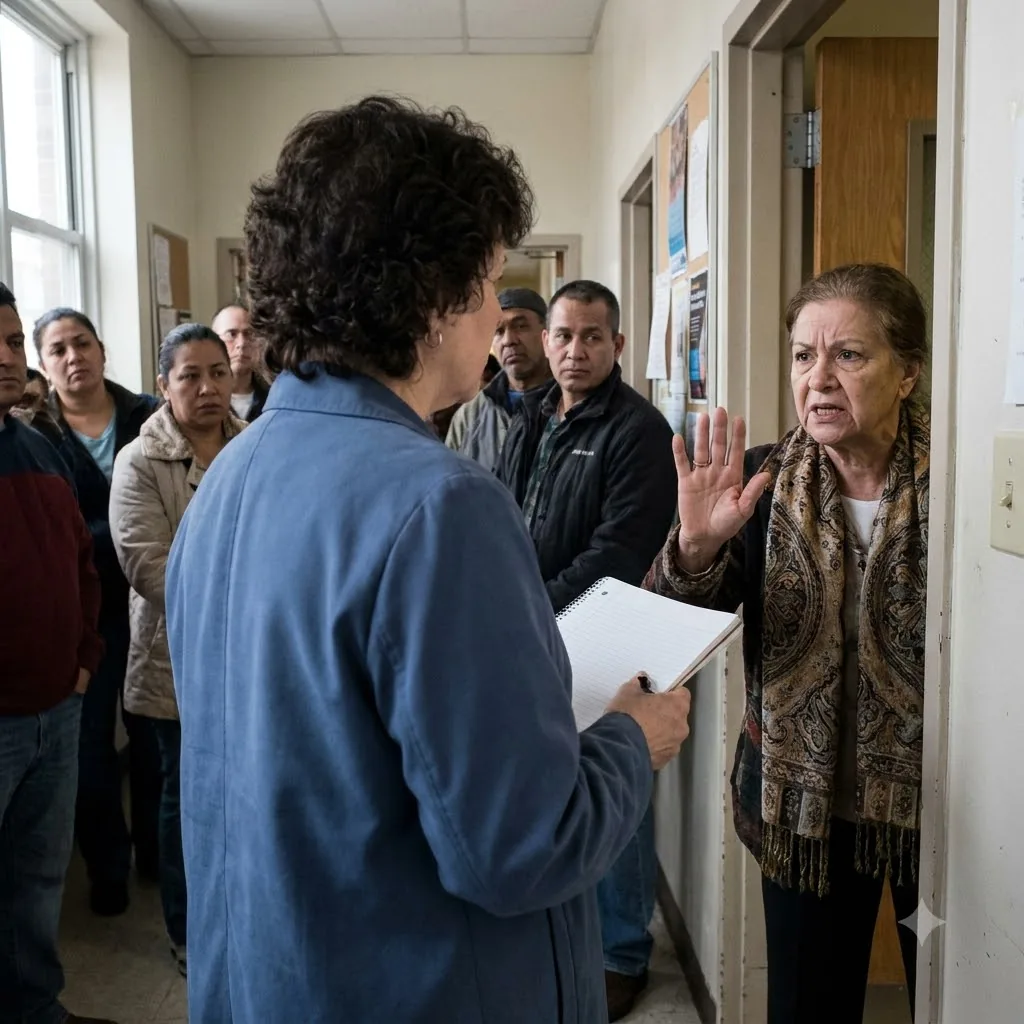
Tia Rosa asked what exactly Mr. Cole was putting in the record, and he answered the way he answered attendance questions every week.
“What was said, what was offered, and what was declined,” he said.
He did not lift his voice. He did not add anything extra. He held the attendance sheet against the doorframe and looked at Marisol, not at her aunt.
I stepped back toward the check-in desk, picked up my clipboard, and wrote the time from the wall clock beside the note I’d already started. I said it out loud as I wrote, because by then every useful thing in that hallway was better said plainly.
“Student present on time,” I said. “Practice notebook in hand. Relative requests immediate removal for emergency. Offered 911, security, and direct family contact. All refused.”
Tia Rosa’s head turned toward me. “You don’t need to narrate it like that.”
“I do if I’m logging an interruption at class start,” I said.
She gave a tight little smile that showed no teeth. “This is exactly why people don’t ask institutions for help. You turn everything into paperwork.”
“Only after someone uses emergency to override a student’s choice,” I said.
Marisol was still standing close enough to the classroom threshold that she could have stepped in with one pace. Instead of moving, she looked at the notebook in her hands and then at the printed emergency contact sign beside the door. Her thumb kept flattening the same bent corner.
Mr. Cole asked her again, calm and direct. “Marisol, do you want to attend class right now?”
Before she could answer, Tia Rosa cut across him. “She can’t answer with all of you pressuring her.”
That landed badly because she had been the only person pressing from the second she arrived. A couple of students inside the room shifted in their chairs. One woman near the front took her bag off the empty seat beside her and set it on the floor, like she was still holding the place for Marisol.
I said, “Then let’s reduce this. You can state the emergency plainly, or you can stop calling it one.”
Tia Rosa folded her arms. “Her grandmother is upset and needs her at home.”
“So not medical,” I said.
“I never said medical.”
Mr. Cole glanced down at his page. “You objected when emergency medical help was offered. Then you objected to security assistance. Then you objected to a direct call.”
“Because I don’t need strangers interfering,” she said.
“And now you are saying grandmother is upset,” I said. “Is Marisol needed for care, translation, transport, or something else?”
That was the moment the hallway narrowed around her. The question was simple enough that any real answer should have come fast.
Instead, Tia Rosa looked at Marisol and said, “Tell them your grandmother asks for you when she gets emotional.”
Marisol did not repeat it. She asked, very carefully, “Did she ask for me right now?”
Tia Rosa blinked once. “She knows I came here.”
“That wasn’t my question,” Marisol said.
Nobody moved. I could hear the fluorescent hum over the check-in desk and a chair leg scrape lightly inside the room.
Mr. Cole said, “Did you speak to the grandmother today and then come directly here, yes or no?”
Tia Rosa opened her mouth, closed it, then let out a short breath through her nose. “I spoke to family.”
Another version. Not grandmother. Not emergency. Just family.
I wrote that down too.
She saw my pen move and stepped toward the desk. “Stop writing every word like I’m on trial.”
“You’re not on trial,” I said. “You’re in a school hallway interrupting class.”
She reached one hand toward Marisol again, palm up this time instead of pointing. “Come outside with me. We’ll talk in Spanish since English is suddenly making everybody confused.”
Marisol lifted her chin a fraction. “I understand both languages. I asked if she asked for me right now.”
That line hit harder than anything shouted would have. Tia Rosa’s mouth went flat. She looked past Marisol into the classroom, then back at me, then at Mr. Cole’s attendance sheet.
I picked up the desk phone and said, “We can settle this in under a minute. If you give me the number, I’ll place the call on speaker with Marisol standing here. If grandmother says she needs her immediately, Mr. Cole can mark the excusal appropriately and she can go.”
“No speaker,” Tia Rosa said at once.
“Then Marisol can take the call herself,” I said.
“No call.” Her answer came even faster.
Mr. Cole made one more note. He didn’t look up while he wrote it.
Tia Rosa heard the pen and stepped toward him. “What now?”
He lifted the attendance sheet just enough for me to see the new line at the bottom. Then he read it aloud for the record in the same flat tone he used for names and late arrivals.
“Relative declines verification of claimed emergency and declines direct contact with the family member cited as the reason for removal.”
For the first time, Tia Rosa did not interrupt him.
Marisol looked at the open classroom door, tightened her hold on the notebook, and said, “Then I’m staying.”
Tia Rosa’s hand dropped to her side. “If you walk into that room after making me stand here like this,” she said, “don’t ask me later why things changed at home.”
Mr. Cole’s pen touched the page again before she finished speaking.