Story code: ST-001244
Part 1: The Empty Counter
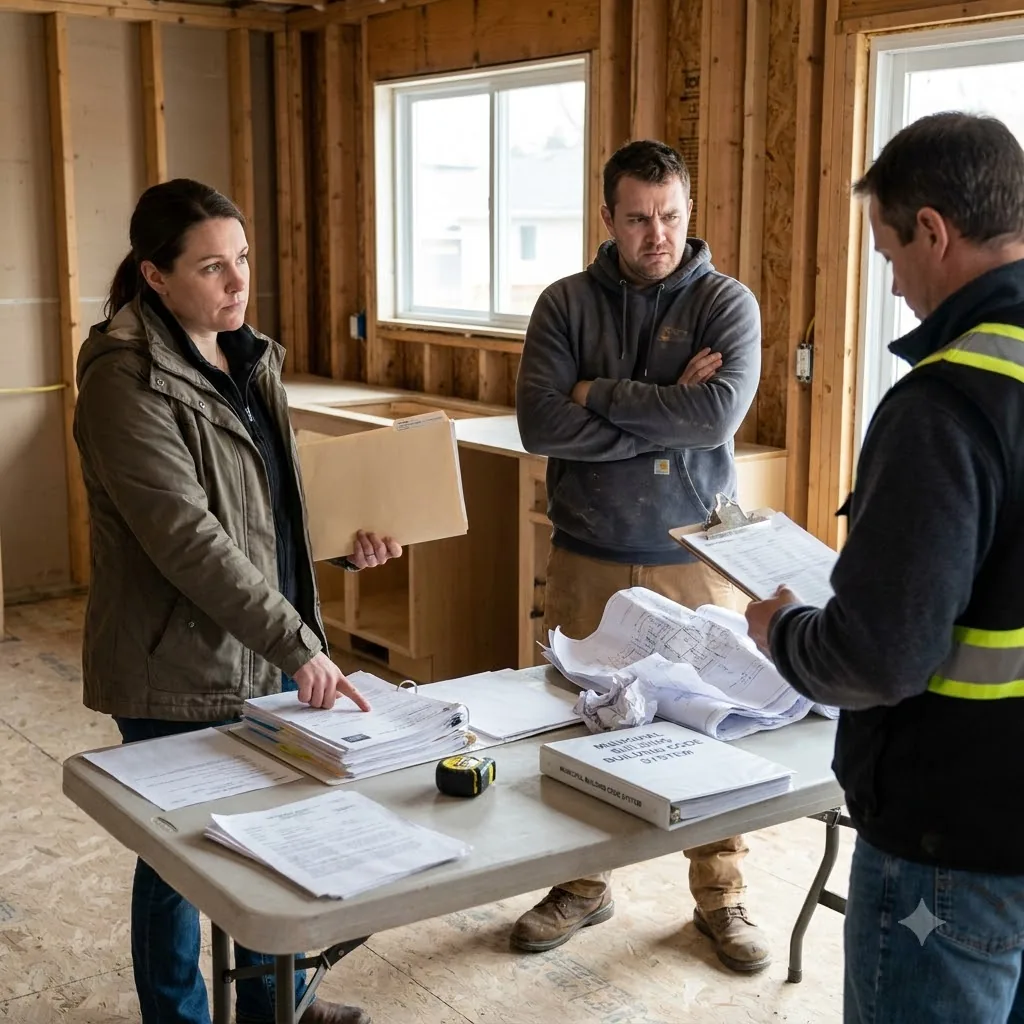
My name is Mara, and my reconstruction of the municipal case file for permit #ST-99042 begins in the unfinished kitchen of Leo Miller. When Leo walked into the space on Tuesday morning, he immediately discovered his contractor brother, Marcus, had taken the bright yellow municipal permit tag right off the plywood counter to pass it off as his own at a failing project across town. This resource theft instantly froze Leo’s home renovation progress, erasing the legal status of months of approved plumbing and framing labor under municipal code rules. I reconstructed this sequence from the inspection logs and the physical evidence left on the dusty plywood.
Inside the kitchen, the walls were down to the bare studs, with blue PEX tubing and copper piping running through the exposed pine joists. Leo stood by the temporary work table, his fingers tracing a clean, rectangular spot in the drywall dust where the official permit tag had sat since the rough-in inspection. Beside him, Inspector Vance held a heavy digital tablet, his thumb tapping against the screen as he compared the empty counter to the city’s active database. Marcus stood near the doorway, shifting his weight from foot to foot and holding a greasy canvas tool bag.
“A physical permit tag must be posted on the job site at all times during active construction,” Vance said, his voice level and dry. “Without the physical tag on this counter, this site is in immediate code violation.”
“I paid the municipal fees and secured the engineering approvals myself,” Leo said, his voice flat. He pointed to a neatly labeled plastic folder containing the original receipts. “The permit was active, and the tag was right here yesterday afternoon.”
“The paperwork is noted,” Vance replied, “but the physical tag carries the municipal tracking code. Right now, our database shows that serial number #ST-99042 was scanned less than an hour ago at a commercial renovation site on Elm Street. Marcus, your name is listed as the contractor of record for both of these addresses.”
Marcus cleared his throat, looking down at his boots instead of meeting his brother’s eyes. “It’s a temporary relocation. I needed to show the inspector at the Elm Street site that we had active municipal clearance to avoid a stop-work order. I was going to return the tag before the end of the day.”
“You took the physical tag off my counter to cover your own unpermitted work,” Leo said, his posture rigid.
“It’s the same basic framing, Leo,” Marcus said, his speech accelerating as he gestured toward the open ceiling. “It’s just a formality to keep both jobs moving.”
Inspector Vance looked up from his tablet, his eyes locked on Marcus. “If the framing and systems are identical, Marcus, tell me the exact PSI requirement for the rough-in pressure test you performed on the Elm Street lines this morning.”
Marcus opened his mouth, then paused. His fingers twitched against the strap of his tool bag. “It was standard,” he said. “The normal pressure for a line like that.”
“The Elm Street commercial zone requires a seventy-five PSI hydrostatic test,” Vance said, his voice dropping into a cold administrative tone. “This residential kitchen requires fifteen. Your lack of technical knowledge is noted for the record. You do not know the engineering specifications for the permit you are displaying.”
My name is Mara, and my reconstruction of the municipal case file for permit #ST-99042 begins in the unfinished kitchen of Leo Miller. When Leo walked into the space on Tuesday morning, he immediately discovered his contractor brother, Marcus, had taken the bright yellow municipal permit tag right off the plywood counter to pass it off as his own at a failing project across town. This resource theft instantly froze Leo’s home renovation progress, erasing the legal status of months of approved plumbing and framing labor under municipal code rules. I reconstructed this sequence from the inspection logs and the physical evidence left on the dusty plywood.
Inside the kitchen, the walls were down to the bare studs, with blue PEX tubing and copper piping running through the exposed pine joists. Leo stood by the temporary work table, his fingers tracing a clean, rectangular spot in the drywall dust where the official permit tag had sat since the rough-in inspection. Beside him, Inspector Vance held a heavy digital tablet, his thumb tapping against the screen as he compared the empty counter to the city’s active database. Marcus stood near the doorway, shifting his weight from foot to foot and holding a greasy canvas tool bag.
“A physical permit tag must be posted on the job site at all times during active construction,” Vance said, his voice level and dry. “Without the physical tag on this counter, this site is in immediate code violation.”
“I paid the municipal fees and secured the engineering approvals myself,” Leo said, his voice flat. He pointed to a neatly labeled plastic folder containing the original receipts. “The permit was active, and the tag was right here yesterday afternoon.”
“The paperwork is noted,” Vance replied, “but the physical tag carries the municipal tracking code. Right now, our database shows that serial number #ST-99042 was scanned less than an hour ago at a commercial renovation site on Elm Street. Marcus, your name is listed as the contractor of record for both of these addresses.”
Marcus cleared his throat, looking down at his boots instead of meeting his brother’s eyes. “It’s a temporary relocation. I needed to show the inspector at the Elm Street site that we had active municipal clearance to avoid a stop-work order. I was going to return the tag before the end of the day.”
“You took the physical tag off my counter to cover your own unpermitted work,” Leo said, his posture rigid.
“It’s the same basic framing, Leo,” Marcus said, his speech accelerating as he gestured toward the open ceiling. “It’s just a formality to keep both jobs moving.”
Inspector Vance looked up from his tablet, his eyes locked on Marcus. “If the framing and systems are identical, Marcus, tell me the exact PSI requirement for the rough-in pressure test you performed on the Elm Street lines this morning.”
Marcus opened his mouth, then paused. His fingers twitched against the strap of his tool bag. “It was standard,” he said. “The normal pressure for a line like that.”
“The Elm Street commercial zone requires a seventy-five PSI hydrostatic test,” Vance said, his voice dropping into a cold administrative tone. “This residential kitchen requires fifteen. Your lack of technical knowledge is noted for the record. You do not know the engineering specifications for the permit you are displaying.”