Story code: ST-000018
Part 2: When Plain Questions Started Cutting Through
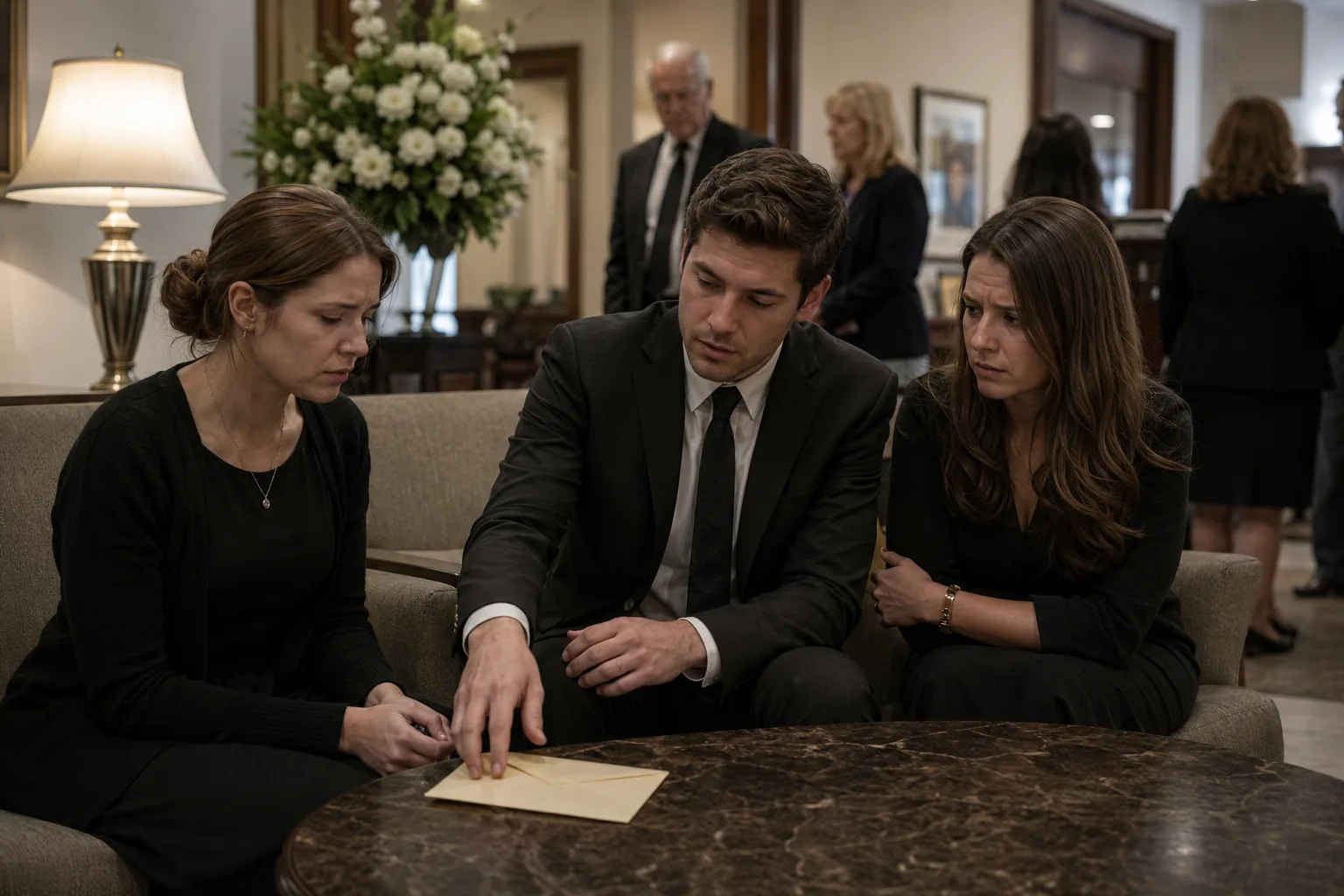
Ethan held the cream envelope up just enough for Mr. Calder to see it and said, in that polished voice, “We need a quick confirmation on family dispersal priority and continuity protocol so Lena stops contesting standard memorial custody.” He said all of it in one breath, like a phrase he had practiced, and for a second the lobby went still around the coffee urn, the paper cups, and the half-signed guest book.
Mr. Calder did not answer right away. He closed the arrangement-room door behind him, came two steps into the lobby, and looked first at the envelope, then at Lena, then at me. His pace never changed.
“What item is in question?” he asked.
“Mom’s keepsake envelope,” Lena said.
She got the words out before Ethan could layer anything over them.
Mr. Calder nodded once. “All right.”
Ethan gave a short smile and tried to keep the lead. “As I explained, because it was designated under family dispersal priority, I’m first steward until continuity review is complete.”
Mr. Calder folded his hands in front of him. “I don’t know those terms as funeral-home procedure. Tell me what action you’re asking me to verify.”
It was a simple question, but it changed the air in the room. Ethan had been speaking in broad, polished circles. Now he had to point to an actual step.
He did not hand over the envelope. He adjusted it against his sleeve and said, “I’m asking you to verify that a coordinating sibling receives provisional possession of sentimental contents pending final household distribution.”
Again, not plain. Again, smooth.
Mr. Calder said, “At this funeral home, personal keepsakes stay where the family places them unless someone asks staff to hold them for safekeeping. We don’t assign siblings provisional possession.”
Nobody moved for a beat after that.
Ethan answered quickly. “Not assign, no. Recognize. It’s recognized practice.”
Mr. Calder’s voice stayed even. “Recognized by whom?”
Ethan’s jaw shifted once. “In bereavement handling.”
Mr. Calder looked at me. “Mara, did staff log this envelope into safekeeping?”
“No, sir,” I said. “It stayed on the lobby table with the personal keepsakes.”
He nodded again, then asked Lena, “Did you request we hold it?”
“No,” she said. “Mom left it for me.”
Ethan cut in before Mr. Calder could answer. “She keeps saying that as if repetition settles custody.”
Mr. Calder turned back to him. “We’re not using custody language for a family keepsake in my lobby.”
That was the first time Ethan lost a little ground where everybody could hear it. Not because Mr. Calder raised his voice. Because he refused the frame.
The aunt near the guest-book table looked up. The cousin with the cup finally stopped pretending to study it.
Ethan gave a small laugh with no smile in it. “Fine. Then call it transitional memorial possession. The point is the same.”
A fresh term. He put it out there like a man laying another plank over a gap.
Mr. Calder did not step onto it. “Describe the process,” he said.
“What process?” Ethan asked.
“The one you keep naming,” Mr. Calder said. “You say there is an order, a stewardship, a continuity review, and now transitional memorial possession. Describe exactly what happens, here, in this building, with that envelope.”
Ethan looked toward the arrangement-room doorway, then back at Mr. Calder. He shifted his weight but kept his hand fixed near the flap.
“The coordinating family member maintains chain integrity,” he said.
I heard the faint scrape of Lena’s shoe against the rug. She wasn’t interrupting. She was just standing there with both hands clasped now, watching him.
Mr. Calder said, “Chain integrity is a phrase used for some kinds of documented handling. We are not documenting a chain on a cream family envelope left on a lobby table. What specific integrity step have you performed?”
This time Ethan did not answer right away.
He looked at the envelope itself as though the paper might offer him another term.
I had seen families freeze for grief, for anger, for exhaustion. This pause was different. It had the shape of someone reaching for a tool that was not where he expected it to be.
Lena spoke into that gap. Her voice was still low, but nobody could pretend not to hear her now.
“Ask him what’s inside,” she said.
Ethan’s head turned fast. “That has nothing to do with handling.”
“You said Mom discussed routing,” Lena said. “Ask him what the envelope is.”
Mr. Calder did not touch the envelope. He only said, “If you are claiming knowledge of a designated keepsake process tied to that item, you should be able to identify the item you’re controlling.”
The aunt near the table set her pen down. Even the coffee urn seemed loud when it gave a soft settling tick.
Ethan drew a breath through his nose. “It contains memorial materials,” he said.
Lena didn’t move. “What materials?”
“Private ones,” he said.
That was the first plain word he’d chosen for himself.
Mr. Calder’s eyes stayed on him. “You don’t have to disclose private family contents in the lobby,” he said. “But if your authority depends on specialist procedure, I need the procedure, not the performance. So here’s the question: do you want staff to hold that envelope neutrally, unopened, until the family decides together, or are you withdrawing your claim that funeral-home protocol gives it to you?”
Ethan’s fingers tightened along the top edge. The flap bent slightly under his thumb. He looked at Lena, then at the arrangement-room door, then back to Mr. Calder.
When he answered, his voice was still controlled, but it had lost that earlier shine.
“If staff holds it,” he said, “it stays sealed.”
Lena’s chin lifted a fraction. She did not thank him. She did not argue. She just said, “Then let staff hold it.”
Mr. Calder extended his hand, not forceful, simply waiting.
Ethan didn’t pass the envelope over right away. He stood with it for one long second, in full view of the family he had been trying to instruct, and I could see the next problem forming as clearly as the envelope itself: if he really knew what he had been claiming all afternoon, handing it over would be easy. If he didn’t, then the room had just arrived at the edge of a much quieter truth than the one he had been selling, and Part 3 began the moment he had to decide whether to prove anything at all.