Story code: ST-000018
Part 3: The Only Test That Mattered
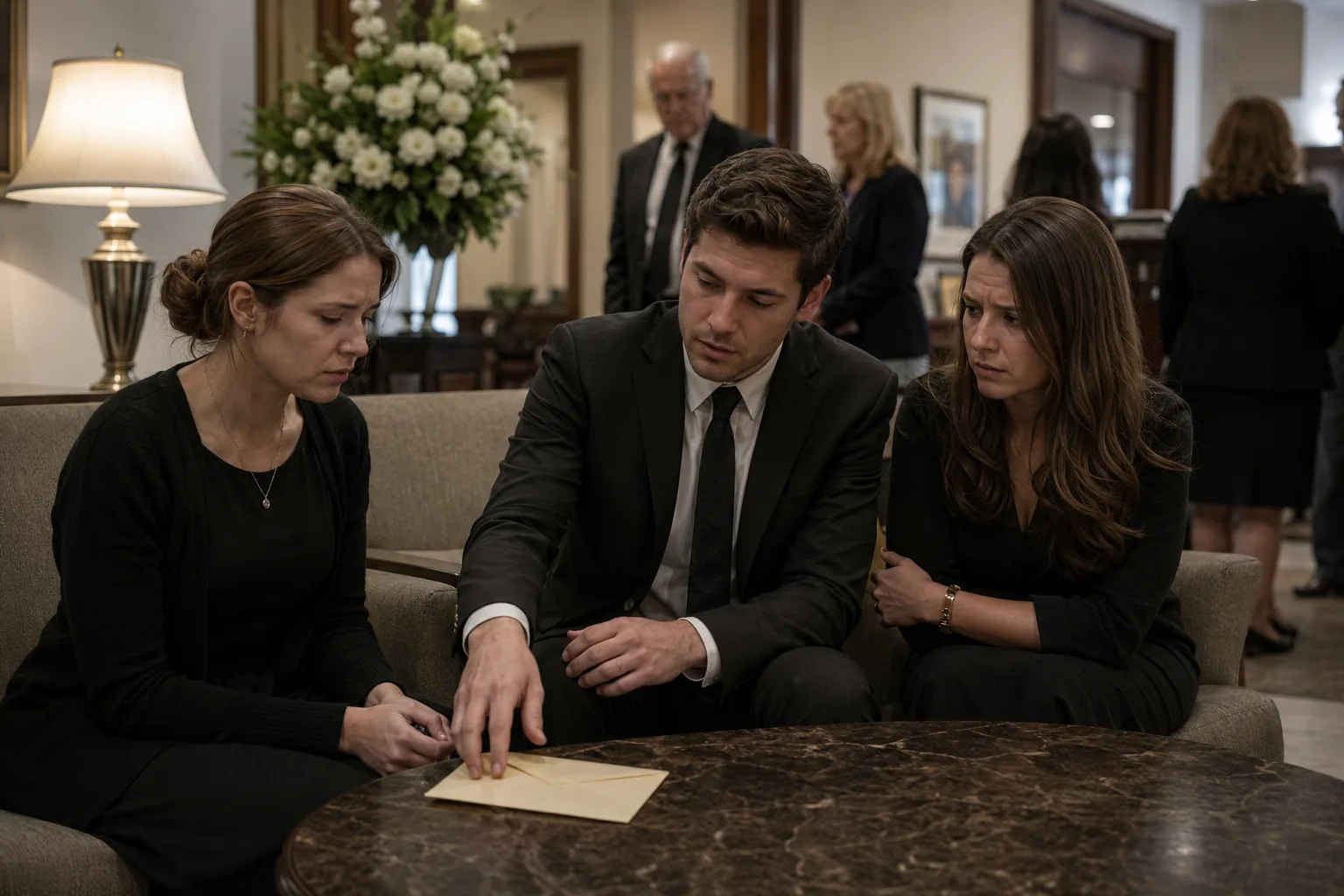
Ethan looked at Mr. Calder’s open hand, then slid the cream envelope over without letting go of it right away. For a second both of them held it between them, Ethan at the flap, Mr. Calder at the bottom corners. Then Ethan released it and stepped back.
Mr. Calder did not open it. He carried it to the low memorial table and set it beside the folders exactly where it had been before. That small return seemed to matter more than if he had locked it away immediately. It put the envelope back in plain sight and stripped it of Ethan’s borrowed authority at the same time.
“All right,” Mr. Calder said. “It stays sealed and visible while we settle what, if anything, staff is being asked to do.”
Ethan smoothed his jacket front. “I already said what staff needs to do. Hold it under neutral continuity until the receiving line is clear and the designated sibling transfer can happen privately.”
There it was again. New words added onto the old ones, polished fast.
Mr. Calder pulled a blank personal-effects card from the top drawer of the memorial table. We use them for ordinary things: watches, prayer cards, loose jewelry, hearing aids families don’t want to misplace. He set the card down with a pen beside it.
“Then let’s do this plainly,” he said. “If there is a staff handling step, you can tell me how you want it logged. Item name first.”
Ethan gave a small shrug. “Family keepsake envelope.”
“Received from whom?” Mr. Calder asked.
“From the coordinating sibling.”
“Name,” Mr. Calder said.
Ethan paused. “Ethan Jensen.”
Mr. Calder wrote nothing. “Released to whom?”
“To the appropriate sibling after continuity review.”
Mr. Calder looked up. “There is no line on this card for appropriate sibling. Put a name to the procedure you say exists. Who receives it, and by what funeral-home step?”
Ethan’s mouth tightened for a moment. He reached toward the card, not touching it, just hovering over it as if proximity might fill in the blanks.
“The point of a review is that release is conditional,” he said.
“Conditional on what?” Mr. Calder asked.
Nobody interrupted. The aunt had both hands folded over her purse now. The cousin set his cup down on the windowsill. Lena stayed by the armchair, but she had turned fully toward the table.
Ethan said, “On contents verification.”
Mr. Calder tapped the sealed flap with one finger. “Then describe the verification. We can do it now. What are we verifying?”
The room got quiet in a different way then. Up to that point Ethan had still been able to answer with another phrase. Now Mr. Calder had given him a live step, in the room, with the object in front of him.
Ethan looked at the envelope and said, “That it contains the memorial item Mom intended to route through me.”
Lena spoke before anyone else could. “Say the item.”
He didn’t look at her. “That isn’t necessary.”
Mr. Calder kept his voice level. “You don’t need to reveal private contents to the whole lobby. But if your claim depends on specific knowledge, I can offer a simple option. We step to the arrangement-room doorway. You tell me, in front of Mara as witness, what you say the item is and what funeral-home procedure applies to it. If you are correct, I can note that staff heard your instruction. If you can’t identify either one, then I return the envelope to the family table and remove staff from your terminology entirely.”
Ethan’s answer came too fast. “Why does she need to witness it?”
Mr. Calder glanced at me. “Because Mara heard the same terms in this lobby, and because staff notes require two people when family conflict is already visible.”
That was true. Not law. Just house practice when voices sharpened around property, keepsakes, or blame.
Ethan’s hand flexed once at his side. He looked toward the arrangement-room doorway, then at Lena, then back to the envelope. He had spent the last half hour acting like the room belonged to his wording. Now the only path left was naming one real thing.
Lena said, very evenly, “If Mom routed it through you, tell him what’s inside.”
Ethan pressed his lips together. Mr. Calder waited. I could hear the coffee urn settling again and a car door shutting somewhere outside the front glass.
Finally Ethan said, “It contains cremation jewelry paperwork and chain documents.”
That was the moment the bluff broke for me, not with a shout, but with the wrong object in the wrong sentence. Our cremation jewelry packets were printed folders from a separate cabinet. Chain documents were release forms, not family keepsakes, and none of them lived in an old cream envelope left on a lobby table.
Mr. Calder did not correct him in front of everyone at once. He picked up the blank personal-effects card, turned it over, and in a voice meant for the people already standing there, not the whole building, said, “Mara, witness this. Mr. Jensen has described funeral-home documents that are not in family circulation and not handled in the way he stated.”
Lena didn’t make a sound. She only closed her eyes for one beat and opened them again.
Then Mr. Calder put one hand lightly on the envelope and asked Ethan the question that left no room to hide in language anymore.
“Do you want to correct that before I ask Lena, privately, whether she can identify what her mother put in this envelope?”